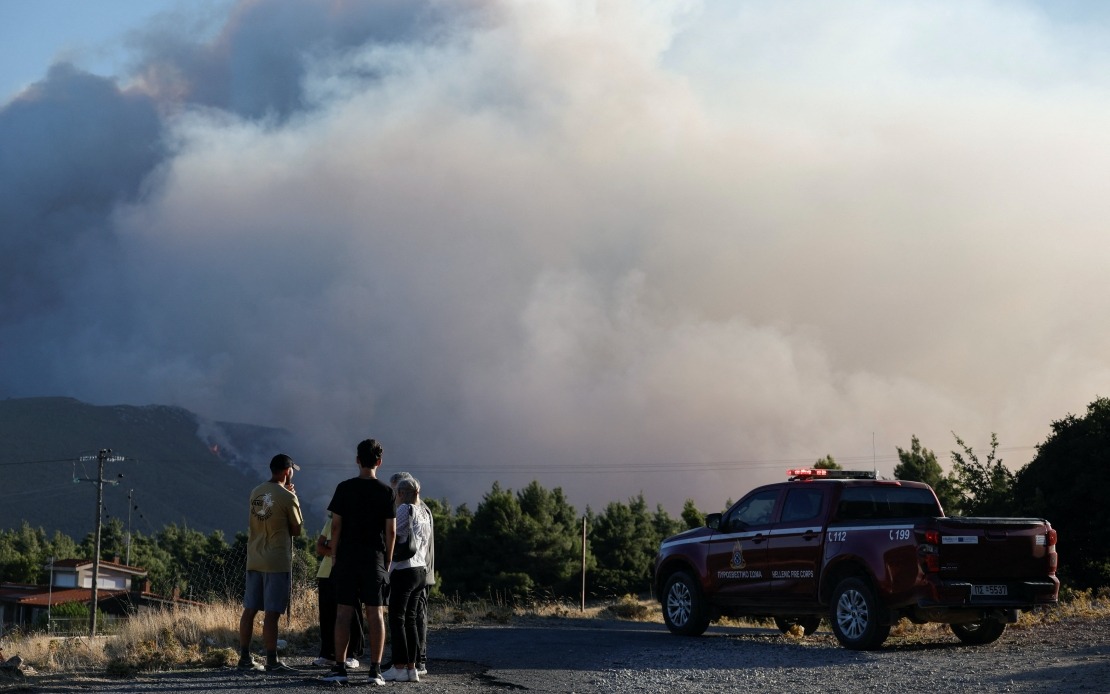
Firefighting efforts in Greece intensified on Sunday as emergency personnel worked through the night to contain a sprawling wildfire that has engulfed the Kithairon Mountains west of Athens. The scale of the deployment underscores the severity of the crisis, with hundreds of responders from multiple nations mobilising ground crews, military support vehicles, and volunteer units across the affected terrain. As dawn broke, aerial assets rejoined the operation, with firefighting planes and helicopters resuming missions to drop water and flame retardants across the burning landscape.
The fire has demonstrated unpredictable behaviour, with rapid lateral spread driven by strong winds that have challenged containment strategies. Two areas in particular—Veniza and Psatha—have suffered severe devastation as the flames moved through residential and forested zones. The eastward trajectory of the fire has placed Megara, a city approximately 50 kilometres west of Athens, within striking distance, prompting heightened concern among local authorities and residents who face potential evacuation orders.
The response mobilised substantial international cooperation, with at least 500 firefighters engaged in suppression operations. Notably, crews from Romania and France bolstered Greek personnel, reflecting a coordinated European approach to managing the crisis. This collaborative deployment reflects both the magnitude of the threat and the mutual interdependency of Mediterranean nations facing increasingly severe wildfire seasons. The involvement of foreign responders also highlights capacity constraints facing Greece's own emergency services when confronted with multiple simultaneous fire events.
Arson investigations have already yielded results, with authorities reporting 13 arrests nationwide on negligent arson charges. This dimension of the crisis underscores the human element underlying many European wildfires—whether through accidental negligence or deliberate action. Such prosecutions, while important for accountability, also reveal the systemic challenge of preventing fire ignition across vast rural territories where enforcement remains difficult despite increased vigilance.
The environmental toll has proven substantial, with preliminary estimates suggesting approximately 10,000 hectares of land across northwestern and western regions surrounding Athens have been consumed by flames. This figure encompasses both forested areas and agricultural land, representing a significant loss of biologically productive terrain. The destruction extends beyond immediate economic losses, affecting wildlife habitats, soil integrity, and carbon sequestration capacity across the region.
Crete, another wildfire hotspot in Greece, has seen significant progress in containment efforts. While several towns were evacuated and up to 200 homes reportedly destroyed, firefighting operations have substantially extinguished the fires on the island. However, official confirmation of casualty and destruction figures remains pending, reflecting the ongoing assessment phase following active firefighting operations. The Crete situation demonstrates the variable nature of wildfire progression—some blazes are suppressed more effectively than others depending on terrain, weather, and resource availability.
A second major wildfire continues to burn on Cephalonia island, though current assessments suggest populated areas face lower immediate risk compared to mainland threats. The simultaneous emergence of fires across multiple Greek territories—mainland, Crete, and the Ionian islands—illustrates the systemic nature of contemporary Mediterranean fire seasons. This pattern reflects broader climate trends affecting the region, where rising temperatures and altered precipitation patterns create conditions favourable to rapid fire development and spread.
For Malaysian and Southeast Asian observers, Greece's wildfire crisis offers relevant lessons regarding disaster response coordination and international mutual aid mechanisms. As the Southeast Asian region faces its own seasonal fire challenges—particularly in Indonesia and other nations affected by transboundary haze—the Greek experience demonstrates both the necessity and feasibility of cross-border firefighting support. The deployment of Romanian and French crews alongside Greek personnel provides a model for how ASEAN nations might strengthen cooperative frameworks for regional fire management.
The broader implications extend to climate resilience planning across the Mediterranean and analogous tropical regions. Increasingly severe fire seasons demand not only improved suppression capacity but also preventive approaches including land management, early warning systems, and community preparedness. Greece's experience suggests that even developed European nations with substantial resources face significant challenges when environmental conditions align to create exceptional fire behaviour.
Looking forward, Greece faces substantial recovery and investigation phases. Beyond immediate damage assessment, questions will emerge regarding prevention strategies, land-use planning in fire-prone zones, and infrastructure hardening to protect communities in wildfire-adjacent territories. The crisis also emphasises the critical importance of maintaining international cooperation frameworks that enable rapid deployment of specialised personnel and equipment across national boundaries during environmental emergencies. As climate patterns continue evolving, such cooperative mechanisms will become increasingly essential for nations throughout the Mediterranean basin and beyond.

