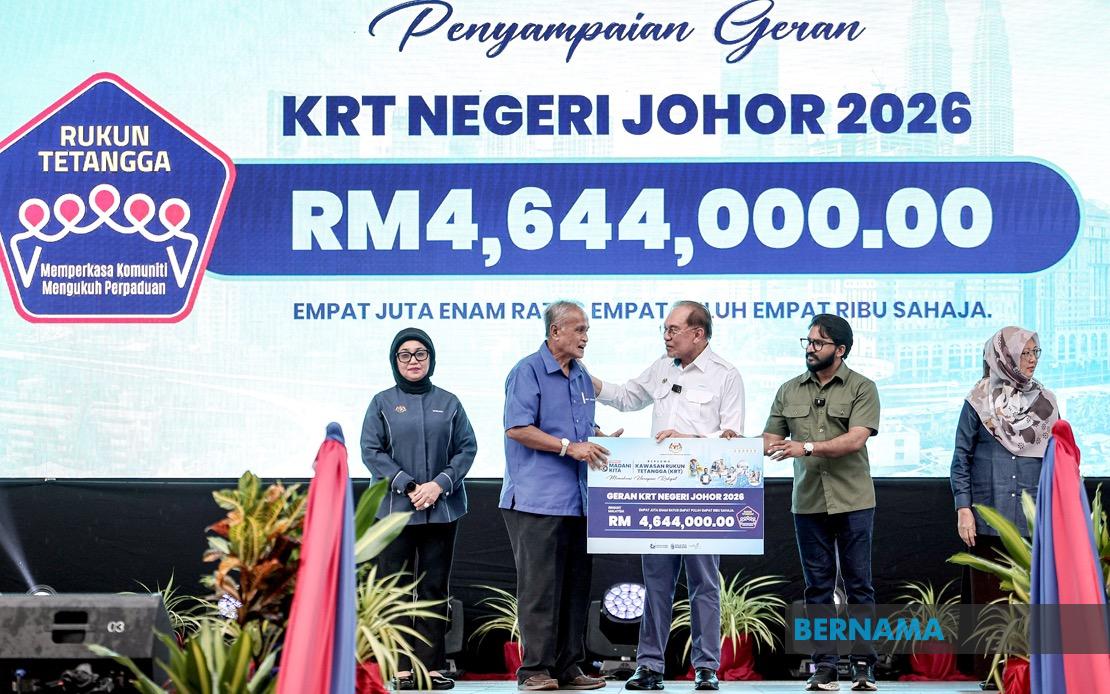
Prime Minister Datuk Seri Anwar Ibrahim has given his backing to a substantial increase in annual funding for Neighbourhood Watch Areas (KRT) across the country, elevating the grant from RM6,000 to RM10,000 effective January 1, 2027. The announcement was made during the MADANI KITA Programme with KRTs at Dataran Segamat, highlighting the government's renewed commitment to grassroots community organisations that have long played a stabilising role in Malaysian society.
The timing of this increase carries particular significance for community leaders and local administrators. The original allocation had remained frozen at RM6,000 for a full decade, a period during which inflation eroded its purchasing power and operational capacity. By raising the grant to RM10,000, the government signals a 67 percent boost in direct funding, acknowledging both the delayed adjustment and the evolving operational demands of these neighbourhood-based organisations that coordinate with local authorities and security services on ground-level matters affecting public safety and social cohesion.
Anwar emphasised that the funding enhancement recognises the institutional importance of KRTs in addressing community challenges from the grassroots up. These organisations serve as critical intermediaries between government agencies and residents, helping security personnel and various departments respond to welfare concerns and safety issues with better local intelligence and community engagement. The increased allocation aims to enable KRTs to more effectively mobilise resources, organise community initiatives, and maintain the institutional infrastructure necessary for their work.
Beyond the budgetary adjustment lies a deeper message about national cohesion that Anwar reinforced during the Segamat event. He stressed that Malaysia's foundational strength since independence has rested upon its ability to sustain harmony among diverse racial, cultural, and religious communities. The KRT system, functioning as a web of neighbourhood-level coordination, embodies this principle of unity in practice—bringing together residents of different backgrounds around shared concerns of safety, welfare, and orderly community development.
The Prime Minister explicitly cautioned against allowing demographic diversity to become a vehicle for division. Rather, he framed Malaysia's multi-racial and multi-religious character as a source of national resilience, one that must be actively cultivated through institutions like KRTs that foster consensus-building and democratic participation at the local level. This ideological positioning suggests the government views community policing and neighbourhood organisation not merely as administrative functions but as essential components of its broader MADANI agenda centred on unity and inclusive development.
Beyond the KRT funding announcement, Anwar used the Segamat event to launch additional development initiatives specific to Johor. An immediate allocation of RM3.205 million was approved for basic infrastructure repairs across 16 Islamic educational facilities in the state, including religious schools, madrasahs, study centres, and tahfiz institutions located in districts such as Batu Pahat, Muar, and Segamat. This funding targets upgrading and repair works designed to provide students with safer, more conducive learning environments reflective of government priorities in religious education expansion.
The investment in Islamic educational infrastructure reflects a deliberate policy direction under the MADANI Government to strengthen facilities and educational quality in religious institutions. As Malaysian Islamic education continues to expand in both traditional madrasah settings and contemporary tahfiz centres, improving physical infrastructure removes practical barriers to enrolment and participation. The specificity of targeting multiple districts indicates a systematic approach to addressing facility gaps rather than ad hoc interventions, suggesting that similar initiatives may extend to other states.
A further allocation of RM1.0 million was earmarked for critical and urgent repairs to Royal Malaysian Police (PDRM) quarters in Johor, underscoring the government's stated commitment to upgrading security personnel facilities. Anwar framed this investment as integral to maintaining the welfare and morale of police officers tasked with national peacekeeping responsibilities. Quality living quarters, maintenance of which had evidently fallen behind, directly affect both recruitment and retention of personnel and their capacity to perform demanding security duties with focus and dedication.
For Malaysian readers and analysts, these announcements carry several implications. The KRT funding increase, while modest in national budget terms, reflects a potential shift toward greater government investment in community-level institutions as crime prevention and social stability become increasingly complex challenges. The disbursement schedule beginning January 2027 also suggests that budget planning for the coming fiscal year will prioritise these community-facing allocations, signalling longer-term commitment beyond a single electoral cycle.
Regionally, Malaysia's emphasis on neighbourhood-level harmony and safety coordination through expanded KRT funding offers a model that other Southeast Asian nations grapple with as urbanisation and social fragmentation intensify. The integration of KRTs with government agencies and security forces, funded through sustained budgetary commitment, demonstrates an approach to social stability that prioritises prevention and community engagement over reactive enforcement alone.
The Johor announcements must also be understood within the context of Johor's recent political dynamics and its importance as a southern anchor of Malaysian development. Targeted infrastructure investments in education and security services signal confidence in Johor's continued stability and growth while directly addressing capacity gaps that local stakeholders have likely raised repeatedly. These moves reflect responsiveness to state-level feedback integrated into broader national development strategy under the MADANI framework.
Looking forward, the effectiveness of the increased KRT grants will depend significantly on how neighbourhood organisations utilise the expanded resources and whether systematic oversight mechanisms ensure transparency and accountability. The success of this initiative will likely inform future decisions about funding levels for community organisations and may establish benchmarks for similar grassroots initiatives across other portfolio areas. Community leaders will face expectations to demonstrate measurable returns on this increased investment through enhanced local coordination, improved crime reporting, stronger disaster response capacity, and documented community welfare improvements.

