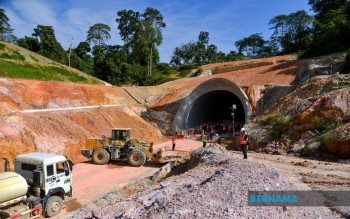
Malaysia's cabinet has given the green light to a RM207.2 million development package comprising 46 distinct projects across the Pasir Puteh parliamentary constituency in Kelantan, with execution scheduled for 2026. The initiative represents a substantial commitment to regional economic transformation, built fundamentally around capitalising on proximity to the East Coast Rail Link infrastructure and its associated cargo operations. Deputy Economy Minister Datuk Mohd Shahar Abdullah disclosed the government's strategic intent during parliamentary proceedings, signalling a coordinated approach to repositioning Pasir Puteh as a potential economic engine for the northeastern coast.
At the heart of this development strategy lies the creation of downstream industrial infrastructure serving the Pasir Puteh ECRL Station, a facility conceived simultaneously as both a passenger transport nexus and a freight and logistics complex. The government has embedded these initiatives within the broader ECRL Integrated Land Use Master Plan, a framework designed to unlock the broader economic potential radiating from the rail corridor. Rather than treating the station as merely transport infrastructure, planners have positioned it as a catalyst capable of stimulating investment attraction, employment generation, and broader community prosperity. This conceptual shift reflects changing attitudes towards how major transport investments can serve as anchors for multi-sectoral development.
The geographic advantage afforded by Pasir Puteh's proximity to the Tok Bali Supply Base substantially enhances the viability of the downstream industrial strategy. This positioning creates a natural convergence point for maritime supply chain operations and rail-based freight movements, an increasingly attractive proposition for regional and international logistics operators. The combination of port-adjacent facilities with modern rail connectivity presents a compelling value proposition in an era when supply chain resilience and modal flexibility have become paramount corporate considerations. For Kelantan, historically characterised by economic reliance on agriculture and cottage industries, this represents a meaningful diversification opportunity into higher-value logistics and value-added manufacturing sectors.
Deputy Minister Shahar articulated the government's logic with deliberate emphasis on the symbiosis between rail and port infrastructure. This synergistic relationship, when properly developed, possesses inherent magnetism for both domestic and foreign capital seeking efficient distribution networks spanning the peninsula and extending into the wider region. The creation of such logistics clusters typically generates immediate employment in warehousing, container handling, and transport operations, whilst simultaneously catalysing secondary economic activity in accommodation, food services, and business support sectors. Kelantan, with youth unemployment patterns historically outpacing national averages, stands to benefit materially from this employment multiplication effect.
The broader policy context underpinning this investment reveals important evolution in how Malaysia's development machinery approaches regional inequality. Rather than deploying generic development templates, the government has adopted a localised approach acknowledging that economic development strategies must align with genuine competitive advantages inherent to specific geographies. The Deputy Minister explicitly referenced this philosophy, indicating that Pasir Puteh's development trajectory would emphasise logistics capabilities rather than tourism infrastructure, thereby avoiding the diffusion of resources across multiple sectoral objectives. This targeted methodology stands in contrast to earlier development patterns where similar allocations might have been spread across miscellaneous projects lacking coherent strategic unity.
Implementation of these 46 projects will unfold across the 13th Malaysia Plan's five-year window extending through 2030, with commencement occurring during the current calendar year. This temporal scaffolding provides sufficient runway for phased land preparation, infrastructure construction, and operational establishment whilst allowing for adaptive management should circumstances or market conditions shift. The government has committed to monitoring project advancement through the MyRMK tracking system, ensuring accountability mechanisms remain functional and providing Parliament with periodic performance updates. This transparency commitment reflects broader governance standards increasingly expected of major infrastructure and development initiatives.
For Malaysia's broader regional development objectives, the Pasir Puteh programme exemplifies how transport infrastructure investments can catalyse spatially-concentrated economic clustering. The ECRL itself, despite earlier controversies surrounding its economic justification, increasingly demonstrates potential to function as a genuine development backbone if complemented by supporting land-use initiatives and industrial capacity building. Pasir Puteh's case study will therefore carry significance beyond Kelantan's boundaries, potentially informing development strategies at other ECRL station locations including Kuantan, Gemas, and Putrajaya. The success or otherwise of this integrated land-use approach will be closely observed by state governments and private sector investors evaluating regional economic prospects across Southeast Asia's eastern corridor.
The initiative also addresses longstanding concerns regarding development disparities between Malaysia's west coast concentrations and the less densely developed east coast regions. Kelantan particularly has experienced relative stagnation in manufacturing and modern logistics sectors, with the state economy remaining substantially dependent on traditional sectors. By strategically positioning Pasir Puteh as a logistics and industrial node, planners have created structural foundations potentially enabling the state to capture greater shares of regional value chains and supply chain flows that would otherwise bypass the area entirely. This represents a strategic recalibration of how federal development resources flow to constituencies and states previously characterised as peripheral to Malaysia's main economic corridors.
The Deputy Minister's parliamentary statement also underscored commitment to narrowing inter-regional development gaps through deliberate prioritisation of spending impact alongside project quantity. This framing suggests that the government views the RM207.2 million allocation not merely as capital expenditure but as an investment in geographic rebalancing and inclusive growth architecture. For constituencies like Pasir Puteh that have historically received modest development attention relative to their populations, this represents meaningful policy acknowledgement and resource commitment. Whether this translates into sustained job creation, income growth, and improved living standards for local communities will depend substantially on effective project implementation, private sector engagement, and the emergence of genuine economic opportunities that induce business activity and worker migration towards the developing logistics hub.

