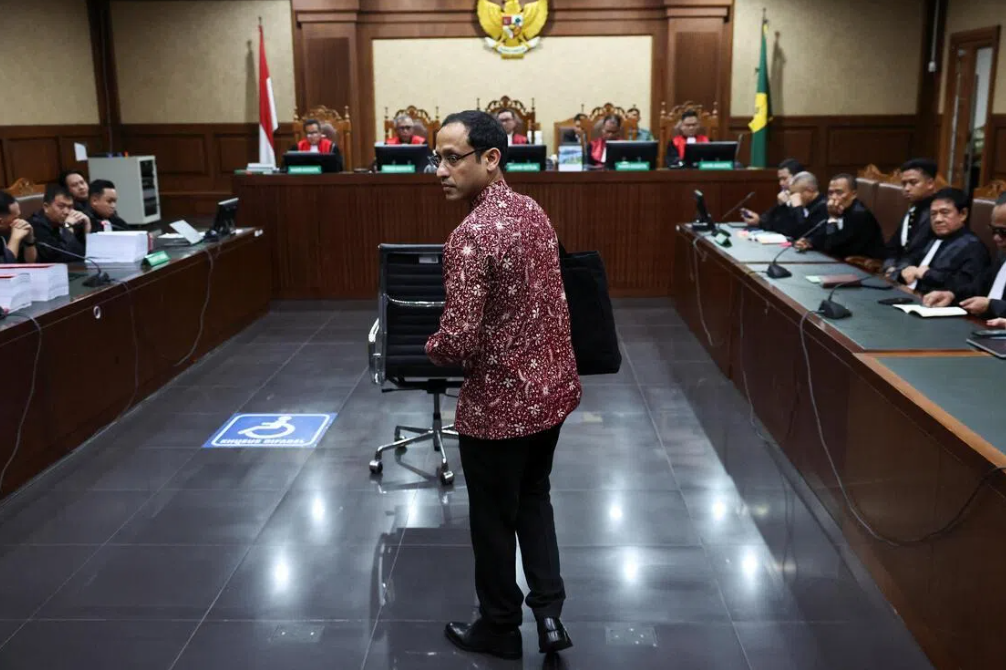
The Jakarta Corruption Court delivered a stunning guilty verdict on Tuesday, June 30, sentencing Nadiem Makarim, the Harvard-educated founder of ride-hailing giant Gojek and former education minister under president Joko Widodo, to a decade in prison. The conviction represents a dramatic fall from grace for a technology entrepreneur who once symbolised Indonesia's new generation of modern, reform-minded leaders and marks the conclusion of one of the nation's most closely watched corruption trials in recent memory.
Beyond the prison sentence, the court imposed a 1 billion rupiah fine and ordered Makarim to pay 809.6 billion rupiah in restitution, approximately US$45 million. Should he fail to settle this substantial sum, he faces an additional five-year prison term, effectively doubling his incarceration period. The restitution figure was substantially lower than the prosecution's demand for 5.6 trillion rupiah, suggesting the judges accepted elements of the defence's arguments while ultimately finding guilt on the core charges.
Chief judge Purwanto explained the court's reasoning in unambiguous language, stating that prosecutors had proven Makarim guilty of abusing his authority as education minister with the explicit intention to benefit particular parties unlawfully. The panel of five judges determined that Makarim had deliberately steered the Chromebook procurement policy and acted from a motivation to strengthen Google's strategic relationship with Gojek, his own company. This motivation, the judges concluded, was fundamentally incompatible with the ministerial oath and therefore constituted a profound breach of public trust.
The case centred on an ambitious programme to purchase approximately 1.1 million Chromebook laptops between 2020 and 2022, a period when Indonesian schools pivoted to remote learning as COVID-19 forced closures nationwide. Prosecutors alleged that this procurement scheme resulted in approximately 2.18 trillion rupiah in losses to the state and that Makarim personally benefited through transactions routed via PT Aplikasi Karya Anak Bangsa, Gojek's parent company. They further contended that Google's financial investments in Gojek influenced the decision to procure Chromebooks, though the technology giant has not been charged with any offence.
Makarim's trajectory from celebrated entrepreneur to convicted felon underscores the perils facing business leaders who transition into public service in Southeast Asia. After founding Gojek in 2010 and transforming it into Indonesia's first unicorn company valued at approximately US$10 billion by 2019, he accepted Widodo's invitation to serve as education minister with a mandate to modernise Indonesia's schooling system through digital innovation. That very digitalisation agenda, once considered his signature achievement, ultimately became the foundation for the corruption allegations filed against him in January 2026.
Throughout the trial, prosecutors presented evidence including an August 2019 group chat that they argued demonstrated discussions about a Chromebook-focused strategy before Makarim's formal appointment to cabinet. They also highlighted ministry studies from 2018, conducted prior to his tenure, which had concluded that Chromebook devices would prove ineffective in remote and rural regions lacking dependable internet connectivity. This evidence suggested, prosecutors argued, that Makarim proceeded with the programme despite knowing its limitations, further indicating improper motivation.
The defence mounted a vigorous counter-narrative, with Makarim and his legal team insisting throughout the proceedings that the allegations lacked foundation and that the programme was executed in genuine good faith during an extraordinary crisis in Indonesia's educational history. They emphasised that Makarim received no personal financial benefit from the procurement and that approximately 97 per cent of the 1.1 million Chromebooks had reached 77,000 schools by 2023, suggesting the initiative accomplished its stated objective despite the corruption charges. They requested complete acquittal, arguing that the case represented a misguided prosecution of legitimate pandemic-era policy decisions.
The trial captured unusual public attention, with Gojek motorcycle taxi drivers regularly attending court sessions to demonstrate solidarity, while court proceedings were livestreamed and sparked coordinated social media campaigns for public viewing parties. On one memorable occasion, Makarim arrived at court wearing a Gojek driver jacket before changing into formal blue batik attire, a symbolic gesture linking him to the hundreds of thousands of workers dependent on his company. The case also attracted formal amicus curiae briefs supporting Makarim, demonstrating the broader institutional and social interest in the outcome.
Makarim's family background as part of Indonesia's political and professional elite may have amplified public attention further. His father, Nono Anwar Makarim, is a prominent legal practitioner, while his maternal grandfather participated in Indonesia's independence struggle, establishing the family as part of the nation's founding generation. This lineage meant that his conviction carried symbolic weight beyond the specific allegations, representing a challenge to whether elite connections could shield even well-connected individuals from judicial accountability.
As the trial approached its conclusion, Makarim reframed the case as extending beyond mere procurement disputes to encompass fundamental questions about Indonesia's institutional future. In his defence plea delivered on June 23, immediately before the verdict, he contended that the judges' decision would shape how young Indonesians perceived public service and whether talented professionals from the private sector would continue willing to sacrifice lucrative careers for government roles. "Youth across all of Indonesia, and the diaspora in every corner of the world, await your answer to the question echoing in their hearts: 'Is this country still safe for us to serve?'" he told the court, attempting to elevate the proceedings into a statement about national institutional health.
The verdict carries significant implications for how Indonesia's development community and neighbouring Southeast Asian nations view the intersection of private entrepreneurship and public service. The conviction suggests that even accomplished business leaders cannot expect preferential treatment when corruption allegations emerge, reinforcing rule-of-law principles. However, the substantial gap between the prosecution's 18-year sentence demand and the court's 10-year judgment indicates judges weighed Makarim's good intentions and the complexity of pandemic-era decision-making against the abuse of authority findings.
Makarim's case also illuminates the challenges developing democracies face in managing large-scale digitalisation initiatives during crises. The Chromebook procurement occurred during unprecedented disruption when education officials operated under severe time constraints and information limitations. Yet the court determined that such circumstances did not justify steering contracts toward technology vendors with existing relationships to the decision-maker's own company, establishing a precedent that officials must maintain strict separation between commercial interests and policy authority regardless of emergency conditions.

