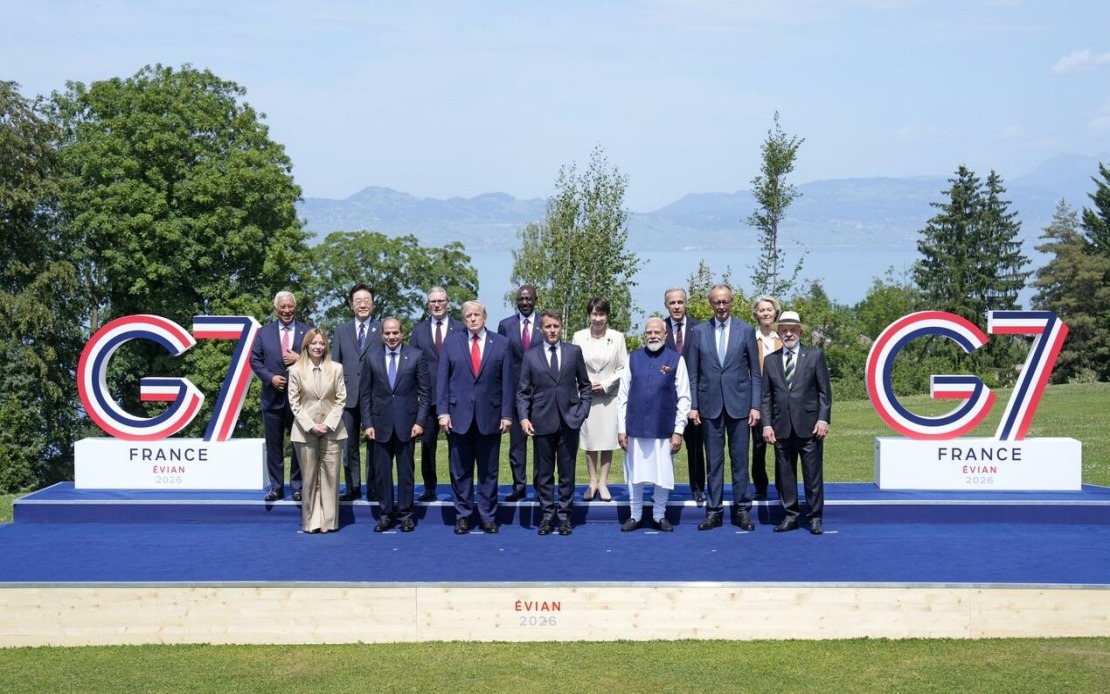
The Group of Seven convened in the French alpine resort town of Evian-les-Bains this week to reaffirm their commitment to supporting Ukraine, even as fractures emerged over how aggressively to pursue a diplomatic resolution. United States President Donald Trump, whose recent engagement with Iran has reshaped American foreign policy in the Middle East, signalled a willingness to channel similar diplomatic momentum toward the Russia-Ukraine conflict, urging Moscow to enter negotiations from what he characterised as a weakened military position.
Trump's approach to the Ukraine question reflects his broader foreign policy philosophy of negotiated settlements backed by the threat of economic pressure. Speaking to reporters at the summit, the American president stressed that both Russia and Ukraine had sustained catastrophic losses in the ongoing conflict, implying that the human and material costs now justified both sides seeking a diplomatic off-ramp. He suggested that the United States possessed leverage through its control over sanctions architecture, particularly measures implemented to counter Russian energy revenues during the earlier phase of the conflict. Trump indicated that should Moscow demonstrate willingness to negotiate, Washington could consider adjusting its stance on existing restrictions.
Ukrainian President Volodymyr Zelenskyy addressed the G7 assembly directly, providing firsthand perspective on battlefield conditions and Kyiv's strategic needs. Rather than echoing Trump's emphasis on immediate negotiation, Zelenskyy framed the summit's discussions around concrete military assistance, specifically highlighting the urgent requirement for enhanced air defence systems to counter Russian aerial bombardment campaigns. His messaging underscored a practical distinction between Ukrainian and American priorities: while Washington entertained the prospect of near-term talks, Kyiv sought to strengthen its defensive posture and negotiating position through continued Western military support. Zelenskyy's subsequent social media statement emphasised that any diplomatic path toward peace must be contingent upon Russia's demonstrated commitment to ending hostilities, suggesting Kyiv would not accept cessation-of-fire proposals that merely froze the current territorial configuration.
Japanese Prime Minister Sanae Takaichi articulated a more cautious approach aligned with traditional G7 consensus-building, cautioning that any resolution must preclude the unilateral alteration of territorial boundaries through military force. Her remarks carried particular weight given Japan's own security concerns regarding China and Russia's deepening military partnership. Takaichi specifically flagged the accelerating military cooperation between Moscow and Pyongyang, alongside the expansion of Russian-Chinese strategic alignment, as matters demanding G7 attention. These observations reflected broader Indo-Pacific anxieties about the emergence of an authoritarian coalition that could challenge the post-Cold War international order across multiple geographic theatres simultaneously.
The summit convened against a backdrop of significant strain within the alliance itself. Trump's recent diplomatic overtures toward adversaries, combined with his protectionist trade positions and controversial statements regarding territorial acquisitions in the North Atlantic region, have strained traditional Atlantic partnerships. The French presidency of the G7 during this period carried particular significance, as Paris sought to maintain Western cohesion while accommodating American foreign policy shifts that often diverged from European strategic preferences. The inclusion of Ukrainian representation transformed what might have otherwise been a routine alliance coordination exercise into a test of G7 solidarity under conditions of disagreement about the optimal pathway forward.
Beyond Ukraine, the summit's agenda expanded to encompass the broader Middle Eastern context, particularly the recently negotiated preliminary agreement between Washington and Tehran designed to reopen the Strait of Hormuz and terminate ongoing hostilities. The G7 leadership and their invited partners from Egypt, Qatar, and the United Arab Emirates engaged in substantive discussions about stabilising West Asia following the four-month military confrontation. The collective emphasis on ensuring freedom of maritime navigation through this critical chokepoint reflected the economic interconnectedness that makes Middle Eastern stability a global concern, particularly significant for Southeast Asian economies dependent on secure energy supply routes. Trump's earlier decision to address the Iran conflict through direct negotiation rather than escalatory military measures represented a fundamental reorientation of American strategy in the region, one that G7 partners acknowledged with cautious optimism.
France, serving as G7host and chair, leveraged the occasion to advance its broader agenda regarding development finance reform and the modernisation of international cooperation frameworks. The traditional model of official development assistance through bilateral government programmes has demonstrably failed to mobilise sufficient capital for infrastructure and capacity-building projects in developing economies. The G7 leadership consequently endorsed a new framework designed to facilitate private sector participation in development initiatives through public-private partnership structures that align commercial interests with development objectives. For Southeast Asian nations evaluating their engagement with established development partners versus emerging alternatives, this G7 commitment to reformed partnership models carries direct implications regarding access to capital, technology transfer, and technical assistance.
The summit's composition itself signalled evolving geopolitical calculations. Beyond the traditional G7 members—Britain, Canada, France, Germany, Italy, Japan, and the United States, plus the European Union—France extended invitations to Brazil, Egypt, India, Qatar, South Korea, and the United Arab Emirates. This expansion acknowledged that global governance challenges increasingly demand participation from nations outside the traditional Western club, particularly those with significant regional influence or strategic importance. South Korea's presence reflected Washington's commitment to its East Asian alliance architecture, while the inclusion of India represented recognition of New Delhi's rising geopolitical weight. For Malaysia and other Southeast Asian observers, the composition suggested that G7 influence would increasingly depend on coalition-building with non-traditional partners rather than unilateral declarations.
Trump's framing of simultaneous efforts to conclude the Iran conflict while addressing Ukraine suggested an American foreign policy predicated on rapid diplomatic resolution of conflicts through negotiation rather than protracted military engagement. This approach, whether successful or not, represents a departure from the post-2001 American preference for extended military interventions. The president's indication that the reactivation of Iranian oil flows into global markets had sufficiently stabilised energy pricing to permit attention to Ukraine's conflict signalled the interconnected nature of these geopolitical challenges. Energy markets, military assistance levels, and diplomatic timelines all converge in ways that require sophisticated coordination among major powers.
The joint G7 declaration affirmed commitment to maintaining pressure on Russia while simultaneously pursuing avenues toward a negotiated settlement. This apparent contradiction—applying coercive pressure while signalling openness to talks—characterises all serious diplomatic efforts toward conflict resolution. However, the emphasis Trump placed on Russia's military exhaustion and the implicit suggestion that Moscow's bargaining position would only deteriorate suggested the American president envisioned negotiations from a position of Ukrainian advantage rather than mutual weakness. Whether this assessment accurately reflects battlefield realities or represents wishful thinking remains subject to considerable debate among military analysts.
For regional audiences in Southeast Asia, the G7 summit underscores several enduring patterns in contemporary international relations. First, the Western alliance retains sufficient cohesion to coordinate responses to major security challenges despite internal disagreements about strategy and tactics. Second, the ability to manage conflicts through negotiation rather than indefinite military engagement appeals to major powers with competing priorities and finite resources. Third, development and economic partnership frameworks increasingly constitute domains of strategic competition, with nations seeking to shape global governance mechanisms to align with their particular interests and values. Finally, the inclusion of non-traditional partners in G7 deliberations reflects declining Western monopolies over global decision-making authority, a trend carrying implications for how multilateral institutions evolve across the coming decade.