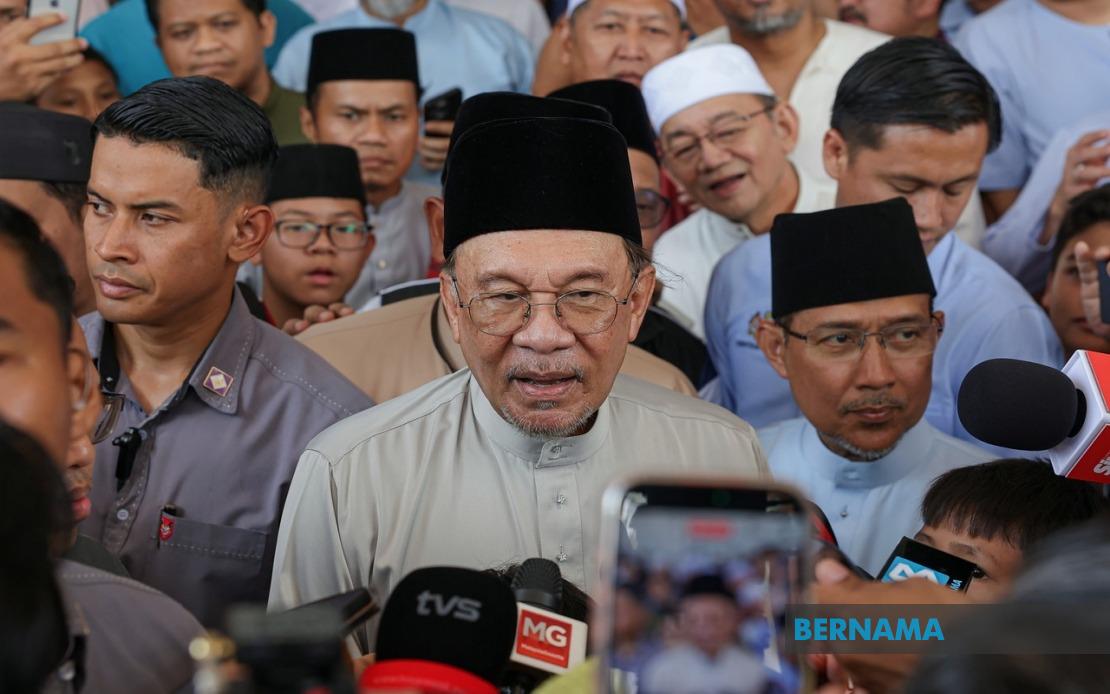
Prime Minister Datuk Seri Anwar Ibrahim has moved to dispel concerns about transparency by declaring that the full Royal Commission of Inquiry report into Tabung Haji's operations has been made public without any censorship or editorial removal. Speaking to media after Friday prayers in Seremban on July 31, Anwar emphasised the government's commitment to unrestricted access to the commission's findings, allowing both the Muslim community and the broader public to assess what the inquiry discovered and what changes it recommends.
The 211-page RCI report, which examined Tabung Haji's management and governance from 2014 to 2020, was published online by the Department of Islamic Development Malaysia (JAKIM) the preceding Wednesday evening. Anwar's clarification came against a backdrop of public discussion about whether the government might withhold sensitive portions of the document. By releasing the entire text, including methodologies and recommendations, the Prime Minister signalled that accountability and public confidence took precedence over any potential embarrassment to particular officials or institutions.
As both Prime Minister and Finance Minister, Anwar underscored that the decision reflected a determination to learn from past governance failures affecting a religious institution that manages savings for millions of Muslim Malaysians. The comprehensive disclosure is intended to facilitate systematic examination of what went wrong, who bore responsibility, and what safeguards must be implemented to prevent recurrence. This approach aligns with the government's broader messaging around institutional reform and the consequences of poor management in public and semi-public bodies.
Anwar was unequivocal about the consequences of any misconduct revealed in the report. He stated that individuals found culpable for wrongdoing must face investigation and prosecution according to legal procedures, ensuring that accountability operates through established prosecutorial and judicial channels rather than arbitrary action. This position reflects the administration's effort to position itself as upholding the rule of law while simultaneously addressing what many Malaysians view as a serious breach of trust in the management of religious assets.
The timing and framing of the release gained added significance given the 16th Negeri Sembilan state election scheduled for the following day. When pressed on whether publishing the report so close to polling day constituted a political calculation to sway voters, Anwar rejected the premise. He argued that an issue of such magnitude—involving the stewardship of funds belonging to millions of believers—transcended electoral considerations. Whether the electorate could fully absorb the report's implications within such a compressed timeframe remained secondary to the principle that concealment was unacceptable regardless of political cost.
Within the ruling Unity Government coalition, the release of a potentially damaging report required consensus among senior figures. Anwar specifically credited Deputy Prime Minister Datuk Seri Dr Ahmad Zahid Hamidi and the broader Cabinet for endorsing the complete publication. By publicly attributing the decision to collective Cabinet support rather than presenting it as a unilateral action, Anwar worked to preempt any suggestion that the inquiry's findings might fracture the governing alliance. His emphasis on Zahid's positive stance signalled that critical examination of institutional failures need not undermine coalition cohesion.
The Tabung Haji inquiry itself represents a culmination of growing public concern over the fund's financial health and governance lapses. The institution, which holds the savings of Muslim Malaysians earmarked for the hajj pilgrimage, had faced mounting scrutiny following investment losses and questions about operational transparency. An independent commission provided the mechanism for systematic investigation, generating documented findings that now serve as a public record against which future performance can be measured.
For Malaysian readers, the broader implications extend beyond Tabung Haji itself. The government's handling of this transparency moment carries lessons for how public institutions operate and how citizen trust is either strengthened or eroded. A decision to withhold portions of the report would have invited suspicion that officialdom remained unaccountable; conversely, unrestricted release frames the administration as willing to face uncomfortable truths and subject itself to public judgment. In a regional context where institutional opacity frequently undermines confidence, Malaysia's move stands as a test case in whether transparent governance can coexist with political management.
The RCI's remit covered the period through 2020, but Anwar acknowledged that Cabinet discussion extended consideration to events and interventions occurring afterwards. He stressed the importance of understanding not only what the original inquiry documented but also what corrective steps the various committees and the current Tabung Haji board have implemented since. This forward-looking angle shifts the conversation from historical accountability toward ongoing institutional reform, demonstrating whether leadership has genuinely absorbed the lessons the commission identified.
Implementation of the RCI's recommendations will now become the critical measure of the government's seriousness. The report's release initiates a second phase in which the public, civil society, religious scholars, and financial experts can scrutinise recommendations and track whether authorities act decisively to adopt them. For a fund serving a purpose deeply rooted in Islamic faith and community obligation, questions of integrity and competent stewardship carry moral weight beyond conventional financial governance, making the government's follow-through particularly consequential for public confidence.

