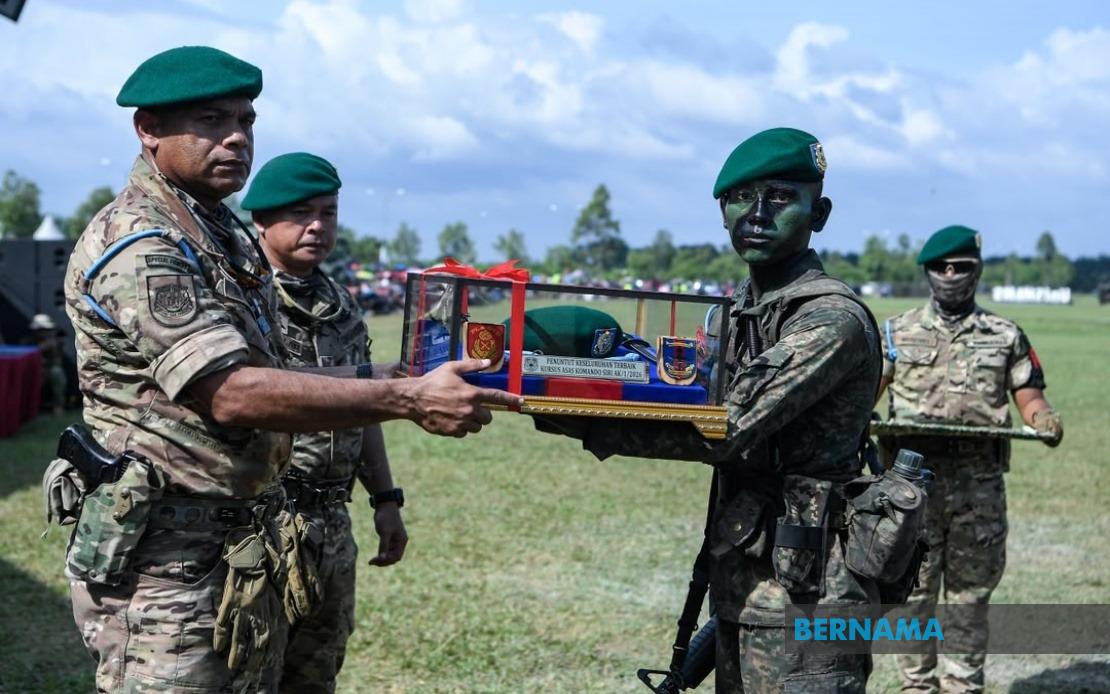
Second Lieutenant Muhammad Fadli Jamalluddin has emerged as the standout graduate of Malaysia's elite commando training programme, demonstrating the kind of perseverance that military leaders often cite when discussing what separates ordinary soldiers from exceptional operators. The 24-year-old officer from Ampang completed the rigorous Basic Commando Course Series AK/1/26 at Universiti Sultan Abdul Halim Mu'adzam Shah in Kuala Ketil with the coveted Best Overall Trainee accolade, a recognition that carries particular weight given his journey to the finish line.
Fadli's path to this achievement was anything but straightforward. He had previously attempted the same foundational commando course during Series 3/2024 but failed to complete it, a disappointment that might have discouraged many aspiring special operations personnel from trying again. Rather than accepting that initial failure as a terminal setback, he regrouped and returned for another attempt, drawing on a resolve that traces back to his secondary school years when he first harboured ambitions of military service. The decision to pursue a second attempt reflects both personal conviction and the kind of institutional support within Malaysia's armed forces that encourages personnel to develop resilience through controlled challenge.
During his second attempt, Fadli encountered another critical juncture that nearly derailed his aspirations entirely. By the eighth week of the three-month course, he failed one of the training exercises, a moment that could have triggered automatic programme repetition. The emotional weight of that moment was considerable—he had already endured more than 100 kilometres of gruelling endurance marching and overcome numerous other obstacles, only to stumble at a point where many would have simply withdrawn. The psychological dimension of commando training often proves as demanding as the physical component, and Fadli's response to this setback reveals as much about his mental fortitude as his physical capabilities.
Fadli's military trajectory began following his graduation from the National Defence University of Malaysia (UPNM), where he completed studies leading to his commission. Upon graduation, he joined the Royal Malay Regiment in 2024, providing him with foundational experience in conventional military operations. His decision to transition from standard infantry service to the elite 21st Special Service Group (21 GGK) represented a deliberate career choice rather than institutional assignment. He articulated this decision during post-ceremony interviews as a calculated determination to pursue what he described as the most challenging path available within military service, reflecting maturity in understanding his own professional development.
The motivation driving Fadli's perseverance extended beyond personal ambition. Family considerations, particularly his relationship with his father, featured prominently in his determination to succeed. His father suffered a stroke more than a year before Fadli's achievement, and the younger man viewed his commando qualification not merely as a personal accomplishment but as a source of strength and pride for his parent. This dimension humanises what might otherwise appear as a straightforward military achievement, revealing how family bonds frequently intersect with professional military development in ways that motivate exceptional performance.
Fadli's educational background demonstrates the increasingly sophisticated preparation pathways for Malaysia's officer corps. His bachelor's degree in Global Policing and Intelligence with Honours indicates that commando training now operates within a context where operators possess formal education in contemporary security domains. This represents a shift from earlier eras when physical prowess dominated selection criteria. Modern special operations, as Fadli himself noted, demand not only raw physical strength but analytical capability and strategic thinking. Complex missions in contemporary operating environments require personnel capable of executing carefully planned operations and making sound decisions under pressure, attributes that educational preparation increasingly seeks to cultivate alongside physical conditioning.
The three-month course structure that Fadli completed represents a comprehensive evaluation of operational capability across multiple domains. Land and sea training components tested his adaptability across different environments, a practical acknowledgment that modern special operations cannot be confined to single terrains. The balance between physical endurance testing—exemplified by the 100-kilometre marches—and technical skill development creates a holistic assessment of trainee suitability. This breadth of evaluation explains why commando qualification carries such prestige within military hierarchies across Southeast Asia; it represents genuine mastery across multiple competency areas rather than excellence in a single domain.
Fadli's final cohort included five other officers and 33 other ranks who successfully navigated the same demanding programme. This graduated structure—wherein officers and enlisted personnel train together within the same qualification framework—reflects professional military organisation principles increasingly common in modern armed forces. The recognition that command authority ultimately rests on demonstrated operational competence rather than rank alone encourages integration of training pathways, ensuring that officer and non-commissioned personnel share common experiential baselines. The relatively small numbers completing each course cycle underscore the selective nature of commando training and the genuine achievement represented by qualification.
The presentation of Fadli's award by Colonel Nordin Abu, Commandant of the Special Warfare Training Centre (PULPAK), carries institutional significance beyond ceremonial formality. The existence of a dedicated special warfare training institution reflects Malaysia's recognition of contemporary security requirements and the investment needed to sustain elite military capabilities. PULPAK's prominence in training commando personnel positions it as a custodian of operational standards and professional development within the special operations domain. The recognition of Fadli's achievement through formal presentation by the institution's leadership reinforces broader military values regarding excellence and perseverance.
Fadli's story carries resonance for Malaysia's defence establishment and broader society. His trajectory from initial failure to top honours demonstrates that setbacks within demanding professional environments need not prove terminal, provided individuals possess both capacity for self-reflection and determination to improve. Within military contexts, this lesson extends beyond individual psychology to institutional implications about how selection and training systems should accommodate failure as a learning opportunity rather than exclusively as grounds for elimination. The commando training environment's infamous difficulty necessarily produces some failures; the question for military leadership concerns whether institutional culture supports second attempts and learning from setbacks.
The recognition of Fadli as Best Overall Trainee reflects assessment across multiple criteria—technical proficiency, leadership potential, physical capability, and psychological resilience. Such comprehensive evaluation distinguishes serious commando training from programmes that emphasize single metrics. His achievement as an officer in the elite special operations community positions him for potential advancement and expanded responsibilities within Malaysia's defence structure. The visibility of his accomplishment, highlighted through media coverage of the course completion ceremony, also contributes to broader public understanding of the demands placed on professional military personnel and the calibre of individuals volunteering for such roles.
Looking forward, Fadli's qualification opens access to advanced operational assignments and potential international training opportunities that specialised skill sets increasingly provide. Within Southeast Asia's contemporary security environment, officers with commando qualification represent valuable human capital, capable of addressing diverse challenges ranging from traditional military operations to humanitarian assistance and disaster relief scenarios where specialised training proves particularly valuable. His specific expertise in security and intelligence, complemented now by commando operational capability, positions him to contribute across multiple mission sets within Malaysia's defence establishment.

