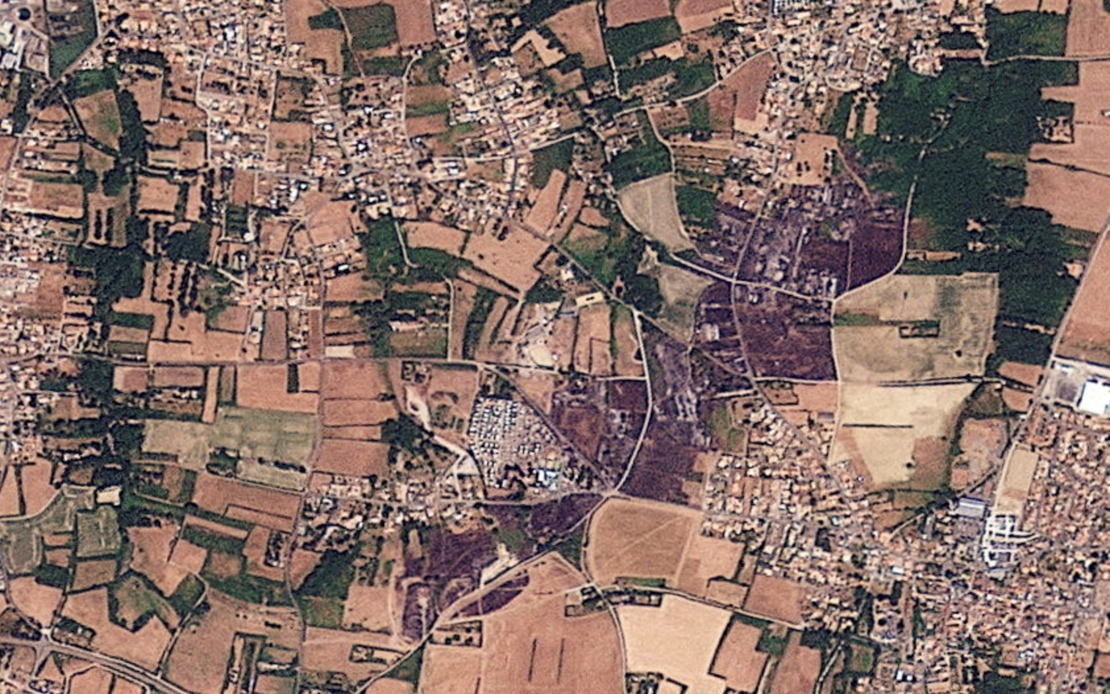
France confronts an expanding wildfire emergency as two separate blazes in the Fontainebleau forest continue to devastate the landscape, having consumed nearly 1,920 hectares of vegetation. The twin disasters underscore the mounting threat posed by deliberately ignited fires across the nation, with law enforcement apprehending two individuals suspected of intentionally sparking the initial outbreak. The situation remains fluid, with some 600 firefighting personnel maintaining active operations on the ground as containment efforts press forward into the night.
The first fire ignited on Sunday and has blackened approximately 1,500 hectares, while a subsequent blaze has destroyed between 300 and 400 additional hectares. Both incidents are occurring within the ecologically sensitive Fontainebleau forest region, a site of significant environmental importance and recreational value for residents across the Paris region. The persistence and scale of these fires demonstrate the challenges faced by emergency responders even as technology and coordination capabilities have improved in recent decades.
The arson dimension of these fires has prompted forceful rhetoric from government officials, reflecting broader frustration with deliberate fire-setting. Transport Minister Philippe Tabarot articulated demands for stringent judicial consequences, asserting that courts should impose substantial prison sentences on those convicted of intentionally igniting forests. His comments revealed a nuanced understanding of the problem, acknowledging that while some perpetrators act with criminal intent, others suffer from pyromania—a psychological disorder requiring medical intervention rather than purely punitive measures.
The scale of the arson problem extends well beyond these two incidents. Since the fire season commenced, French authorities have arrested 59 individuals nationwide on suspicion of deliberately starting wildfires. This figure suggests a systematic challenge that cannot be attributed to accident or negligence alone, indicating that deliberate fire-setting constitutes a meaningful portion of France's wildfire burden. The authorities' response demonstrates a commitment to prosecution, yet the ongoing arrests indicate the difficulty of prevention and the psychological dimensions underlying some fire incidents.
Beyond the Fontainebleau situation, France's wildfire troubles have rippled through its transportation infrastructure. The Trevillach fire, which erupted earlier in July within the Pyrenees-Orientales region, caused significant damage to railway installations serving the Perpignan-Villefranche-Vernet-les-Bains corridor. The national railway operator SNCF has suspended train services between Ille-sur-Tet and Villefranche-Vernet-les-Bains until at least July 20, disrupting regional connectivity and affecting both residents and tourism in this popular mountain destination.
Wildfire activity has not concentrated in any single location but instead has scattered across multiple French regions, illustrating the geographic breadth of the crisis. Brittany experienced evacuations when a heath fire broke out near Cap Fréhel in the Côtes-d'Armor department, forcing the removal of over 100 residents and destroying approximately 38 hectares of protected coastal landscape. Simultaneously, the Lozère region reported the loss of some 107 hectares to active fires, suggesting simultaneous pressure points straining emergency services across several departments.
For Malaysian observers, this scenario offers instructive parallels to Southeast Asian fire management challenges, particularly given the region's own susceptibility to large-scale wildfires during drought conditions. The deliberate arson component in France's crisis echoes problems seen in Malaysia and Indonesia, where unauthorized land clearing and agricultural burning practices have historically contributed to transboundary haze events. The French experience demonstrates that even wealthy nations with sophisticated emergency infrastructure face difficulties preventing and containing fires when human incitement is involved.
The requirement to balance criminal prosecution with medical treatment for pyromania reflects evolving understanding of fire-setting behavior across developed nations. Transport Minister Tabarot's distinction between arsonists deserving severe punishment and individuals with pyromania requiring treatment suggests France is moving toward a more differentiated response. This approach could provide useful models for Southeast Asian jurisdictions wrestling with wildfire causation, where distinguishing between intentional harm and uncontrolled land-clearing practices often proves legally and administratively complex.
The mobilization of 600 firefighting personnel indicates substantial resource commitment, yet the continued spread of blazes throughout July suggests that even such deployment levels face constraints when dealing with multiple simultaneous incidents across different regions. Railway closures, evacuations, and agricultural losses accumulate as secondary consequences of the primary fire events, demonstrating the cascading economic and social impacts of wildfire crises. For France, a nation accustomed to maintaining tight control over its natural resources, these incidents represent a significant challenge to emergency management systems.
The broader context involves climate patterns and environmental conditions that remain incompletely characterized in available reports. While deliberate incitement explains some fire starts, the rapid spread and persistence of these blazes suggest favorable conditions—likely involving dry vegetation, elevated temperatures, and wind patterns. Understanding the interplay between human behavior and environmental conditions becomes essential for developing comprehensive wildfire strategies that address both prevention of arson and adaptation to changing climate circumstances that increase fire vulnerability.

