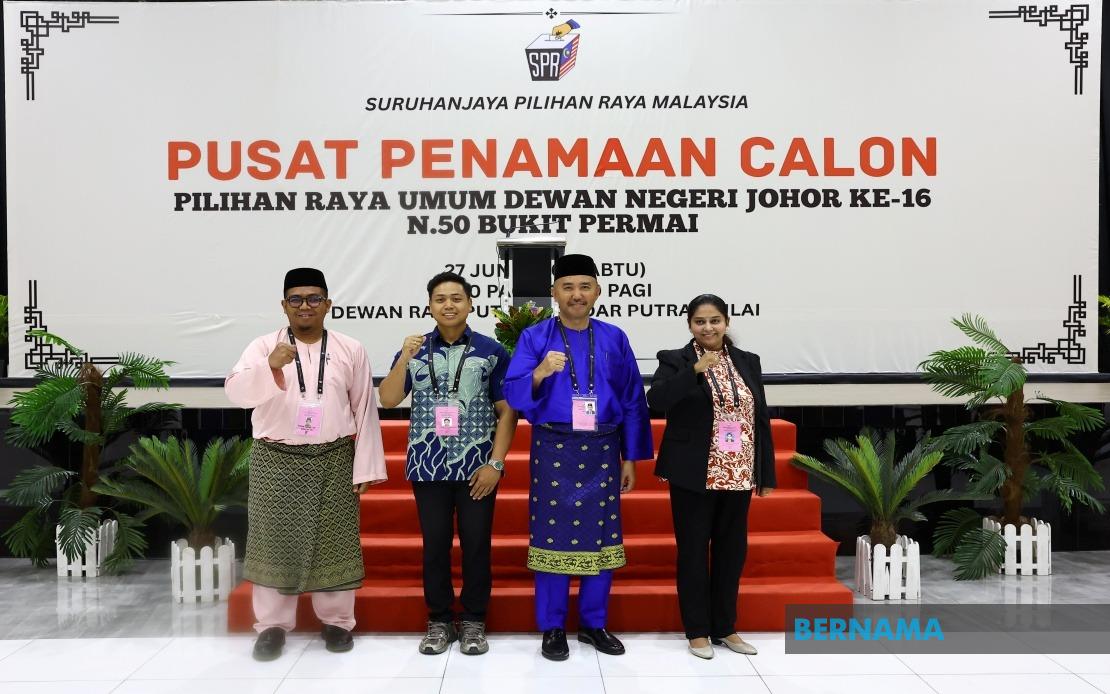
Datuk Mohd Jafni Md Shukor of Barisan Nasional will defend his Bukit Permai seat against three other candidates in a hotly contested four-way battle during the 16th Johor state election, with nominations officially closed and all candidates confirmed for the July 11 polling day.
The incumbent assemblyman faces serious competition from Mohamad Shafwan Ani representing Pakatan Harapan, M. Lina Manoh of Perikatan Nasional, and Muhammad Aidil Riduan Mohd Yusof fielded by Parti Bersama Malaysia. Returning officer Afzan Azhari announced the final slate of candidates at the nomination centre located at Dewan Raya Putra in Bandar Putra following the conclusion of the nomination process at 10 am. The announcement marks the formal opening of the campaign period ahead of voting day.
Mohd Jafni's bid for re-election comes on the back of a convincing performance in the previous electoral contest. When voters went to the polls in 2022, the BN representative secured a comfortable majority of 4,755 votes despite facing four opponents at that time, demonstrating solid grassroots support within his constituency. That result positioned him as the clear favourite heading into this election, though the composition of challengers has shifted and political dynamics have evolved considerably over the past two years.
The Pakatan Harapan challenge carries particular significance as PH continues its efforts to consolidate support across Johor's urban and semi-urban constituencies. Mohamad Shafwan's candidacy received backing from prominent party figures, with Johor DAP chairman Teo Nie Ching arriving at the nomination centre at 8.26 am to accompany and publicly endorse the candidate. This high-profile show of support underscores PH's determination to capture or contest key seats aggressively during the state election campaign.
Perikatan Nasional's entry into the contest through M. Lina Manoh reflects the coalition's strategy to contest broadly across Johor, seeking to capitalise on any fragmentation of the anti-government vote or discontentment with incumbent administration. The presence of a PN candidate adds another layer of complexity to vote splitting dynamics in the constituency, particularly in terms of determining which opposition coalition can most effectively challenge the ruling BN.
The emergence of Parti Bersama Malaysia as an electoral force through Muhammad Aidil Riduan Mohd Yusof's candidacy highlights the increasingly fragmented nature of Malaysian electoral politics. Bersama's participation suggests that newer political movements are gaining confidence to contest state-level elections, potentially fragmenting voter support among multiple options beyond the traditional two-coalition framework. This development may benefit the incumbent if opposition votes split unevenly.
Bukit Permai's electoral character reflects broader patterns seen across the Johor landscape, encompassing a diverse mix of urban, semi-rural, and suburban communities with varying economic interests and demographic profiles. Understanding these micro-level constituencies has become increasingly important for campaign strategists, as state elections in Malaysia now frequently turn on performance in these medium-sized seats rather than in major urban centres alone.
The campaign period unfolds against the backdrop of national political developments and recent shifts in Johor's political alignment. BN's performance in this state holds significance for broader coalition stability and internal party dynamics, particularly given Johor's historical importance within UMNO's power structure. Meanwhile, PH's campaigns across Johor constituencies serve as important testing grounds for opposition messaging ahead of potential federal electoral contests.
Voters in Bukit Permai will cast their ballots on July 11, following an early voting opportunity on July 7 for eligible voters unable to participate on the main polling day. The Election Commission's decision to stagger voting through the early voting mechanism provides flexibility for certain voter categories, though it also extends the campaign period and requires candidates to maintain momentum across multiple voting days.
Mohd Jafni's experience as an incumbent assemblyman provides practical advantages in terms of constituency services, name recognition, and access to official resources. However, these traditional incumbent benefits may be offset by broader political headwinds, voter appetite for change, or effective opposition campaigning. The four-way contest adds unpredictability compared to straight fights, as coalition behaviour and vote concentration become crucial variables.
The result in Bukit Permai will contribute to the overall composition of the 56-member Johor state assembly and may influence post-election negotiations regarding state government formation. Even individual constituency outcomes can carry significance if the overall state election produces a closely contested overall result, making each seat potentially pivotal to determining the final political alignment in Johor's state government.

