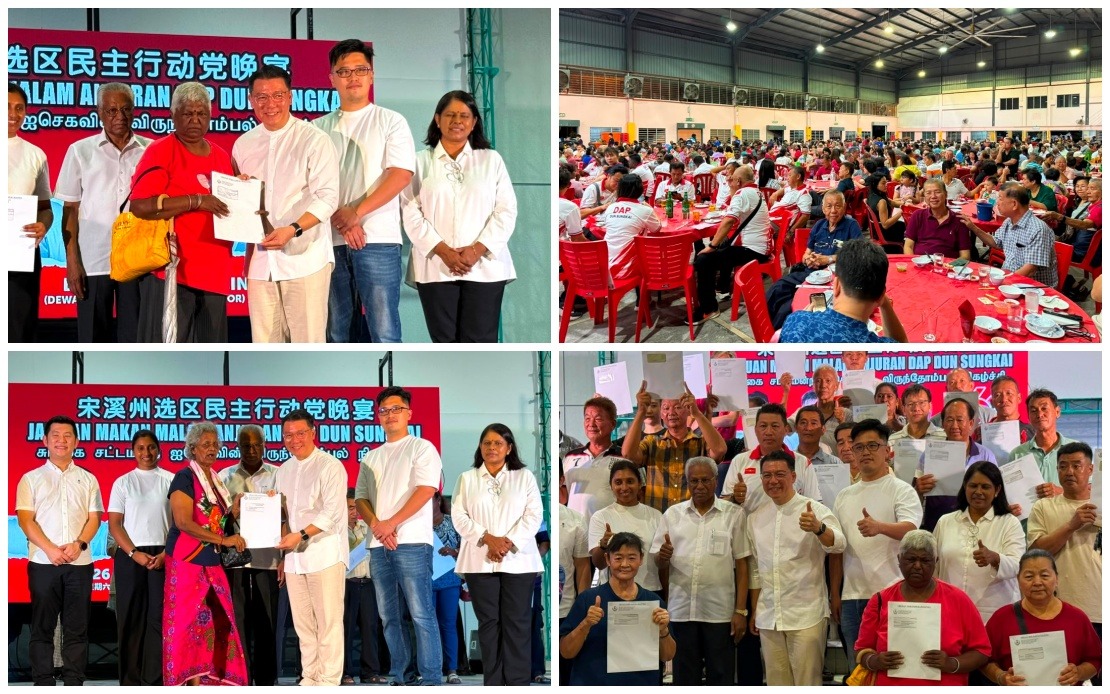
A protracted housing crisis spanning four decades has finally reached resolution in Perak's Sungkai and Kuala Bikam areas, with 120 squatter families now receiving formal land grants. The milestone represents a significant victory for residents who have endured decades of tenure insecurity and housing instability. Housing and Local Government Minister Nga Kor Ming announced the breakthrough at a dinner organised by the DAP Sungkai state constituency division, attended by more than 1,200 community members from diverse backgrounds across the region.
The settlement of this longstanding dispute holds particular weight in Malaysia's ongoing conversation about inclusive governance and equitable development. For generations, these families have existed in legal limbo, unable to access formal property rights or the financial security that home ownership provides. The distribution of land grants represents not merely a bureaucratic resolution but a tangible improvement in living conditions and prospects for future generations whose lives have been constrained by their parents' uncertain housing status.
Nga emphasised that the resolution reflects the MADANI Government's fundamental principle of leaving no Malaysian behind regardless of ethnicity or economic standing. In his remarks, he framed the achievement as consistent with the administration's broader commitment to inclusive nation-building under Prime Minister Datuk Seri Anwar Ibrahim. The minister stressed that such initiatives demonstrate the government's dedication to ensuring that development benefits reach all segments of society rather than concentrating advantages among privileged groups.
The Indian community has received particular attention within the government's welfare agenda, reflecting the demographic composition of Sungkai and surrounding constituencies. The Housing Ministry has allocated RM20 million specifically for improvements to Indian settlements across the country, while the Education Ministry's allocation of RM50 million directed toward Tamil vernacular schools indicates a sustained commitment to supporting vernacular education infrastructure. Additionally, the Malaysian Indian Transformation Unit received an expanded budget of RM150 million, substantially increasing resources available for community development initiatives targeting Indian Malaysians.
Sungkai assemblyman Datuk A. Sivanesan, who chairs the state's Human Resources, Health, Indian Community Affairs and National Integration Committee, received acknowledgment from Nga for his instrumental role in navigating the bureaucratic complexities that had stalled resolution for decades. The assemblyman's advocacy represents the type of persistent local representation often necessary to dislodge long-standing administrative bottlenecks. Civil servants involved in processing applications and coordinating between various government agencies were similarly credited for their sustained efforts to see the project through to completion.
The timing of this announcement carries political significance amid an environment where Malaysian governance continues to grapple with questions about performance versus perception. Nga urged citizens to evaluate government achievements on their merits rather than allowing historical narratives or communal sentiments to overshadow concrete deliverables. His call for Malaysians to assess "actual performance and achievements" reflects a broader challenge facing the MADANI Government—establishing credibility through tangible outcomes that resonate across diverse constituencies.
The minister articulated a vision of political renewal centred on unity and service delivery rather than the divisive rhetoric that has characterised Malaysian politics historically. He advocated for a political culture grounded in development outcomes and citizen wellbeing, moving away from what he characterised as outdated and destructive approaches centred on racial or religious grievance. This framing suggests an attempt to reorient political discourse toward pragmatic governance metrics rather than identity-based mobilisation.
The Sungkai gathering drew representation from multiple levels of government and across party lines, including Ipoh Timur MP Howard Lee Chuan How and several state assemblymen including Buntong's M. Thulsi, Malim Nawar's V. Bavani, and Astaka's Jason Ng Thien Yong. The broad attendance from both DAP and non-DAP elected representatives signals that housing security transcends partisan boundaries and reflects concerns shared across the political spectrum.
For Malaysia's broader housing policy landscape, the Sungkai resolution offers both encouragement and caution. While the successful conclusion of a four-decade stalemate demonstrates government capacity to address entrenched problems, the fact that resolution took so long raises questions about institutional efficiency in land administration and property rights allocation. Many other communities across Malaysia remain in similarly precarious circumstances, suggesting that while this breakthrough is welcome, systemic reforms may be necessary to prevent similar delays from occurring elsewhere.
The land grant distribution also intersects with Malaysia's urbanisation patterns and the concentration of informal settlements around major towns and cities. As urban populations continue growing, housing demand will intensify, placing greater pressure on government agencies to streamline processes for formalising squatter settlements and providing alternative housing solutions. The Sungkai case demonstrates both the possibility of resolution and the institutional challenges that must be overcome to achieve it systematically rather than on an ad-hoc basis.
Looking forward, the successful conclusion in Sungkai may serve as a template for addressing similar situations in other states. The involvement of multiple government tiers, sustained political commitment from both state and federal levels, and coordination between land agencies appears to have been crucial. Replicating these conditions elsewhere could accelerate the resolution of comparable cases, though each locality presents unique administrative and financial complexities that may require customised approaches.
The broader significance of this development extends beyond housing provision alone. It reflects an understanding within government that sustainable development requires addressing historical inequities and ensuring that all citizens possess the basic security of formal housing tenure. In a regional context where informal settlements remain widespread across Southeast Asia, Malaysia's approach to resolving Sungkai offers insights into how governments can tackle entrenched housing crises through sustained commitment and inter-agency coordination, though much work remains to scale such successes across the nation.

