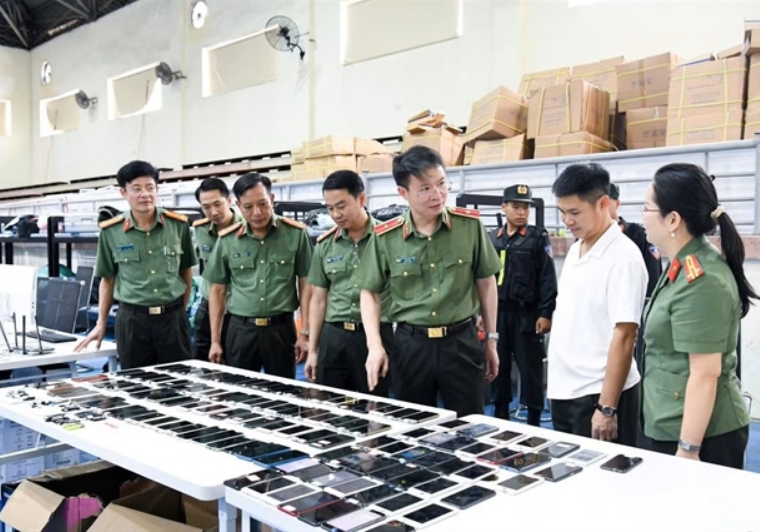
Law enforcement authorities in Phu Tho province in northern Vietnam have moved against four suspects accused of orchestrating a scheme to transplant a sprawling online fraud enterprise from Cambodia into Vietnamese territory. The charges, filed on June 17, represent a significant success in regional efforts to combat transnational cybercrime networks that have increasingly migrated across Southeast Asian borders in response to intensified enforcement actions.
The investigation centred on Zhao Wei Zhong, a 37-year-old Chinese national who police identified as the mastermind of the relocation plan. According to investigators, Zhao entered Vietnam on explicit instructions from an overseas-based associate with connections to criminal networks operating across Cambodia. His specific mission was preparatory in nature—securing suitable housing, arranging transportation infrastructure, and laying the groundwork for an anticipated surge of personnel crossing from Cambodia into Vietnam to establish what police characterize as a functioning call-centre operation devoted to online fraud schemes.
Zhao's background provided him with intimate knowledge of the mechanics of transnational scam operations. Police records indicate he had previously been employed at Chinese-managed fraudulent call centres operating throughout Cambodia, where he cultivated professional relationships that would prove instrumental to his Vietnamese venture. It was through these established connections that he identified and subsequently recruited two Vietnamese accomplices to facilitate the logistical dimensions of his plan.
The two Vietnamese nationals enlisted were Tran Thi Thu Huong, aged 24, and Dình Nam, aged 27, both residing in Bac Ninh province in the north. Their roles were designated as supporting functions essential to the operation's success. Huong and Nam were tasked with providing translation services to bridge communication gaps between foreign operatives and Vietnamese authorities or landlords they would encounter, managing transportation logistics for moving personnel and equipment, and scouting potential locations capable of accommodating the anticipated influx of Cambodia-based scam workers.
A fourth figure emerged during the investigation as instrumental to the conspiracy's operational dimensions. Nguyen Thanh Long, a 43-year-old resident of Hanoi, was identified by police as having contributed substantially to the arrangement of logistical support structures necessary for executing the relocation strategy. His involvement underscored the operation's seriousness and the resources committed to ensuring a smooth transition from Cambodia to Vietnamese soil.
The sophistication of the suspected operation becomes apparent when examining the scale of technological infrastructure investigators discovered during their enforcement action. Police conducted raids on properties connected to the four suspects, recovering an extensive cache of equipment explicitly intended to support large-scale fraud operations. The seizure included 73 computers, 134 mobile phones, 34 USB drives, and 20 Wi-Fi routers, alongside additional electronic apparatus. This substantial hardware collection reflects the technical prerequisites necessary to operate a functional scam call centre capable of targeting multiple victims simultaneously across digital networks.
What makes this case particularly significant for the Southeast Asian region is the window it opens into organised cybercrime's adaptive behaviour. Investigators detected growing indications that criminal networks operating throughout Cambodia—facing mounting pressure from authorities implementing stricter oversight—had begun strategically repositioning operations into neighbouring jurisdictions perceived as offering less intensive law enforcement scrutiny. Vietnam's experience mirrors patterns observed across the region as transnational fraud enterprises seek jurisdictions with perceived enforcement gaps or where corruption might facilitate their establishment.
The timeline and coordination of police action proved decisive in preventing the conspiracy's materialisation. Authorities detected the emerging plot during its nascent stages, before significant personnel transfers could occur and before the scam operation achieved full functionality on Vietnamese territory. This preemptive intervention prevented what could have become a substantial ongoing criminal enterprise targeting victims potentially across multiple countries through digital fraud mechanisms.
The criminal charges reflect the severity with which Vietnamese authorities treat such violations. Zhao Wei Zhong, Tran Thi Thu Huong, and Nguyen Thanh Long were all charged with organising the illegal stay of foreign nationals in Vietnam—a serious offence that carries significant penalties. All three were remanded into pretrial detention, signalling prosecutors' intent to pursue vigorous prosecution and reflecting judicial assessment of flight risk and danger to the community. Dình Nam, though charged with the identical offence, received more lenient provisional measures consisting of movement restrictions confining him to his residence while proceedings continue, suggesting potentially reduced culpability or stronger ties to the Vietnamese community that authorities deemed stabilising factors.
For Malaysia and other Southeast Asian nations grappling with organised cybercrime, the Phu Tho case demonstrates both the extent of transnational fraud network activity and the critical importance of international law enforcement coordination. The operation's cross-border architecture—with Cambodian bases, Chinese leadership, overseas coordination points, and Vietnamese expansion—reflects how modern organised crime transcends national boundaries. The case underscores the necessity for regional governments to strengthen information-sharing mechanisms, harmonise legal frameworks addressing cybercrime, and develop sophisticated intelligence capabilities capable of identifying emerging criminal migration patterns before they materialise into operational threats.
The successful disruption achieved by Vietnamese authorities also highlights prosecution capabilities when supported by timely intelligence and decisive action. The comprehensive seizure of technical equipment and systematic arrest and charging of key conspirators within a compressed timeframe demonstrates the effectiveness of coordinated investigative effort. As cybercriminal networks continue adapting their operational footprints in response to enforcement pressure across Southeast Asia, similar proactive and transnational approaches will prove essential to maintaining the region's cybersecurity integrity and protecting vulnerable populations targeted by increasingly sophisticated fraud schemes.

