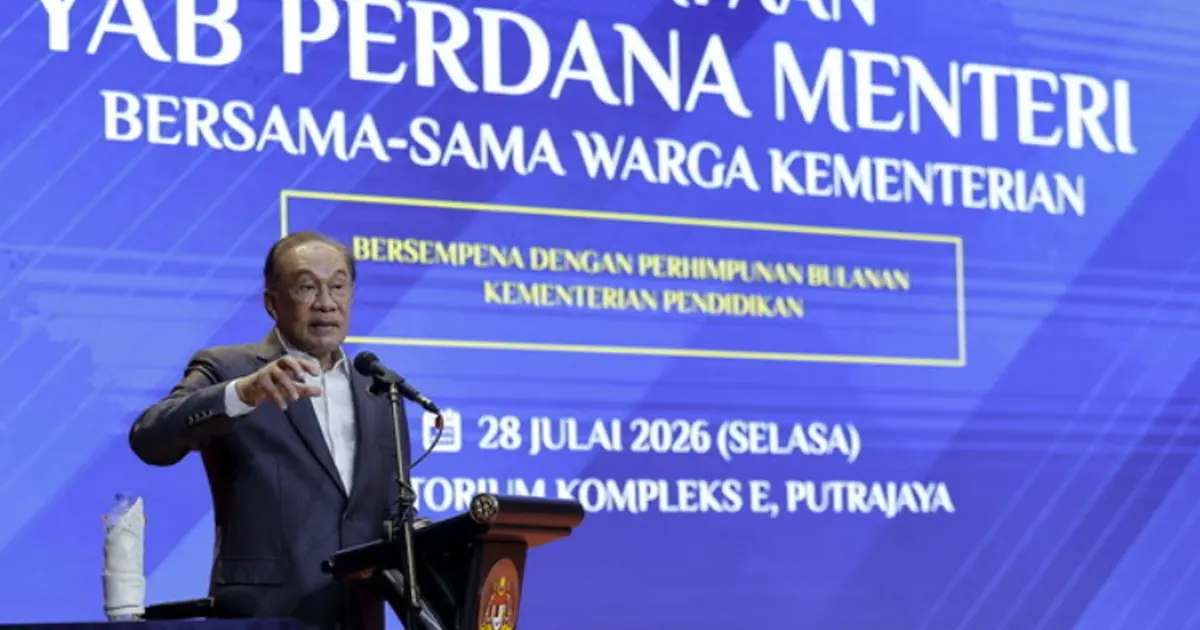
Prime Minister Anwar Ibrahim has clarified that the Form 6 programme will persist under the administrative umbrella of the Education Ministry, resolving speculation about potential institutional restructuring. The decision reflects the government's assessment that maintaining the current arrangement serves the Malaysian education system most effectively.
Anwar's statement addresses underlying concerns about the programme's governance and operational framework. The administration of Form 6, which serves as Malaysia's primary pre-university pathway for students completing their secondary education, involves complex considerations spanning curriculum design, teacher deployment, and quality assurance mechanisms. These interconnected elements have prompted the government to preserve the existing institutional structure rather than pursue alternatives.
The confirmation carries particular significance for Malaysia's education landscape, where Form 6 enrollments represent a substantial portion of post-secondary participation. Approximately 450,000 students are enrolled in the two-year programme nationwide, making it a cornerstone of accessibility to higher education. Any institutional restructuring would inevitably disrupt established protocols and create administrative friction at a time when educational continuity remains paramount.
Systemic considerations influenced this decision substantially. The Education Ministry has developed comprehensive frameworks governing curriculum standards, assessment protocols, and pedagogical approaches across Malaysia's Form 6 cohort. Transferring these functions to an alternative ministry would necessitate duplicating entire administrative systems and potentially fragmenting oversight mechanisms that have evolved over decades. Maintaining centralised education ministry control ensures consistency in educational outcomes and resource allocation across peninsular Malaysia, Sabah, and Sarawak.
Teacher utilisation presents another critical dimension underlying the policy decision. Form 6 educators represent a specialised pool within Malaysia's teaching workforce, with qualifications and experience tailored to advanced secondary instruction and pre-university preparation. The Education Ministry's infrastructure for teacher recruitment, professional development, and performance evaluation has been calibrated specifically for this cohort. Relocating Form 6 administration would necessitate restructuring these human resource mechanisms, creating disruption during a period when teacher shortages and retention challenges already strain the system.
The broader policy environment contextualises Anwar's confirmation. Successive Malaysian governments have grappled with education ministry coordination challenges, particularly regarding the balance between federal oversight and institutional autonomy. Form 6 colleges, though diverse in character and intake patterns, function most efficiently within a unified administrative framework that enables resource distribution, curriculum harmonisation, and quality benchmarking across institutions.
Stakeholders within Malaysia's education sector have generally welcomed clarity on Form 6's institutional future. School administrators and principals benefit from definitive governance structures, whilst parents and students gain assurance regarding programme stability and credential recognition. The decision eliminates uncertainty that might have prompted institutional hedging or created administrative paralysis during a period when post-pandemic education recovery remains incomplete.
Regional implications extend beyond Malaysia's borders. Several Southeast Asian nations have observed Malaysia's Form 6 model with interest, particularly regarding its effectiveness in facilitating university transitions and supporting diverse learner profiles. Institutional instability would have signalled broader governance concerns to regional education policymakers evaluating comparable systems. The confirmation of continued ministry administration projects institutional confidence and reinforces Malaysia's educational credibility within the region.
Looking forward, the Education Ministry faces the challenge of demonstrating that centralised Form 6 administration can continue driving excellence and innovation. This requires sustained investment in curriculum modernisation, particularly regarding integration of digital literacy, critical thinking, and vocational orientation alongside traditional academic pathways. The confirmation of ministry stewardship implicitly commits the government to enhancing Form 6's pedagogical relevance in an economy increasingly demanding adaptable, technologically proficient graduates.
The decision also reflects pragmatic recognition that education ministry capacity, whilst stretched, remains superior to alternative arrangements for managing a programme serving such diverse constituencies. Policy coherence across the education system—from primary through pre-university levels—depends on integrated planning and resource deployment. Form 6's integration within the broader ministry structure facilitates this coordination, even as administrators acknowledge capacity constraints.
Anwar's announcement effectively concludes an institutional debate that, whilst not dominating public discourse, had created uncertainty within education circles regarding Form 6's future positioning. The confirmation provides the stability necessary for strategic planning, whether through curriculum enhancement initiatives, infrastructure improvements, or pedagogical innovation. This clarity enables education stakeholders to focus resources on substantive improvements rather than organisational restructuring.

