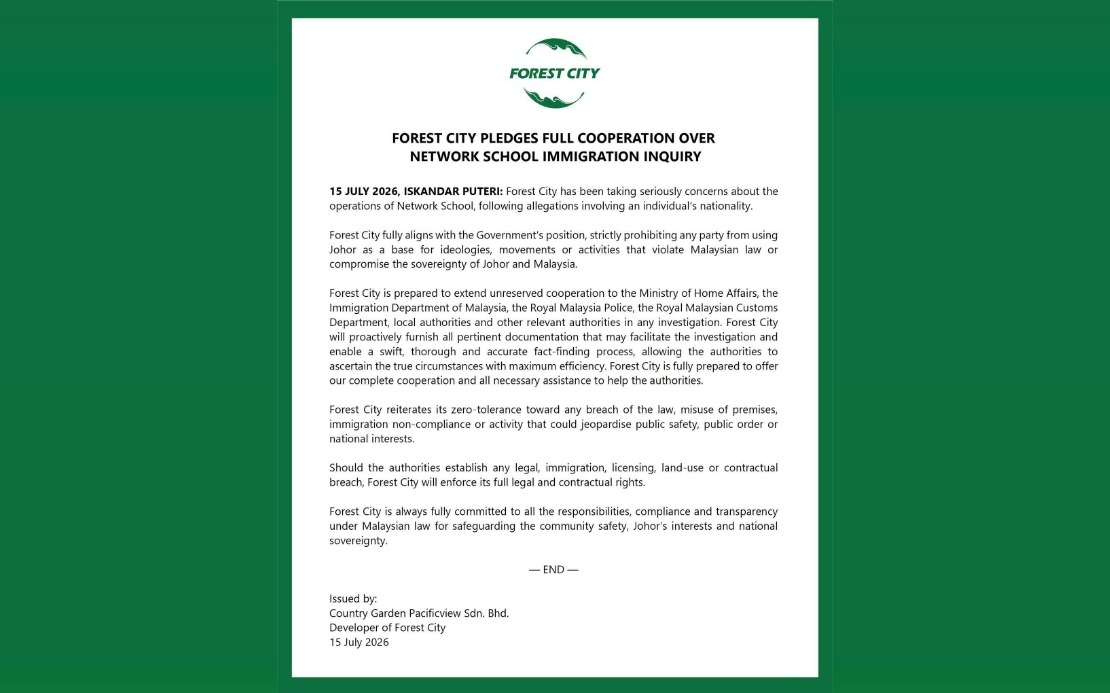
Country Garden Pacificview, the developer behind the Forest City megaproject in Johor Bahru, has signalled its willingness to cooperate completely with authorities investigating allegations that the Network School programme enrolled Israeli citizens in contravention of national regulations. The developer's position reflects the mounting scrutiny surrounding the educational operation and underscores the complexity of managing a sprawling mixed-use development that attracts international residents and organisations.
In a formal statement released on July 15, the company emphasised that it takes the matter with utmost seriousness and aligns itself with the federal government's firm policy against permitting Johor to serve as a platform for unlawful activities or initiatives that could compromise national sovereignty. This explicit positioning is strategically important, as Forest City has long been a prominent investment by Chinese interests in Malaysia and has occasionally drawn public and political attention regarding its management and tenant vetting protocols.
The developer has extended its cooperation offer to a broad spectrum of enforcement agencies, including the Home Ministry (KDN), Immigration Department (JIM), Royal Malaysia Police, Royal Malaysian Customs Department, and municipal authorities. This multi-agency coordination reflects the scale of the investigation and the range of potential violations that may be under scrutiny, from immigration documentation irregularities to security-related concerns.
Country Garden Pacificview has committed to furnishing all documentation and records deemed necessary by investigating authorities to expedite a comprehensive and factually grounded inquiry. This transparency undertaking is significant for establishing the timeline and mechanisms through which Network School may have operated, and for clarifying what oversight mechanisms, if any, were in place within Forest City's administrative structure regarding institutional tenants and their compliance with local regulations.
The developer has also articulated a zero-tolerance policy towards legal violations, unauthorised use of facilities, breaches of immigration law, and activities that could endanger public safety or social order. Such declarations are standard corporate damage-control responses, yet they also establish a public benchmark against which the company's future conduct will be measured, particularly regarding tenant screening and premises management across the sprawling development.
The investigation was catalysed by remarks from Johor Menteri Besar Datuk Onn Hafiz Ghazi, who on July 14 called for authorities to probe the Network School operation within Forest City. Onn Hafiz raised concerns that foreign participants were reportedly using passports from other nations to enter Malaysia, thereby circumventing immigration protocols designed to monitor and regulate entry by citizens of certain countries. This disclosure points to sophisticated document manipulation or exploitation of loopholes in Malaysia's immigration screening procedures.
The allegation carries geopolitical weight given Malaysia's longstanding policy of not recognising the State of Israel and maintaining restrictions on Israeli nationals entering the country. Any circumvention of these restrictions through fraudulent documentation or coordinated deception constitutes a serious breach of national policy and immigration law, raising questions about how such an operation could have functioned without detection across what should be standard security checkpoints.
In response to the allegations, the Immigration Department conducted an inspection of 266 foreign nationals residing or present in Forest City, representing 40 different countries. Preliminary findings indicated that all individuals inspected possessed valid immigration documentation, though this initial sweep does not necessarily exonerate the Network School programme or rule out past irregularities. The ongoing nature of the investigation suggests authorities are pursuing leads beyond the immediate physical inspection, likely examining enrolment records, financial transactions, and communications associated with the programme.
The Network School incident highlights broader challenges facing Malaysia in managing large-scale integrated developments that host diverse international populations, educational institutions, and commercial enterprises. Forest City, which encompasses residential towers, retail facilities, hospitality venues, and institutional spaces, operates somewhat as a semi-autonomous ecosystem requiring coordination between the developer, municipal authorities, and federal agencies. The apparent ease with which a potentially problematic educational programme could operate within the development underscores gaps in oversight mechanisms and inter-agency information sharing.
For Malaysia's regulatory framework, the episode reveals vulnerabilities in vetting processes for institutions within private developments and in detecting document fraud at entry points. These weaknesses are particularly concerning given heightened regional tensions and Malaysia's need to maintain strict immigration controls aligned with its foreign policy posture. The incident may prompt a broader review of how large commercial developments accommodate educational and institutional tenants, and what compliance certifications and audits should be mandated.
The developer's swift and comprehensive commitment to cooperation serves multiple purposes: it mitigates potential corporate liability, demonstrates responsiveness to government concerns, and signals to investors and authorities that the company takes regulatory compliance seriously. However, the credibility of these assurances ultimately depends on the investigation's findings and on tangible improvements to Forest City's administrative practices going forward.
For regional stakeholders, the Network School investigation represents a test case in Malaysia's capacity to enforce its immigration policies consistently and to protect its geopolitical interests through vigilant security screening. The outcome will likely influence how other Southeast Asian nations assess their own vulnerability to similar circumvention attempts and may shape future protocols for vetting educational and cultural institutions seeking to operate within the region.

