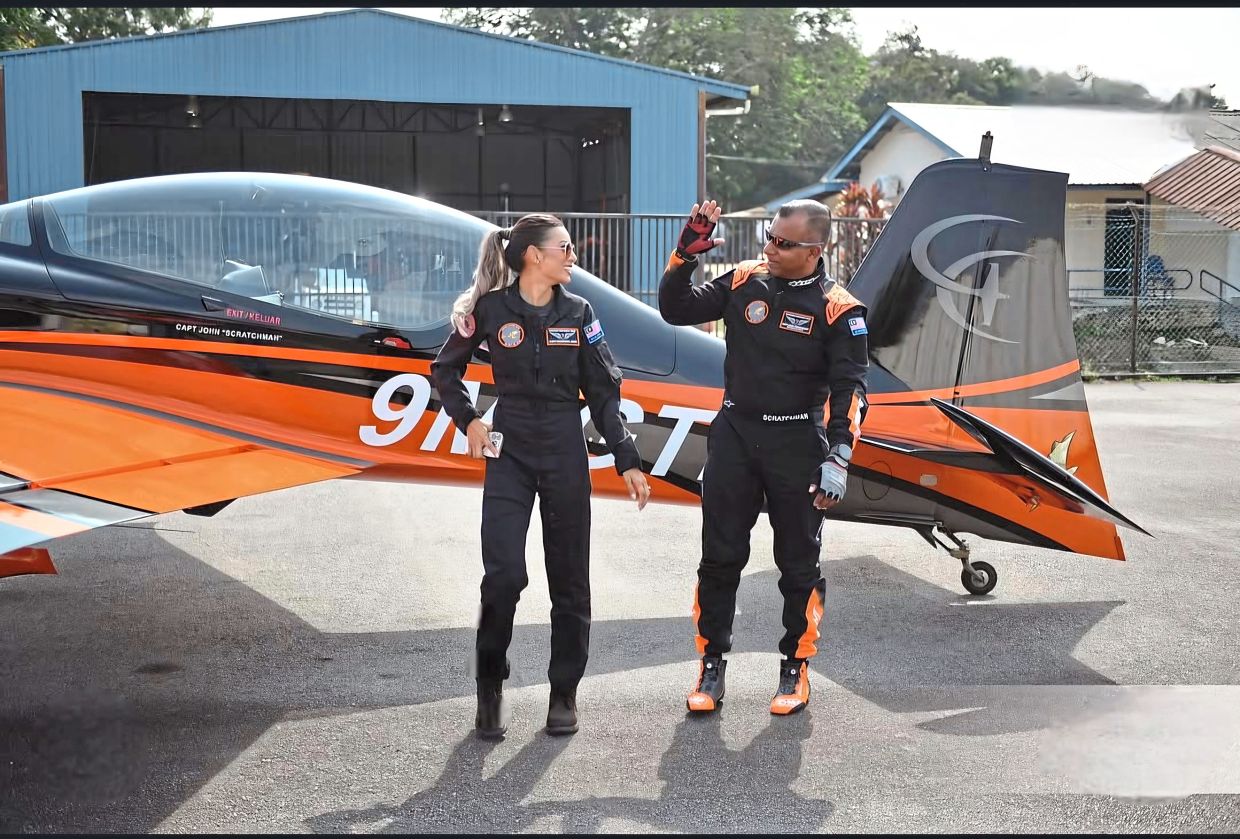
Samantha Laura John completed her flight training in Ipoh and qualified as a pilot in 2025, embodying a family legacy deeply rooted in Malaysia's aviation sector. Her father, Lieutenant-Colonel (Retired) John Sham Alagarsamy, spent 26 years as a Royal Malaysian Air Force fighter pilot, instructor and examiner before transitioning to the commercial aviation industry in 2019. The younger John's achievement represents more than a personal milestone; it exemplifies how passion, discipline and familial encouragement can shape career trajectories across generations within a specialised field.
Growing up as the daughter of a decorated RMAF pilot, Samantha was immersed in an environment of professional dedication and national service. Her childhood memories centre on watching her father prepare for combat readiness training and navigation exercises, experiences that cultivated both admiration and aspiration. "I was always so proud to have a father serving the nation," she reflects. The visibility of her father's commitment to safeguarding Malaysia's airspace instilled in her a particular understanding of aviation as something beyond a career—a calling tied to national responsibility and purpose. These formative observations proved pivotal, even as gender remained an underrepresented dimension in Malaysian aviation at that time.
When Samantha expressed her determination to pursue aviation, her father adopted a philosophy of encouragement without compulsion. John Sham Alagarsamy emphasises that while he hoped his children would follow his professional path, he never imposed that expectation. His approach reflects contemporary parenting wisdom supported by academic research: the study "Parental Influence and Undergraduates' Career Choice Intentions" from Universiti Teknologi Malaysia's social science journal demonstrates that strong parent-child relationships, open communication and mutual trust significantly influence career exploration and long-term planning. His guidance—"if they aim for the stars, at least they'd reach the sky"—encapsulates the balance between inspiration and autonomy that research suggests fosters both ambition and genuine commitment.
The path to Samantha's pilot's licence was neither linear nor immediate. After completing her International General Certificate of Secondary Education, she initially chose a different trajectory, enrolling in a two-year cadet pilot programme with an airline based in Sepang, Selangor in 2018. While the role proved rewarding, she eventually concluded it did not align with her deeper aspirations. Rather than representing failure, this detour underscores her father's broader philosophy: the importance of allowing individuals to explore, reassess and ultimately commit to their authentic calling. Her realisation that she remained fundamentally drawn to aviation validates the value of that exploratory process.
John Sham Alagarsamy's own aviation career extends well beyond conventional military and commercial parameters. Following his departure from the RMAF, he became the country's first and only civil aviator officially recognised by the Civil Aviation Authority of Malaysia for aerobatics expertise. His performances at major exhibitions including the Langkawi International Maritime and Aerospace Exhibition, piloting the GB1 GameBird aircraft in aerobatic displays, have established him as a distinctive figure in Malaysian aviation circles. This parallel pursuit of excellence beyond the standard career framework demonstrates the multifaceted approach to professional achievement that has evidently influenced Samantha's own thinking about career possibilities.
The family's geographical mobility through multiple RMAF postings across Malaysia—from Labuan to Kuantan, Alor Setar and Butterworth in Penang—created both logistical challenges and profound developmental benefits. These relocations, which occurred during Samantha's early childhood, exposed her to disciplined military environments characterised by clear hierarchies, shared purpose and collective responsibility. The experience of living on air force bases provided direct, tangible observation of how aviation professionals operate under structured conditions and maintain readiness for national security objectives. This immersion shaped her understanding of aviation not as an isolated technical discipline but as integral to Malaysia's broader defence architecture.
A pivotal moment came in 2012 when the family relocated to Canberra for two years. John Sham Alagarsamy was attached to the Australian Defence Force whilst pursuing a master's degree in military and defence studies from the Australian National University. This international sojourn significantly broadened Samantha's perspective on aviation and defence systems. Exposure to international defence cooperation, different operational frameworks and comparative military aviation practices provided context that enriched her understanding of her father's profession and the global aviation ecosystem. Such cross-cultural professional experience, though brief, often catalyses sophisticated thinking about career possibilities and international opportunities.
Today, Samantha holds her pilot's licence but currently operates outside the aviation sector. Based in Kota Kinabalu, she co-runs an event management company with her husband, David Chong, whilst providing vocal coaching services. This apparent departure from aviation reflects not abandonment but pragmatic life management. She maintains explicit intention to return to commercial flying, positioning her current work as a temporary arrangement rather than a permanent pivot. Her situation mirrors that of numerous highly trained pilots navigating the complexities of dual-career relationships, family considerations and financial planning that characterise contemporary professional life in Malaysia and Southeast Asia.
The John family is not unique within Malaysia's aviation landscape. Sisters Safia Amira Abu Bakar and Safia Anisa Abu Bakar similarly followed their father, Captain Abu Bakar Shafie, into aviation, suggesting an emerging pattern of intergenerational career transmission within this specialised sector. As Malaysia seeks to expand its aviation workforce and improve gender diversity in pilot recruitment, these family narratives provide compelling evidence that atmospheric and cultural factors—family role modelling, early exposure, mentorship and encouragement—significantly shape entry decisions. The regulatory recognition given to professionals like John Sham Alagarsamy, including his receipt of the Most Gallant Order of Military Service (Kesatria Angkatan Tentera) during his RMAF service, also signals institutional value placed on aviation excellence.
Crucially, Samantha emphasises the psychological and cognitive dimensions of piloting that transcend technical proficiency. "Once you're in the cockpit, you have to be fully focused and aware of your surroundings," she explains. "You're always looking ahead, thinking ahead, and staying situationally aware. It's almost like working in six dimensions." This description captures aviation's demand for simultaneous attention to multiple variables—altitude, airspeed, weather systems, navigation, communication and aircraft systems—whilst maintaining strategic foresight. Such cognitive intensity appeals to individuals with particular temperamental and intellectual profiles, qualities often identifiable in childhood through patterns of curiosity, risk assessment and sustained concentration.
The father-daughter dynamic reflects values emphasising integrity and legacy. John Sham Alagarsamy observes that professional impact is "measured by the positive influence we leave on others, especially our children, who often learn more from what we do than what we say." This philosophy, grounded in lived experience rather than abstract principle, acknowledges that children absorb professional ethos, standards and commitment through observation and immersion rather than exhortation alone. Samantha's respectful yet warm engagement with her father—evident in recent family gatherings where they reminisce about air force bases and aviation stories—demonstrates how such values become embedded in family relationships across time and distance.
For Malaysian aviation stakeholders and policymakers, the John family narrative carries several implications. First, it demonstrates that family networks and role modelling remain powerful vectors for talent pipeline development, particularly in technical fields where early exposure significantly influences career trajectory. Second, it highlights the necessity of supporting dual-career pathways and flexible arrangements for aviation professionals, particularly women who navigate pressures to prioritise family relocations whilst maintaining professional advancement. Third, it underscores the value of international professional exchange—Samantha's Canberra experience broadened her aviation perspective in ways domestic exposure alone might not achieve. Finally, as Malaysia positions itself as a regional aviation hub and seeks to diversify its pilot workforce, the authentic enthusiasm and lived commitment evident in stories like Samantha's provides a powerful counternarrative to generic recruitment messaging. Aviation in Malaysia, these individuals demonstrate, is not merely employment—it is vocation, legacy and national service intertwined.

