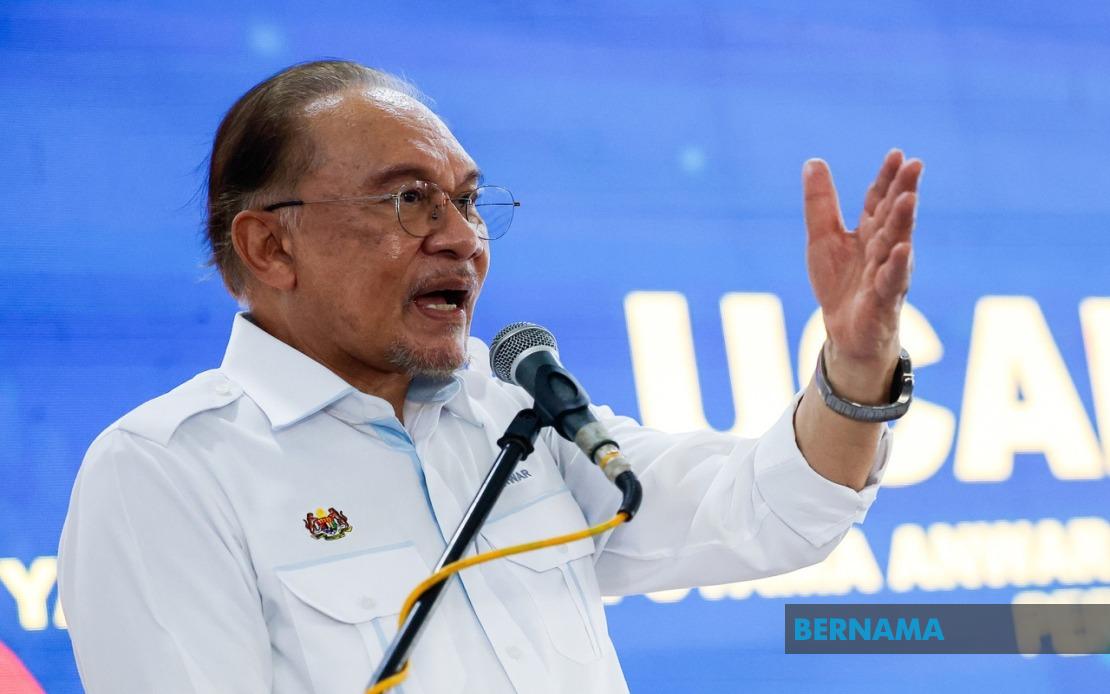
Prime Minister Datuk Seri Anwar Ibrahim has urged the Pakatan Harapan campaign machinery to dedicate its final days before the Negeri Sembilan state election to intensive ground work rather than becoming preoccupied with the swirl of competing election forecasts that have emerged in recent weeks. Speaking at a youth engagement programme in Port Dickson on July 31, Anwar pointed out the inherent unreliability of polling predictions, noting that six different surveys currently circulating about the election have produced six entirely different sets of conclusions about the likely outcome.
The prime minister's remarks came in response to questions about an Ilham Centre prediction suggesting that the combined strength of Barisan Nasional and Perikatan Nasional could potentially capture 22 of the 36 seats in the Negeri Sembilan State Legislative Assembly, with Pakatan Harapan expected to secure at least nine. Rather than engage in detailed commentary on any particular survey, Anwar chose to dismiss the exercise of prediction-watching altogether, arguing that the most productive use of the remaining campaign period would be to mobilise party volunteers and supporters on the ground.
This strategic pivot away from polls reflects a calculated messaging approach by Anwar, who serves concurrently as Pakatan Harapan chairman. By dismissing the predictive framework entirely, the prime minister attempts to redirect attention from forecasts that might suggest opposition momentum, while simultaneously creating a narrative in which the outcome remains genuinely contested and entirely dependent on campaign intensity. The statement implicitly critiques party members or sympathisers who might spend time analysing polls rather than knocking on doors or organising grassroots events.
The divergence among the six surveys Anwar referenced underscores a broader challenge facing Malaysian electoral analysts. Polling in the Malaysian context faces methodological hurdles including the complexity of multi-cornered contests, the significance of last-minute voter movement, and the differential likelihood of turnout across demographic and geographic segments. When six ostensibly professional surveys produce six different outcomes, the credibility of each individual forecast naturally diminishes, validating Anwar's implicit argument that campaigns remain fluid and unpredictable.
The Negeri Sembilan election takes place against a backdrop of shifting coalition dynamics in Malaysian politics. The formation of the Perikatan Nasional alliance between the Malay-Muslim focused parties has fragmented the opposition vote in ways that benefit either Pakatan Harapan or Barisan Nasional depending on local political circumstances and campaign effectiveness. In Negeri Sembilan specifically, the state has traditionally been competitive, with Pakatan Harapan winning the 2018 state election but losing significant ground in the 2023 federal election.
Anwar's emphasis on campaign mobilisation carries practical implications for how Pakatan Harapan allocates its organisational resources in the final stretch. Rather than deploying staff to analyse polling data or craft messaging based on survey findings, the party is being directed to concentrate on voter contact, logistics, and morale-building activities designed to increase turnout among its identified supporters. This represents a departure from more data-driven campaign strategies that have become commonplace in contemporary politics.
For Southeast Asian observers, Anwar's approach illustrates the persistent tension between modern campaign analytics and traditional grassroots organising. While sophisticated polling and data modelling have transformed political campaigns in developed democracies, their reliability in the Malaysian context remains contested, particularly when dealing with three-way or four-way contests and modest sample sizes. The prime minister's dismissal of polls as a distraction reflects both pragmatism and an acknowledgment of their limited utility.
The Ilham Centre forecast specifically pointing to 22 combined seats for Barisan Nasional and Perikatan Nasional represents a substantial projection if accurate, effectively suggesting that opposition unity or success would require outperforming that prediction. However, such forecasts carry significant uncertainty margins that are often underappreciated in public discourse. The fact that multiple competing surveys exist means that any single prediction carries diminished weight as a definitive assessment of likely outcomes.
Anwar's message also serves an internal party management function, preventing demoralisation among Pakatan Harapan cadres who might interpret unfavourable surveys as reasons to reduce campaign effort. By explicitly instructing party machinery to ignore predictions and focus on work, the prime minister maintains organisational momentum and discipline during the final days of campaigning. This demonstrates sophisticated understanding of how messaging affects volunteer motivation and campaign sustainability.
The Negeri Sembilan election itself represents a significant test for all three major political blocs in Malaysia. For Pakatan Harapan, a strong performance would reinforce the legitimacy of the federal government following the coalition's relative underperformance in the 2023 general election. For Barisan Nasional, the race provides an opportunity to demonstrate renewed competitiveness at state level. For Perikatan Nasional, the outcome will indicate whether the newer coalition structure can effectively compete beyond its traditional strongholds.
As the campaign enters its final hours, Anwar's directive to party workers reflects the reality that election outcomes depend ultimately on factors that no survey can perfectly capture: voter turnout, last-minute persuasion effects, ground organisation quality, and unforeseen developments during the final campaign period. This empirical reality validates his emphasis on campaign execution over prognostication as the most rational allocation of party resources and attention during the critical closing phase of the election.

