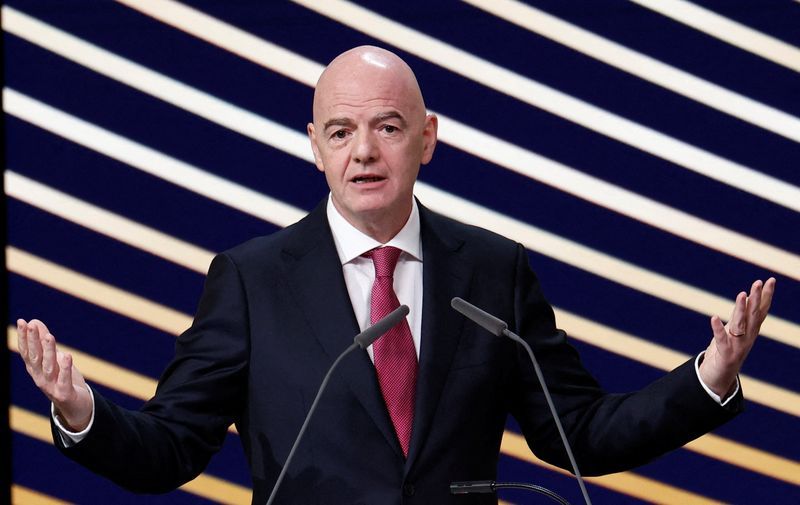
Gianni Infantino's grip on the FIFA presidency is weakening considerably following widespread rejection of his controversial proposal to sell a private equity stake in the World Cup to institutional investors. The backlash has been swift and severe, with national soccer federations from Serbia, Sweden and Wales publicly withdrawing support for the incumbent administrator. This erosion of backing has transformed what should have been a routine re-election campaign into a genuine competitive race, with the electoral battle set to conclude at a vote in Morocco on March 18 that will determine FIFA's leadership through 2031.
The scale of the resistance to Infantino's privatization scheme has caught many observers by surprise, revealing deep fractures within the global football establishment over the future direction of the sport's commercial interests. What began as a proposal for financial restructuring has morphed into a broader referendum on Infantino's leadership style and decision-making processes. National federations that previously supported him have calculated that the reputational risks of endorsing such a dramatic shift in World Cup governance outweigh the loyalty they once felt toward the incumbent.
Victor Montagliani, the Canadian businessman who serves as president of CONCACAF, the North American and Caribbean confederation, represents perhaps the most natural challenger to emerge from within the established FIFA hierarchy. Montagliani has begun seriously contemplating a presidential bid that would position him as a bridge candidate capable of uniting different regional interests. Though CONCACAF ultimately rejected Infantino's private equity proposal, the confederation stopped short of the complete condemnation issued by UEFA, suggesting that Montagliani might retain flexibility to negotiate with multiple factions. The incoming hosting of the 2026 World Cup in North America gives the region considerable leverage in FIFA politics, and Montagliani's stewardship of that tournament could provide a powerful platform for his candidacy.
European football leaders have crystallized around alternative visions for FIFA's future, with Aleksander Ceferin, the Slovenian president of UEFA, emerging as a particularly vocal critic. Ceferin's decision to boycott the World Cup final last month signaled the depth of his displeasure with Infantino's governance and strategic direction. UEFA's organized resistance to both the privatization proposal and broader policy disagreements has positioned European football's governing body as the nucleus of anti-Infantino sentiment, giving Ceferin substantial credibility as a candidate capable of commanding Continental support while potentially attracting backing from other regions frustrated with the current administration.
From the Asian Football Confederation, Sheikh Salman bin Ibrahim Al Khalifa of Bahrain has positioned himself as an alternative voice, having previously opposed several of Infantino's signature initiatives including the expansion of the World Cup to 64 teams. As a senior vice president on the FIFA Council, Salman carries institutional weight and legitimacy. The AFC's formal critique of Infantino's private equity proposal specifically attacked the president's consultation methodology, suggesting that Salman represents a constituency demanding more inclusive and transparent decision-making processes at FIFA headquarters. This appeal to procedural reform could resonate broadly among federations exhausted by what they perceive as top-down governance under Infantino.
Nasser Al-Khelaifi, the influential Qatari sports executive who leads Paris Saint-Germain, has emerged as perhaps the most intriguing alternative candidate from a geopolitical perspective. European football officials, according to recent reporting, have begun actively exploring Al-Khelaifi as a potential unifying candidate capable of bridging traditional divisions within FIFA's power structure. His combination of substantial wealth, proven sports management experience, and connections spanning multiple continents positions him as someone who could potentially broker compromises between competing regional interests. However, Al-Khelaifi's appointment would also represent a significant shift in the geography of FIFA's power base, with implications that extend far beyond football administration into broader questions of influence and regional standing.
Lise Klaveness, the Norwegian football federation president, represents a distinctly different approach to challenging Infantino. As one of global football's most prominent female leaders, Klaveness has emerged as perhaps the most vocal and principled opponent of the World Cup privatization scheme. Beyond her position on commercial issues, Klaveness has demonstrated a willingness to challenge FIFA on governance questions, including Norway's consideration of ethics complaints regarding Infantino's handling of disciplinary decisions. Her potential candidacy signals that opposition to Infantino transcends purely organizational politics and extends to fundamental questions about FIFA's ethical standards and commitment to transparent administration.
The constellation of five potential challengers reflects the diverse nature of opposition to Infantino's leadership. Rather than a single unified alternative, the field appears to be fragmenting into regional representatives with distinct bases of support. For Malaysian and Southeast Asian observers, the outcome carries genuine significance, as the AFC's influence on FIFA policy directly affects the Asian region's prospects for hosting major tournaments and securing favorable scheduling and revenue arrangements. The previous AFC president's opposition to World Cup expansion suggests that regional federation leaders retain considerable autonomy in FIFA politics despite the president's formal authority.
Infantino's miscalculation regarding the private equity proposal appears to have underestimated the deep attachment that national federations maintain to the World Cup's cultural and institutional significance. The tournament's commercial value has become inseparable from questions of sovereignty and democratic governance within the football world. By attempting to fundamentally restructure World Cup ownership without achieving genuine consensus, Infantino triggered a cascading series of defections that now threaten his political viability even among confederations that had previously accommodated his ambitious agenda.
The March 18 vote in Morocco will represent a watershed moment for FIFA's institutional direction. A Infantino defeat would signal that even an incumbent with substantial administrative power cannot simply override the preferences of national federations when they coalesce around shared concerns about governance process and commercial control. The emergence of multiple credible challengers suggests that the 2027-2031 presidency will be genuinely contested, potentially ushering in a more collegial approach to FIFA leadership compared to Infantino's more centralized model. Southeast Asian federations will watch closely to determine which candidate demonstrates the strongest commitment to equitable regional representation in FIFA's future governance structures.

