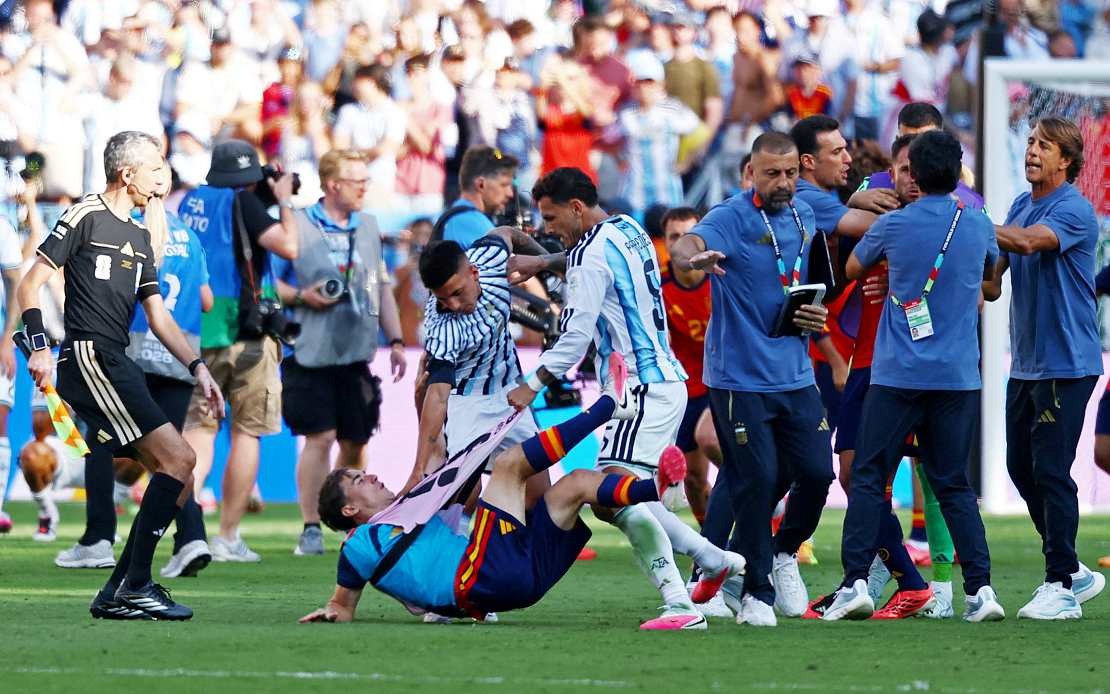
FIFA has opened a formal investigation into Argentina's conduct during and after the World Cup final against Spain, marking the latest chapter in a tournament marked by mounting scrutiny over the South American team's disciplinary record. The world football governing body confirmed on July 21 that it has appointed a Disciplinary and Ethics Prosecutor to examine potential violations of the FIFA disciplinary code arising from incidents that occurred in New Jersey following the final whistle. The probe underscores growing international concern about how the tournament's most visible matches are policed and whether consistency is being applied across different nations and situations.
The investigation centres on a dramatic post-match confrontation in which Argentina midfielder Leandro Paredes appeared to throw punches at Spain players as they celebrated their victory on the pitch. Eyewitness accounts and broadcast footage captured the altercation, prompting the match commissioner to file a detailed report that eventually reached FIFA's review desk. The alleged physical contact during this celebratory phase of the match has triggered the formal inquiry process, as FIFA seeks to determine whether specific articles of its disciplinary code were violated and whether sanctions are warranted.
Argentina's conduct throughout the tournament had already drawn criticism from multiple quarters. During their semi-final triumph over England, the team attracted negative attention for an overtly physical approach to play, with midfielder Enzo Fernandez receiving a red card for accumulating two bookable offences. This pattern of aggressive play, combined with the alleged post-match incident against Spain, has painted a picture of a team operating at the boundaries—and possibly beyond—acceptable competitive standards. For Malaysian and regional observers, the case highlights how premier international competitions navigate the line between permitted intensity and disciplinary misconduct.
A separate but equally contentious issue complicates the disciplinary landscape. Following Argentina's victory over England, Argentine players displayed a banner claiming sovereignty over the Falkland Islands, a British Overseas Territory. This political gesture potentially breached Article 34.3 of the tournament regulations, which typically restrict nationalist and political messaging at official events. FIFA has not yet clarified whether its investigation encompasses this specific incident or focuses exclusively on the post-match physical altercation involving Paredes.
The Falkland Islands banner incident carries particular weight given FIFA's established precedent on the matter. The Argentine Football Association (AFA) was previously fined following a 2014 friendly against Slovenia for a similar political expression. However, the governing body's enforcement record suggests inconsistency. When UEFA addressed comparable nationalist conduct during Euro 2024, it imposed one-match bans on Spain players Rodri and Alvaro Morata for chanting about Spain's territorial claims to Gibraltar. This disparity in punishment raises questions about whether FIFA applies uniform standards or whether factors such as geopolitical context and regional sensitivities influence outcomes.
FIFA's approach to political and symbolic gestures has long been contentious. At the 2022 World Cup in Qatar, the English Football Association received explicit warning that captain Harry Kane would face sporting sanctions, beginning with a yellow card, if he wore the 'OneLove' rainbow-coloured armband in protest against the host nation's criminalisation of homosexuality. That decision, widely perceived as prioritising diplomatic relations with Qatar over human rights advocacy, illustrated FIFA's reluctance to permit players to use the global stage for causes beyond sport—yet the restriction appeared less stringently applied to nationalist messaging.
The appointment of a dedicated prosecutor represents FIFA's standard procedure for complex cases requiring detailed examination before the Disciplinary Committee reaches a verdict. This process typically involves gathering additional evidence, reviewing video footage, obtaining written submissions from relevant parties, and allowing the accused federation an opportunity to respond. For Argentina and the AFA, the investigation could culminate in financial penalties, match bans for specific players, or both, depending on the prosecutor's findings and the Committee's judgment.
From a Southeast Asian perspective, this disciplinary process underscores the challenges facing international sports governance when political sensitivities intersect with sporting conduct. The region has witnessed comparable tensions in football and other sports, where national pride and territorial disputes occasionally surface during high-stakes competitions. The FIFA investigation demonstrates how governing bodies attempt to maintain competitive integrity while navigating geopolitical complexities—a balancing act with no universally accepted solution.
The broader implications extend beyond Argentina's immediate situation. The investigation signals that FIFA intends to scrutinise the conduct of all teams, particularly those with histories of aggressive play or provocative behaviour. For national associations across Asia, Africa, and the Americas, the message is clear: post-match incidents and nationalist gestures will not escape formal review, even when involving major football powers. However, critics will likely continue questioning whether such enforcement mechanisms operate with genuine consistency or reflect underlying biases.
FIFA's statement confirmed that further details would be released once the Disciplinary and Ethics Prosecutor completes their investigation and submits findings to the Disciplinary Committee. The timeline for this process remains unspecified, though such inquiries typically conclude within weeks rather than months. In the interim, the investigation remains active, with the governing body continuing to assess match reports and gather relevant documentation.
The case also reflects evolving expectations around player conduct in the modern era. With matches broadcast globally and social media amplifying every incident, football authorities face intensified pressure to respond decisively to breaches, real or perceived. For players and teams, this heightened scrutiny means that actions during the final moments of matches—when emotions run highest and composure is most fragile—can carry serious competitive and financial consequences extending far beyond the immediate contest.

