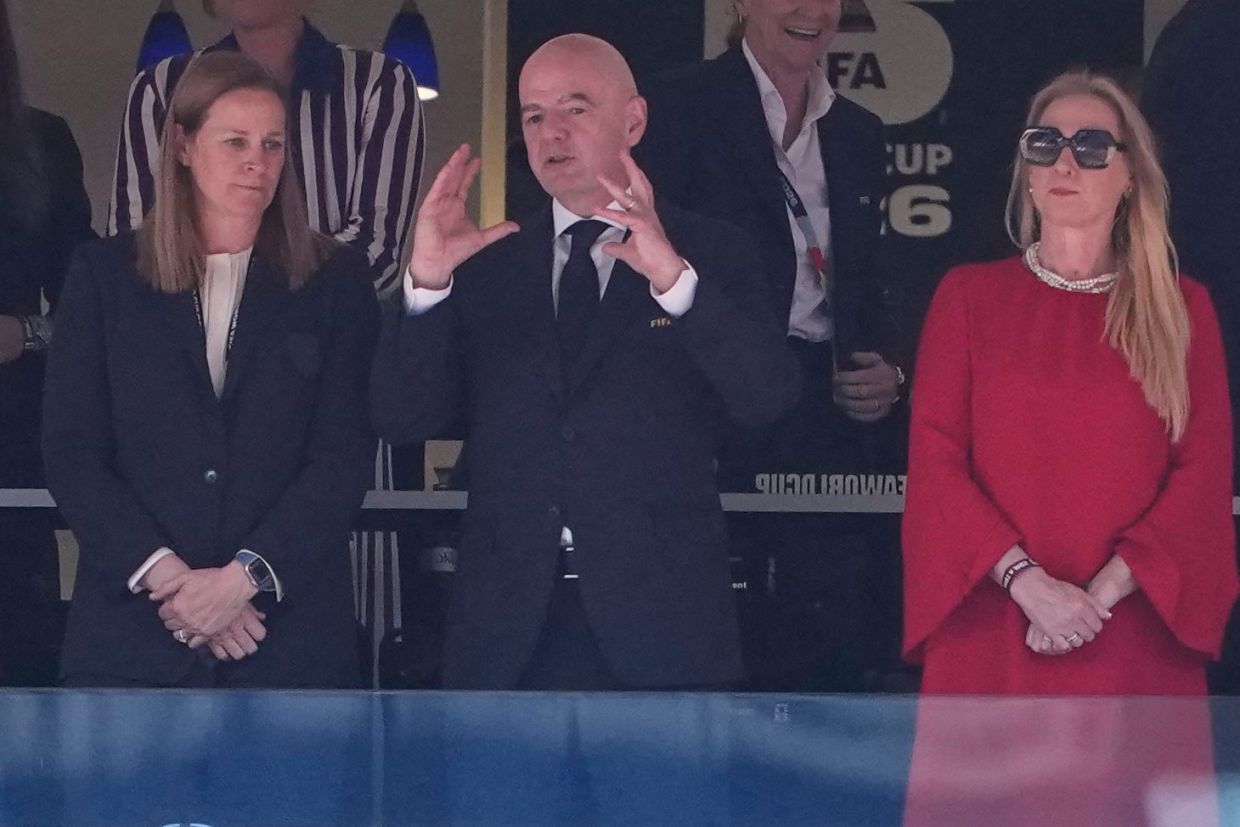
The 2026 FIFA World Cup has proven remarkably contentious, yet the organization appears positioned to emerge financially stronger than ever. From disputed refereeing decisions to concerns about ticket pricing and diplomatic tensions, the tournament has faced criticism on multiple fronts. Yet amid these controversies, FIFA chief Gianni Infantino has maintained a steady course focused on revenue generation, demonstrating that the sport's governing body has become increasingly insulated from the reputational damage that might cripple other organizations.
The flashpoint that crystallized these tensions involved American footballer Folarin Balogun being permitted to play following a contentious red card decision, reportedly after direct intervention from President Donald Trump. The incident prompted fierce backlash from footballing figures and political leaders across Europe, who viewed the decision as a fundamental breach of sporting integrity. Jurgen Klopp, the former Liverpool manager, characterized the situation as evidence that FIFA had surrendered control of the sport to external political forces. "If Donald Trump and Gianni Infantino really sorted this out between themselves, it is madness," Klopp stated, his criticism reflecting broader anxieties that the organization had compromised its regulatory authority for political convenience.
Yet the intensity of such complaints appears destined to fade once the tournament concludes, particularly when host nations and commercial partners stand to benefit substantially from FIFA's expanded World Cup model. The organization is projecting approximately $9 billion in direct revenue from the 2026 tournament, roughly $2 billion beyond what the 2022 Qatar edition generated. This financial trajectory underscores a strategic calculation that has defined Infantino's tenure: the organization can tolerate reputational challenges so long as revenue streams remain robust and member nations remain financially satisfied.
The expanded tournament format, which has increased team participation from 32 to 48 squads, has fundamentally transformed the economics of international football. The prize pool has doubled to a record $871 million, with every participating nation guaranteed a minimum $12.5 million simply for participation. For smaller football federations, particularly those from Africa and the Caribbean, FIFA's financial distribution has become essential to their operational budgets. Cape Verde, for instance, earned over $21 million from its unprecedented tournament run—approximately 0.75 percent of the nation's entire GDP. This financial dependency creates a structural incentive for member associations to support Infantino's leadership, regardless of governance controversies.
The commercial ecosystem surrounding the tournament extends far beyond FIFA's direct revenue. Stadium concessionaires have capitalized on captive audiences, with some venues recording per-person spending approaching $100—nearly double typical NFL match expenditures. Advertisers have benefited from mandated hydration breaks that effectively restructure the competition's rhythm into an American-style four-quarter format, maximizing commercial opportunities. Host cities, despite pre-tournament anxieties about infrastructure costs, have experienced measurable economic gains, with Bank of America data showing credit and debit card spending in World Cup host cities up 6.3 percent year-on-year during the tournament period, and non-local visitor spending surging 16.7 percent.
Infantino's consolidation of power reflects a broader transformation of FIFA since his 2015 appointment following his predecessor Sepp Blatter's resignation amid corruption scandals. Where FIFA had been synonymous with institutional corruption just over a decade ago, Infantino has implemented marginal transparency improvements while simultaneously expanding the scale and profitability of FIFA tournaments. The organization has traded traditional governance stability for a more commercially aggressive posture, accepting reputational volatility in exchange for revenue maximization and political flexibility. This calculation appears to be yielding dividends among the membership that ultimately determines FIFA's direction.
Infantino's path to re-election in early 2027 appears unobstructed, as he is running unopposed at the 77th FIFA Congress scheduled for Rabat, Morocco. The venue itself—a nation that will co-host the 2026 World Cup—symbolizes how FIFA has intertwined its electoral processes with commercial interests. With 211 member associations each possessing one vote, and federations from Asia, South Africa, and Africa having already pledged support, Infantino's re-election constitutes a procedural formality. This third term will extend his tenure well beyond Blatter's, consolidating a leadership model centered on expansion, revenue generation, and political pragmatism rather than traditional governance principles.
For the broader football community, the tournament has delivered genuine sporting achievements that complicate simple narratives about FIFA's failings. Nine African nations reached the knockout stage, representing unprecedented continental representation. Stadiums have remained full despite ticket pricing concerns, and elite athletes have delivered compelling performances. The hospitality standards in host nations have favorably contrasted with the previous World Cups in Russia and Qatar. These genuine successes provide FIFA and its leadership with legitimate grounds to characterize the tournament as fundamentally successful, rendering integrity concerns peripheral to broader assessments of tournament quality.
The political response to FIFA's decision-making has been notably divided along geographic lines. European leaders, particularly from the United Kingdom and Belgium, have called for Infantino's resignation, viewing his apparent responsiveness to Trump as a capitulation to external pressure that fundamentally threatens the sport's independence. However, federation leaders from Asia, Africa, and the Middle East have remained steadfast in their support. Sheikh Salman, president of the Asian Football Confederation, declared FIFA to be "in its best position ever," while the Royal Moroccan Football Federation praised Infantino's contributions to African football development. This divergence reflects how FIFA's financial expansion disproportionately benefits smaller federations that lack alternative funding sources, creating alignments that transcend traditional governance concerns.
The structural durability of Infantino's position derives partly from FIFA's transformation into an organization where financial distribution mechanisms have become intertwined with political loyalty. Unlike traditional institutional hierarchies where governance failures trigger accountability mechanisms, FIFA's member-based structure means that organizations benefiting from expanded prize pools and participation opportunities possess incentives to overlook controversial leadership decisions. The organization has effectively monetized its regulatory authority, allowing commercial and political considerations to supersede traditional sporting principles without triggering the institutional collapse that such compromises might provoke elsewhere.
Looking forward, the question of whether FIFA's apparent governance vulnerabilities will eventually trigger meaningful reform remains unresolved. For now, Infantino has successfully demonstrated that revenue generation, coupled with strategic financial distribution to member nations, can provide sufficient political insulation to withstand reputational challenges that would ordinarily undermine organizational legitimacy. The 2026 World Cup appears destined to be remembered as both a commercially triumphant and a governance-compromised event, with FIFA's leadership having calculated that financial success ultimately matters more to the sport's stakeholders than the integrity concerns that animated international criticism.

