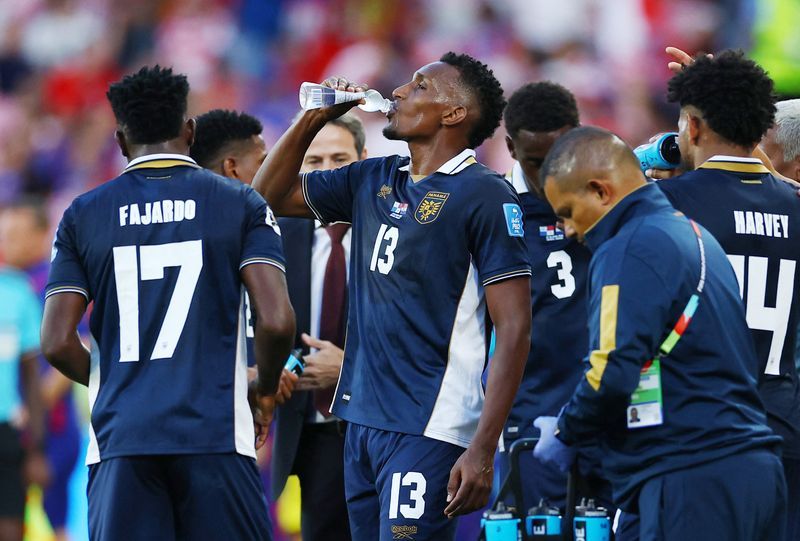
FIFA President Gianni Infantino has moved to quell growing controversy surrounding the mandatory hydration breaks now being implemented at the World Cup, asserting that the measure stems entirely from concerns about player welfare and fairness rather than any desire to generate additional revenue for football's governing body. The introduction of these stoppages, occurring at fixed intervals during every match, has provoked considerable pushback from coaches, players, and fans who worry about their impact on the sport's fundamental character and flow.
The three-minute breaks, positioned at the 22nd and 67th minutes of each match across the tournament hosted in North America, represent a significant departure from traditional football protocol. While Infantino emphasises that FIFA receives no additional financial compensation from these interruptions since all broadcast agreements were negotiated months before the innovation took effect, the reality remains that broadcasters have seized upon these windows to insert advertising. This contradiction between FIFA's stated intentions and the practical commercial outcomes has fuelled scepticism among observers, particularly those concerned about the creeping commercialisation of the beautiful game.
The structural impact of these breaks cannot be understated. Beyond merely allowing players to hydrate and recover during intense physical exertion, the stoppages fundamentally transform how matches unfold tactically. Coaching staffs now possess designated moments to deliver fresh instructions, adjust formations, and implement strategic pivots without the traditional constraints that have long defined football's competitive landscape. For tactical purists and traditional enthusiasts, this represents an unwelcome deviation that compromises the spontaneity and unpredictability that have always characterized elite-level football.
Several prominent managers have articulated this concern with considerable force. Thomas Tuchel, the England manager, characterised the breaks as interrupting and altering the essential identity of football matches themselves. Marcelo Bielsa, Uruguay's coach, went further, arguing that fragmenting matches into smaller segments fundamentally strips away the sport's defining characteristic—the continuous ebb and flow of play that develops organically over ninety minutes. These perspectives reflect a broader philosophical concern that FIFA's innovation threatens to rewrite the sport's foundational rules in ways that cannot easily be reversed.
However, not all elite voices dismiss the measure entirely. Some coaches and captains, including Spain's Luis de la Fuente and Netherlands defender Virgil van Dijk, acknowledge the legitimate sporting rationale underpinning the breaks, particularly in regions experiencing extreme heat. Their objections are more nuanced, focusing instead on the indiscriminate application of the rule across all venues and conditions, irrespective of actual temperature variations or whether matches occur in climate-controlled environments. This perspective suggests that context-specific implementation might have proved more defensible than universal application.
Infantino's core justification rests on two interconnected arguments regarding player welfare and competitive equity. The FIFA president emphasised that the World Cup's compressed 39-day schedule, which can require participating teams to play up to eight matches within that window, creates exceptional physical demands that justify additional rest opportunities. This reality distinguishes the World Cup from domestic league play, where matches are typically spaced several days apart, allowing natural recovery periods between fixtures.
The equity argument carries particular weight in a tournament context. Infantino contends that without standardised breaks across all matches, teams competing in hotter conditions would gain tactical advantages through additional stoppage time, while those playing in cooler venues would be denied equivalent opportunities. By mandating identical breaks regardless of environmental conditions, FIFA ensures that no team can claim it received preferential treatment based on meteorological circumstance. This logic, while abstractly sound, assumes that heat's actual physiological impact on players is irrelevant—a proposition many sports scientists might challenge.
Regarding concerns about match intensity and entertainment value, Infantino argued that the breaks have not visibly diminished the competitive quality of matches, suggesting that players maintain high performance levels throughout games despite the interruptions. This assertion requires empirical verification; preliminary observations from the tournament suggest the contrary for many observers, who report noticeably reduced pace and intensity following stoppages as players reset mentally and physically after unexpected disruptions to rhythm.
For Southeast Asian football enthusiasts and stakeholders, these developments carry broader implications. As tropical climates characterise much of the region, climate-related rule modifications could eventually influence how regional tournaments and domestic competitions operate. Malaysia and neighbouring countries increasingly host major football events; FIFA's World Cup precedent regarding heat-related interventions may establish templates that governing bodies could adopt at ASEAN Football Federation or AFC tournaments. The question becomes whether climate adaptation should drive permanent tactical modifications or whether alternative solutions—improved stadiums, match scheduling, enhanced medical support—might address physical demands without fundamentally restructuring the sport.
The underlying tension in this debate reflects a fundamental question about football's future direction. Should the sport adapt its traditional structures to accommodate external pressures, or should it find creative ways to manage those pressures while preserving established conventions? FIFA's approach suggests the former; critics worry this opens a door to progressively greater modifications justified by increasingly marginal concerns. As football continues internationalising and expanding into diverse climates and venues, these questions will recur with greater frequency and urgency.

