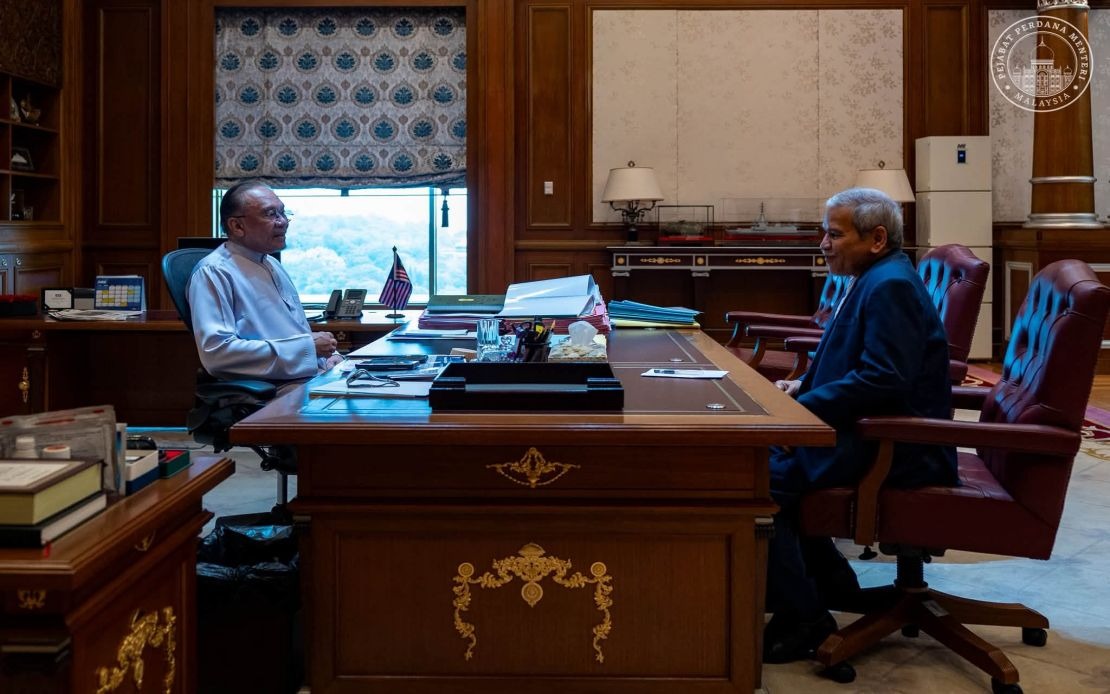
Prime Minister Datuk Seri Anwar Ibrahim has underscored the critical importance of maintaining institutional momentum at the Federal Land Development Authority, emphasizing that the organization's ability to deliver meaningful improvement in settlers' lives depends on continuous organizational strengthening and strategic renewal. Speaking following a meeting with newly appointed FELDA chairman Tan Sri Ahmad Badri Mohd Zahir in Putrajaya, Anwar articulated a comprehensive vision that extends beyond immediate welfare concerns to encompass broader questions of long-term economic viability and generational relevance.
The Prime Minister, who concurrently holds the Finance Ministry portfolio, framed FELDA's institutional development as inseparable from the welfare aspirations of settler communities across the country. His remarks suggest an administration acutely aware that FELDA's historical significance as a social engineering institution carries contemporary policy weight, particularly given the political constituency it represents and the socioeconomic vulnerabilities of settler populations who have long depended on the authority's support structures and market access arrangements.
Anwar's emphasis on balancing settler welfare with institutional competitiveness reflects recognition that FELDA operates within a rapidly evolving economic landscape where traditional plantation-based models face intensifying pressures from commodity market volatility, climate-related production challenges, and shifting global demand patterns. The dual mandate he articulated—supporting immediate welfare needs while simultaneously positioning FELDA for sustainable economic performance—acknowledges tensions inherent in rural development institutions attempting to serve developmental and commercial objectives simultaneously.
The particular attention Anwar devoted to younger-generation settlers signals awareness of demographic and intergenerational complications within FELDA communities. Succession planning, youth engagement in agricultural activities, and the provision of economic opportunities beyond traditional smallholder farming represent mounting challenges as younger settlers increasingly seek alternatives to inherited plots or gravitate toward urban economic opportunities. These dynamics have periodically prompted social tensions and political volatility within settler communities, making youth-focused policy a strategically important dimension of FELDA governance.
Ahmad Badri's appointment as FELDA chairman, effective July 15, represents a transition in institutional leadership following the conclusion of Datuk Seri Ahmad Shabery Cheek's tenure on June 30. The timing and nature of leadership changes at FELDA historically carry significance within Malaysian political discourse, given the organization's traditional alignment with Bumiputera policy frameworks and its constituency base among Malay-Muslim rural populations. Ahmad Badri's appointment suggests continuity in institutional priorities while potentially signaling adjustments in operational approaches under the MADANI Government.
Anwar's public affirmation of confidence in Ahmad Badri's capacity to advance FELDA's restoration and strengthening agenda serves multiple communicative functions. It signals to settler communities governmental commitment to institutional renewal, conveys to financial and development stakeholders that FELDA remains a policy priority, and establishes performance expectations for the incoming chairman within a defined strategic framework emphasizing both welfare delivery and economic competitiveness.
The government's pledge to provide continued institutional support carries implications for resource allocation and policy prioritization within broader national development frameworks. FELDA's resource requirements—encompassing infrastructure maintenance, agricultural extension services, commodity price stabilization mechanisms, and debt servicing—compete with other rural and agricultural priorities within national budgets. Anwar's public commitment suggests sustained budgetary attention, though the specific modalities and funding levels remain subject to broader fiscal constraints and economic conditions.
FELDA's contemporary policy significance extends beyond its immediate settler communities to encompass broader questions regarding Malaysia's agricultural productivity, food security, rural economic development, and the integration of smallholder farmers into modernized supply chains. The authority's approximately 112,000 settler families constitute a substantial rural constituency whose economic circumstances carry implications for rural migration patterns, urban unemployment pressures, and social stability in regions with significant FELDA concentrations.
Institutional strengthening at FELDA entails multiple interconnected dimensions. Operational efficiency improvements, technological adoption in agricultural production, supply chain modernization, market access enhancement, and financial management improvements all contribute to institutional capacity building. Simultaneously, strengthening encompasses governance improvements, accountability mechanisms, stakeholder engagement, and responsiveness to settler preferences—dimensions sometimes in tension with efficiency imperatives.
The framing of FELDA's future within MADANI Government priorities positions the institution within broader governance narratives emphasizing institutional effectiveness, stakeholder-centered service delivery, and sustainable development. This contextual positioning influences resource mobilization possibilities, inter-agency coordination opportunities, and the political capital available for pursuing institutional reforms that may generate short-term adjustment costs despite long-term benefits.
For Malaysian readers and regional observers, FELDA's trajectory carries implications extending beyond agricultural economics. The institution represents an approach to rural development and Bumiputera empowerment that has evolved significantly since its establishment, yet continues generating political attention and resource commitments from successive governments. How effectively FELDA navigates contemporary economic challenges while sustaining settler welfare will provide instructive lessons regarding rural development institution governance in Southeast Asia's middle-income transition contexts, where balancing immediate welfare delivery with long-term economic transformation remains persistently challenging.

