The government has moved to clarify widespread confusion about the Federal Territory Muslim Cemetery Development Project in Hulu Semenyih, Selangor, emphasising that strategic planning for the initiative stretches back nearly two decades. Minister in the Prime Minister's Department (Federal Territories) Hannah Yeoh issued the statement on Facebook following viral social media misinformation, underscoring the long-standing nature of this infrastructure undertaking and its critical importance to Kuala Lumpur's Muslim population.
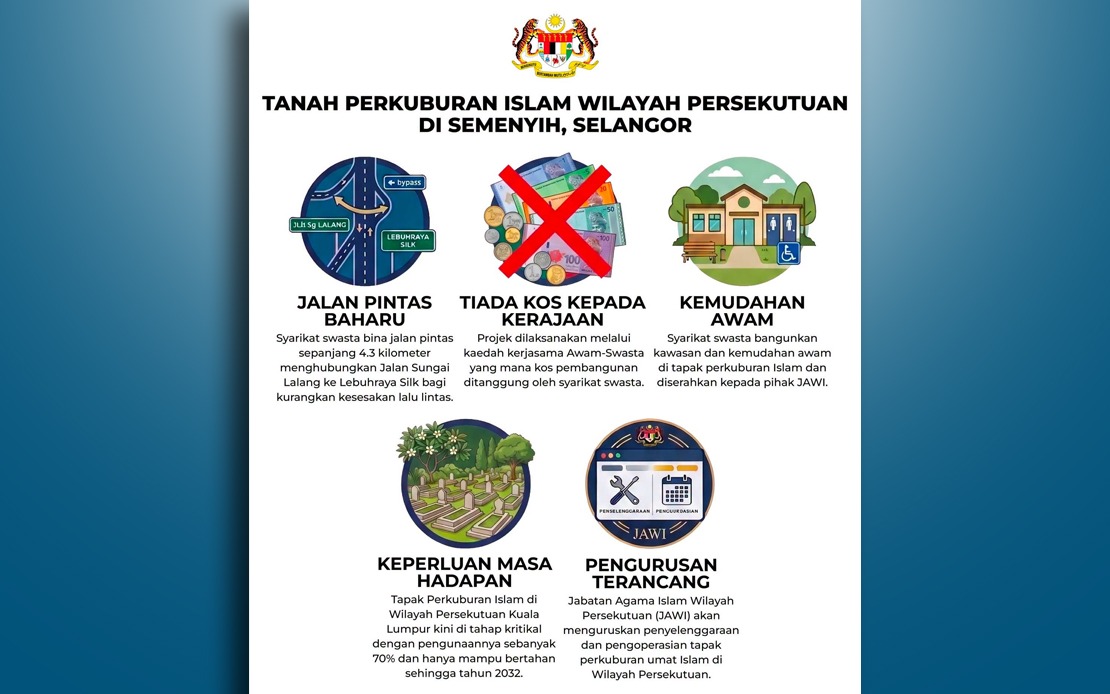
The project addresses a pressing shortage of Islamic burial grounds within Kuala Lumpur, a challenge that has intensified as the capital's population continues to expand. Existing cemeteries in the Federal Territory of Kuala Lumpur have already exceeded 70 per cent capacity utilisation, leaving the community facing an increasingly acute shortfall. As of June 2023, approximately 29 per cent of burial plots—representing 34,496 available spaces—remained across existing facilities, a reserve expected to meet demand only until approximately 2032, creating a window of just nine years before a major crisis emerges.
Yeoh stressed that the urgency of the situation cannot be overstated. The rapid depletion of available burial sites poses serious welfare concerns for Muslim residents and their families, who face mounting difficulties in arranging dignified burials within their faith tradition. Without intervention, the Federal Territory would confront a humanitarian challenge requiring immediate, costly remedial action. The long germination period—from 2005 to implementation—reflects both the complexity of large-scale infrastructure projects and the gradual recognition of the crisis's severity.
The development will unfold across a 332.6-acre site owned by the Federal Lands Commissioner, structured through a public-private partnership arrangement. This financing model allows the government to leverage private sector resources and expertise without bearing the full capital burden. The private developer will fund all infrastructure requirements, including staff residential facilities, a prayer room (surau), administrative headquarters, cafeteria services, sanitary facilities, a guardhouse, and comprehensive earthworks necessary to develop 104,470 Muslim burial plots dedicated to Federal Territory residents.
Crucially, governance arrangements preserve public control over the sacred facility. While the developer bears construction costs, the Federal Lands Commissioner retains ownership of the land itself. Operational management, administration, and day-to-day oversight remain exclusively within the purview of the Federal Territories Islamic Religious Department (JAWI), with no private company involvement in these sensitive functions. This arrangement balances fiscal efficiency with communal stewardship, ensuring religious and cultural sensitivities receive appropriate consideration.
The project encompasses infrastructure extending beyond the cemetery itself. A 4.3-kilometre link road connecting Jalan Sungai Lalang to the SILK Highway forms an integral component, designed to ameliorate traffic congestion that currently burdens the Semenyih area. The road development, financed entirely by the developer as a condition imposed by Selangor's state government, represents a RM93.89 million investment that will benefit local residents regardless of cemetery usage. Yeoh emphasised that taxpayer funds bear no portion of these construction expenses, with the developer absorbing all costs as part of contractual obligations.
The project has traversed multiple approval layers, demonstrating governmental rigour in assessment. Technical evaluations, a Value Management Lab review, and approvals from both Selangor state authorities and federal agencies have examined the proposal from various angles. These gatekeeping mechanisms aim to ensure public interest protection and establish that the facility meets established standards for safety, environmental impact, and social utility.
The initiative carries particular significance for southeast Malaysian governance and resource planning. Selangor and Kuala Lumpur exemplify rapid urbanisation challenges across the region, where basic infrastructure struggles to match population growth trajectories. The cemetery project illustrates how governments can address fundamental communal needs through innovative financing while preserving democratic oversight. For Malaysian policymakers across other states confronting similar burial land pressures, the Hulu Semenyih model offers a replicable template combining private capital with public stewardship.
Beyond Federal Territory residents, the cemetery will serve surrounding Selangor communities, with 10 per cent of total capacity—approximately 10,447 plots—allocated to burial of residents from neighbouring areas. This regional dimension recognises that Hulu Semenyih's location makes it a natural service hub for a broader population, encouraging cross-jurisdictional cooperation rather than zero-sum territorial competition. Such arrangements increasingly characterise modern governance in Malaysia's densely populated Klang Valley and Greater Kuala Lumpur regions.
Yeoh's emphasis on the project's historical provenance reflects sensitivity to accusations of sudden imposition. By demonstrating continuous planning since 2005, government communications position the cemetery as a deliberate, long-considered response to documented community needs rather than an impulsive decision. This rhetorical strategy acknowledges the legitimate role of public discourse in infrastructure development while defending bureaucratic decision-making against populist scepticism, a tension increasingly prevalent in Malaysian political discourse.

