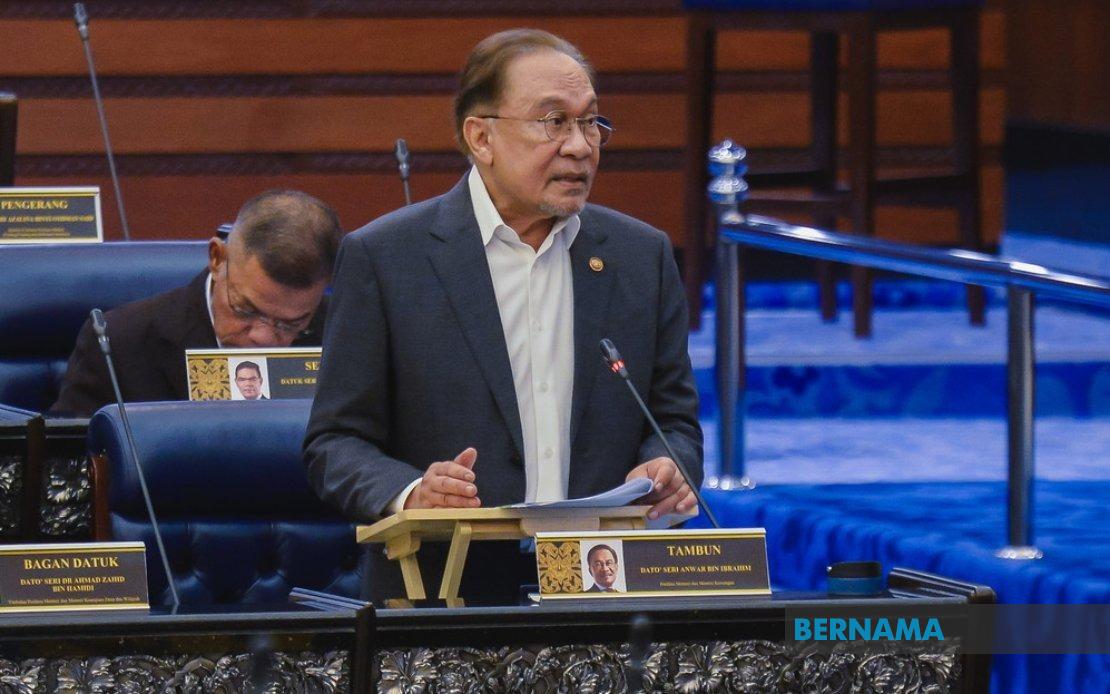
Prime Minister Datuk Seri Anwar Ibrahim has signalled a stricter approach to state requests for supplementary project funding, insisting that any claim for additional resources tied to a Notice of Change arrangement must be subject to fresh federal scrutiny and renegotiation. Speaking in Parliament during the Minister's Question Time, Anwar made clear that the federal government will not passively rubber-stamp cost increases simply because a state administration has approved them or a contractor has issued a change order.
The Prime Minister's statement was prompted by a question from Datuk Awang Hashim, the Pendang representative from Perikatan Nasional, regarding Kedah's pursuit of extra funding for the Pulau Bunting Water Treatment Plant project. That infrastructure development faces cost pressures that would require formal acknowledgement through an NOC—a legal instrument that formally documents modifications to a project's scope, timeline, or financial requirements. Anwar's response illustrated growing federal concern about the cascading costs of state-backed infrastructure initiatives and the potential fiscal exposure to Putrajaya.
Central to Anwar's position is the principle that a Notice of Change carries substantial financial consequences that demand careful reassessment rather than routine approval. When a contractor issues an NOC, it typically signals that unforeseen circumstances—whether material price inflation, design complications, supply chain disruptions, or site conditions—have pushed the project beyond its original budget. The federal government, Anwar emphasized, cannot simply absorb these incremental costs whenever states encounter difficulty. Instead, officials must drill down into the underlying reasons for the cost pressure and determine responsibility for the overrun.
A crucial part of that investigation involves establishing whether the contractor itself bears culpability for the budget blowout. Contractors sometimes encounter genuine external shocks beyond their control; in other cases, poor project management, inadequate planning, or contractual disputes drive costs upward. By requiring renegotiation, the federal government positions itself to distinguish between legitimate, unavoidable cost pressures and avoidable expenses stemming from contractor negligence or mismanagement. This distinction matters enormously for fiscal discipline and for setting the right incentives within the construction and development sector.
Anwar's framework also reflects a broader constitutional and administrative principle: the federal government cannot be held hostage to autonomous state decisions. While Malaysia's federal system grants states substantial authority over certain services and development matters, that autonomy cannot extend to unilateral claims on federal coffers. Once additional funding becomes necessary, the matter necessarily enters the federal domain because federal resources—whether from the national budget or through borrowing—must be committed. The Prime Minister was articulate on this point, underscoring that automatic approval of state funding requests would undermine fiscal governance and create perverse incentives for states to approve ambitious projects without rigorous cost discipline.
The practical implication is that states seeking additional funds must be prepared for scrutiny, justification, and potentially lengthy negotiations. This requirement could slow project timelines, as Kedah's water infrastructure initiative might experience delays while federal agencies examine the Pulau Bunting project's cost explosion. However, from the federal perspective, such delays are preferable to a system in which states could generate cost overruns with confidence that Kuala Lumpur would eventually foot the bill. The approach signals that states bear responsibility for contractor selection, project oversight, and initial budget discipline, even if federal support becomes necessary later.
For state governments across Malaysia, Anwar's remarks carry significant policy weight. Chief ministers and state financial officers must now anticipate that cost escalation requests will trigger detailed federal examination rather than expedited approval. This reality incentivizes states to invest in stronger project management capacity, more conservative initial budgeting, and tighter contractor supervision. Conversely, states may become more selective about which infrastructure projects they authorize, knowing that federal support for overruns cannot be assumed. Over time, this approach could improve the quality of state-level project planning and reduce waste across the development portfolio.
The Kedah water project serves as a telling case study. Water infrastructure is essential for public health and economic development, particularly in states where supply reliability remains inconsistent. Yet the Pulau Bunting facility's cost pressures illustrate how even vital projects can spiral in expense without firm management. Whether Kedah's overrun stems from contractor underperformance, unforeseen geological conditions, supply chain shocks, or other factors will become apparent during renegotiation. Federal officials, likely working through the Energy Transition and Water Transformation Ministry overseen by Deputy Prime Minister Datuk Seri Fadillah Yusof, will examine these questions before committing additional resources.
Fadillah is expected to elaborate further on the federal position regarding water infrastructure financing and Kedah's specific request. As the minister responsible for water transformation—a priority domain for national development—Fadillah carries the portfolio responsibility for ensuring that water projects receive adequate support while maintaining fiscal discipline. His anticipated clarification will offer state governments and the development community more granular guidance on the criteria, process, and timeline for renegotiating NOC-related funding requests.
For the broader Southeast Asian region, Anwar's stance reflects contemporary challenges facing middle-income economies. As infrastructure ambitions grow and project complexity increases, cost management becomes critical. States across the region grapple with the tension between infrastructure ambition and fiscal constraints. Malaysia's approach—requiring federal-state renegotiation rather than automatic approval—exemplifies pragmatic governance, balancing the imperative for development against the imperative for sound money management.
The Prime Minister's comments also underscore the importance of the federal-state fiscal relationship in Malaysian governance. Anwar has previously prioritized fiscal consolidation and expenditure discipline as foundations for macroeconomic stability. His insistence that state cost overruns cannot simply become federal problems aligns with that broader philosophy. Whether through stricter NOC renegotiation processes, enhanced state-level project management, or revised cost-sharing formulas, the federal government appears intent on resetting expectations about how development costs are shared and approved across the federation.

