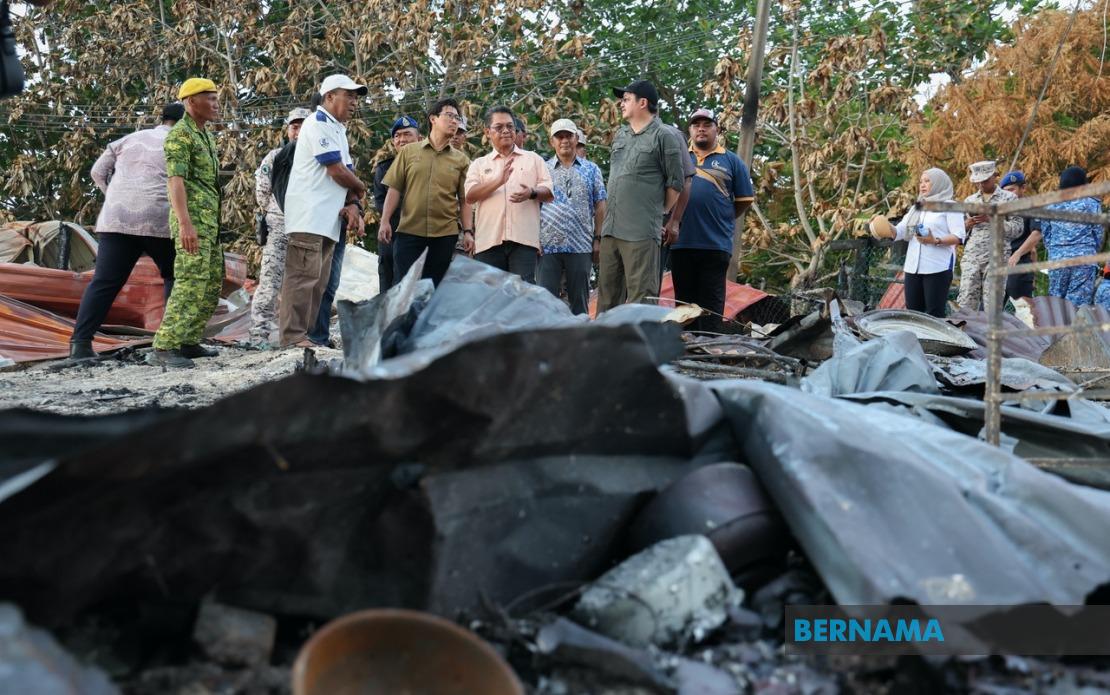
The Prime Minister's Department has swiftly deployed emergency assistance to communities reeling from a catastrophic fire on Pulau Nunuyan in Sandakan, signalling the federal government's commitment to disaster recovery in East Malaysia. Initial aid packages have been distributed to 29 household heads affected by the blaze, which erupted in the early hours of yesterday morning and razed 28 residential structures, rendering more than 100 residents homeless.
Datak Mustapha Sakmud, the Minister in the Prime Minister's Department responsible for Sabah and Sarawak affairs, led the relief efforts personally, visiting the devastated settlement alongside Sandakan Municipal Council president Datuk Walter Kenson. Beyond conventional financial assistance, the Implementation Coordination Unit of the Prime Minister's Department has demonstrated sensitivity to the vulnerable populations affected by the disaster, including providing wheelchairs for elderly residents who faced immediate challenges in evacuating or relocating. This targeted approach reflects an understanding that disasters disproportionately impact marginalised communities who often lack resources to cushion themselves against sudden crises.
The coordination framework being established represents a deliberate strategy to prevent bureaucratic fragmentation during emergency response. Rather than operating in silos, the Prime Minister's Department has charged the Sandakan Municipal Council and associated agencies with conducting a comprehensive needs assessment to ensure relief measures address the actual situation on the ground rather than relying on assumptions. This collaborative model mirrors best practices in disaster management, where horizontal coordination between federal, municipal, and specialised agencies accelerates recovery timelines and reduces duplication of effort.
A particular concern highlighted by Mustapha relates to educational continuity for affected children. The fire has damaged critical infrastructure including a jetty that serves as the primary transit route for schoolchildren travelling to and from educational institutions. By prioritising the restoration of this facility, the government acknowledges that sustained disruption to children's education can perpetuate long-term disadvantage and undermine social mobility. The emphasis on minimising educational disruption underscores recognition that disaster recovery must encompass not just immediate survival but the restoration of normal community functioning within weeks rather than months.
The medium-term challenge involves permanent relocation of displaced residents, a process complicated by land tenure issues that reflect broader questions about informal settlements in Malaysia. According to Kenson, the victims have been occupying private land involving two separate titles, a situation not uncommon in maritime communities where formal land administration struggles to keep pace with informal housing patterns. Rather than viewing this as grounds for protracted legal disputes, the Rural Development Department has committed to determining appropriate relocation options, potentially including village reserve land that could be formally allocated for this purpose.
The infrastructure upgrades being contemplated extend beyond emergency shelter provision to encompass foundational services that define liveable communities. Plans include formalisation of electricity connections, water supply systems, and maritime infrastructure such as the reconstructed jetty. These investments represent a substantial commitment to ensuring that displaced residents do not simply return to marginal conditions but gain access to services that urban and developed rural communities take for granted. For a settlement that has historically occupied an economic periphery within Sandakan's municipal boundaries, such interventions could catalyse longer-term development and integration.
The fire's context within Sandakan's geography carries implications for regional development patterns. Maritime settlements in East Malaysian towns frequently develop organically, accommodating working-class populations—fishermen, maritime labourers, and families engaged in informal economy activities—whose economic contributions to the broader community often remain invisible in formal economic statistics. These communities frequently lack political voice proportionate to their demographic weight, making government responsiveness during crises particularly significant as a test of inclusive governance.
The mobilisation of resources also reflects the politics of federal-state relations in Malaysia. Sabah, as a constituent state of the federation, has historically received variable attention from Kuala Lumpur depending on broader political calculations. By assigning a dedicated minister responsible for Sabah and Sarawak affairs and demonstrating tangible action through the Prime Minister's Department's Implementation Coordination Unit, the federal government signals that East Malaysian constituencies merit sustained institutional attention rather than crisis-driven attention followed by indifference.
The disaster exposes vulnerabilities in Malaysia's informal housing sector that extend well beyond Sandakan. Across the country, marginalised communities occupy precarious housing stock—often on temporary land tenure, in flood-prone areas, or in structures lacking formal building certifications. While formal regulatory frameworks exist requiring fire safety compliance, enforcement in informal settlements remains inconsistent. The Pulau Nunuyan incident should prompt broader reflection on whether current building codes and enforcement mechanisms adequately protect economically marginalised residents, or whether regulatory architecture inadvertently penalises informal communities through impossibly stringent compliance costs.
As recovery operations progress, the coordination between the Prime Minister's Department, local government, and development agencies will reveal whether disaster management transitions effectively into development management. The risk lies in initial enthusiasm fading once media attention dissipates, leaving displaced residents in poorly planned temporary shelters that calcify into permanent inadequacy. Sustained engagement at the federal level, evidenced by Mustapha's direct involvement and the specific commitment to infrastructure restoration, suggests greater determination to achieve genuine recovery than has characterised some previous disaster responses in Malaysia.
The pathway forward requires maintaining momentum across multiple interventions simultaneously: completing needs assessments, negotiating land arrangements with private owners, securing permanent settlement sites, mobilising development infrastructure, and establishing support mechanisms for vulnerable subgroups including elderly residents and families with young children. The speed and effectiveness with which these elements crystallise into coordinated action will determine whether Pulau Nunuyan's residents experience this tragedy as a temporary catastrophe leading to improved circumstances or as an inflection point toward permanent displacement and marginalisation.

