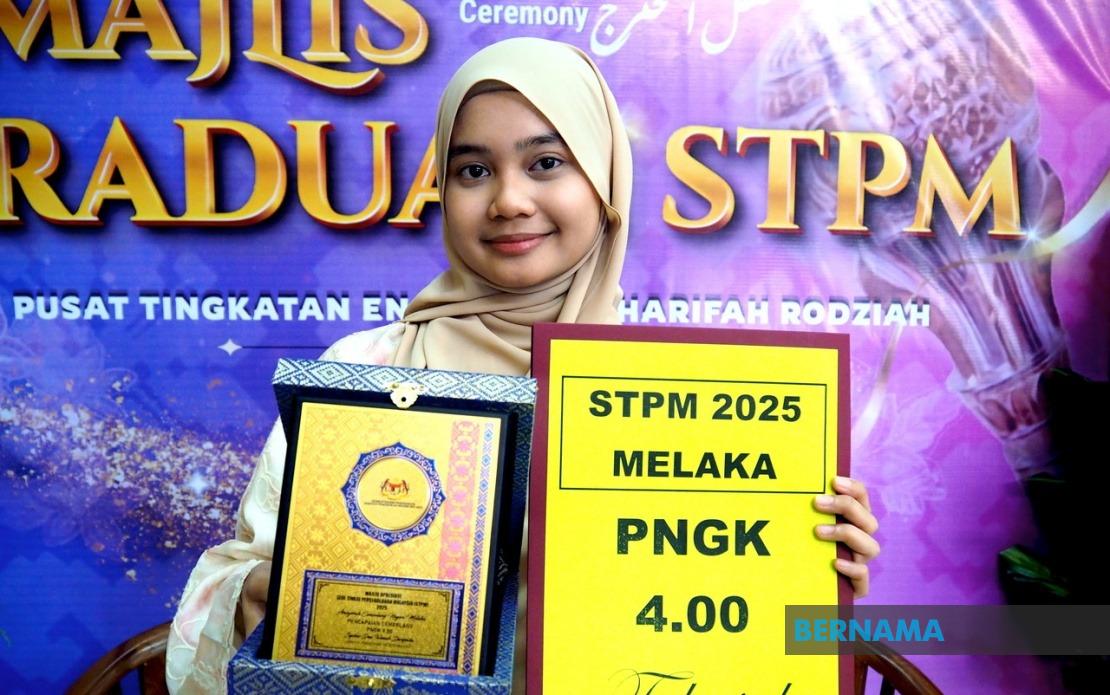
Nurfariesya Nasywa Hamedee, a 21-year-old student from Sekolah Menengah Kebangsaan Agama Sharifah Rodziah in Melaka, has secured a Cumulative Grade Point Average of 4.00 in the 2025 Sijil Tinggi Persekolahan Malaysia examination, a remarkable achievement that carries deep personal meaning. The outstanding result represents far more than academic excellence—it embodies her determination to honour a promise to her late father, Hamedee Asri, whose words of encouragement became her guiding light through years of grief and uncertainty.
The trajectory toward this success was far from straightforward. When Hamedee Asri died of a heart attack just a week before Nurfariesya's Sijil Pelajaran Malaysia trial examination, the loss threatened to derail her educational aspirations entirely. Confronted with profound grief and the practical pressures of supporting her family financially, the teenager seriously contemplated leaving school to take paid employment. That moment of crisis, however, became a turning point when her mother Yusnita Ruslan relayed her late father's parting message: a simple but powerful instruction to study diligently and never waste her potential. This advice, transmitted at the most vulnerable moment in the family's life, crystallised into an unwavering determination to pursue excellence.
What makes Nurfariesya's achievement particularly striking is her own candour about her expectations. Based on trial results and preliminary calculations, she had anticipated achieving around 3.92—a respectable score by any standard, yet falling short of the perfect mark she ultimately attained. The gap between expectation and reality underscores the degree to which her final push went beyond mere academic mechanics. Her capacity to exceed her own projections suggests a psychological resilience that extended through the examination period itself, transforming her preparation into an act of filial devotion.
The student's academic profile demonstrates a sustained commitment to excellence across her secondary schooling. She obtained seven A's in her SPM examination, establishing early the foundation upon which her STPM performance would build. For her matriculation studies, she selected a demanding subject combination centred on Islamic jurisprudence: General Studies, Arabic, Usuluddin, History, and Shariah law. This deliberate selection reveals a student guided by genuine intellectual interest rather than opportunistic grade-chasing. Her long-held passion for Shariah law, nurtured across her school years, provided intrinsic motivation that often proves more durable than external pressures.
Nurfariesya's academic ambitions extend naturally from her subject choices toward a professional career in Shariah law. She has already progressed through the interview stage for a Bachelor's Degree programme at Universiti Malaya, positioning herself to translate her STPM success into postgraduate opportunities. Her choice of STPM as the pathway to higher education—rather than alternative pre-university routes—reflects strategic thinking about timeframes and institutional access. She recognised that the two-year STPM programme, while intensive, offered a more direct corridor into degree programmes at premier Malaysian universities than some competing pathways.
When asked to distil the essence of her academic success, Nurfariesya offered an answer devoid of pretence: unrelenting effort, refusal to surrender to setback, and steadfast spiritual faith. These principles—diligence, persistence, and religious conviction—resonate powerfully within Malaysian educational culture, particularly in religious secondary schools where spiritual and academic development intertwine. Her willingness to articulate this framework publicly, without qualifying it through appeals to natural talent or inherited advantage, positions her achievement as potentially replicable by other students facing comparable pressures.
Melaka's 2025 STPM cohort produced another standout performer whose trajectory deserves examination. Ng Zhen Hong, a 20-year-old from Kolej Tingkatan Enam Tun Fatimah, has been named the recipient of the National-Level Best Student Award for the Science Stream. His recognition at the national level, rather than merely state level, elevates Melaka's representation within Malaysia's highest-performing pre-university students and signals the state's capacity to nurture excellence across diverse academic disciplines.
Ng's path to national recognition rested on different foundations than Nurfariesya's but shares comparable commitment. The eldest of two siblings, he attributed his achievement directly to parental support, teacher guidance, and what he characterised as a passion for science that particularly manifested in subjects involving calculation and problem-solving. This specification—identifying precisely which dimensions of scientific study engaged him most deeply—demonstrates self-awareness about his own cognitive strengths. His daily revision regimen of one to two hours, maintained over the full study period, exemplifies the consistency that underpins top-tier performance in rigorous science curricula.
Ng's previous academic record proved formidable from the outset. He obtained ten A's in his SPM examination, establishing himself among the elite cohort of secondary school students nationally. His deliberate framing of scientific challenges as motivational rather than discouraging reveals a psychological orientation toward difficulty that separates sustained high achievers from those whose performance plateaus. For higher education, he plans to pursue Chemical Engineering or Electrical Engineering at Universiti Malaya—fields that align logically with his demonstrated strengths in calculation-based science.
The significance of Ng's national award extends beyond individual recognition. When states compete implicitly for representation among Malaysia's best pre-university students, success in science fields carries particular weight, as these pathways lead toward engineering, medicine, and advanced research—sectors viewed as strategically important for national economic development. Melaka's success in producing a nationally-ranked science performer reinforces the state's educational capacity and may enhance recruitment prospects for its tertiary institutions.
Taken together, Nurfariesya and Ng's achievements illustrate distinct pathways toward excellence. Nurfariesya's journey emphasises resilience in the face of personal tragedy and the motivational force of familial obligation, while Ng's trajectory underscores consistent discipline, collaborative support structures, and intrinsic intellectual engagement with subject matter. Both benefited from institutional frameworks—their schools and examination systems—yet both transcended typical performance through exceptional individual commitment.
For Malaysian secondary school students currently navigating STPM or equivalent programmes, these two cases offer instructive models. Neither student reported discovering hidden shortcuts or employing controversial methodologies. Instead, both emphasised diligence, emotional resilience, and alignment between personal values and academic pursuits. As universities nationwide process applications and select intake cohorts for 2025-2026 academic years, students like Nurfariesya and Ng will populate Malaysian higher education at the highest performance levels, shaping the intellectual landscape of the nation's future professional classes.
The Melaka State STPM results announcement, officiated by Datuk Rosli Abdullah in his capacity as State Deputy Exco for Education, Higher Education, and Religious Affairs, provided the formal occasion for celebrating these achievements. Yet the deeper significance lies not in ceremonial recognition but in the demonstrated capacity of Malaysian students to achieve international standards of academic performance while maintaining spiritual values and family-centred motivations.

