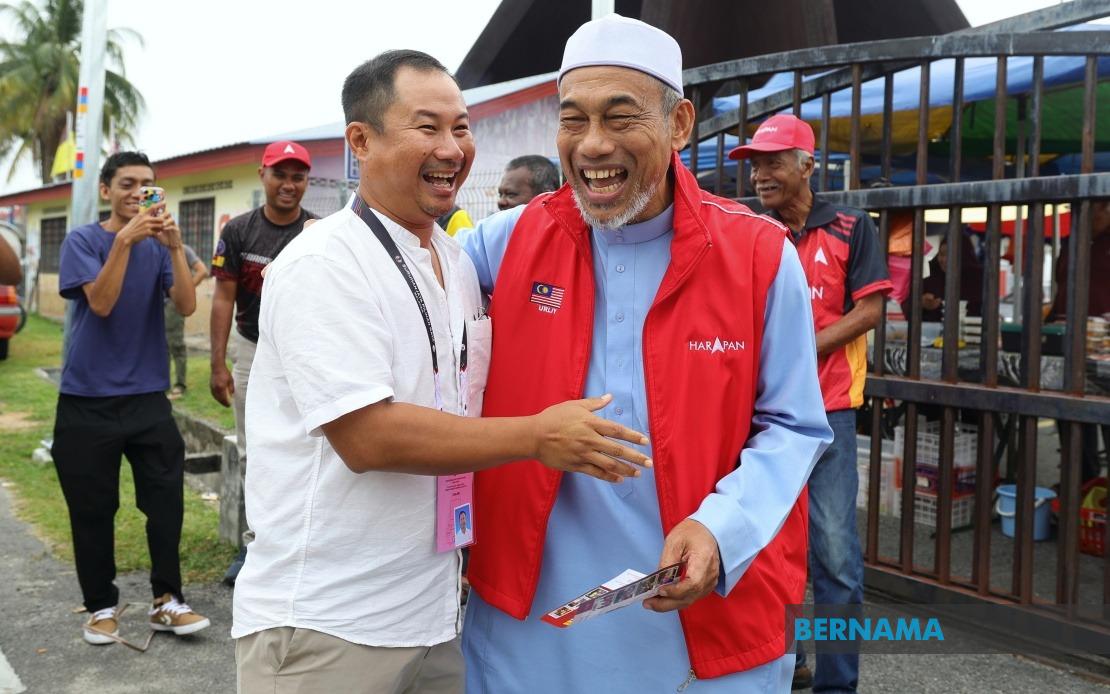
The Negeri Sembilan State Election is serving as an unexpected stage for a familial political showdown in Klawang, where incumbent Datuk Bakri Sawir and his cousin Danni Rais have found themselves on opposite sides of a campaign that has thus far unfolded with surprising harmony despite their competing allegiances. The two men encountered each other this week at the Kuala Klawang weekend market in Jelebu, drawing considerable public interest as voters observed the unusual sight of family members vying for the same parliamentary seat while maintaining cordial relations.
Bakri, representing the Pakatan Harapan coalition, has held the Klawang seat as the incumbent candidate, while Danni campaigns under the Perikatan Nasional banner. Their simultaneous presence at the market during the campaign's second day created a moment of unexpected theatre, as curious onlookers gathered to witness the family rivalry firsthand. Rather than displaying animosity, the two candidates managed their encounter with professionalism, shaking hands with the same voters, exchanging pleasantries, and even sharing jokes as they worked separate routes through the bustling market stalls.
The Klawang state seat encompasses a constituency of 13,355 registered voters, making it a closely contested prize in what political analysts view as a critical state-level election for Negeri Sembilan. The battle for representation in this district extends beyond the family duel, however, as a third candidate has entered the fray. Muhammad Adib Musa, fielded by Bersatu, represents a three-cornered contest that could significantly fragment the voter base and complicate victory for any single candidate. The addition of a third contender means that winning the seat may require building broader coalition support rather than simply outpacing one opponent.
When approached by media representatives following their market encounter, Bakri articulated a perspective that frames the election as an opportunity for public service rather than personal conflict. He deliberately downplayed the sensational aspects of contesting against his own cousin, instead emphasizing that what truly matters is conducting a campaign rooted in integrity and adherence to electoral regulations. His comments suggest a maturity in approach that prioritizes the democratic process itself over family rivalry, positioning the election as fundamentally about offering constituents a choice between different visions of governance.
Bakri's commitment to lawful campaigning received a practical test earlier in the week when local authorities, specifically the Jelebu District Council, took issue with how his campaign team had installed flags on a stadium fence. Rather than contest or delay the removal order, Bakri's team promptly complied, taking down the offending materials immediately. This willingness to respect regulatory authority, even when enforcement might favour competitors, underscores his public messaging about the importance of maintaining democratic norms. He pointedly asked how any political party could expect voters to respect the rule of law if politicians themselves flouted regulations during election campaigns.
The broader implications of Bakri's stance extend beyond his individual campaign and speak to larger concerns about electoral conduct in Malaysian politics. State and federal elections have occasionally witnessed heated confrontations between opposing campaign machinery, with disputes over campaign materials, territorial access, and voter engagement creating tensions that simmer long after polling day concludes. By consciously choosing a different path, Bakri is signalling that competitive elections need not inevitably corrode social harmony or family relationships. This approach holds particular resonance in multiethnic, multireligious Malaysia, where elections serve as periodic affirmations of democratic participation but also carry risks of exacerbating communal divisions if conducted recklessly.
Bakri has also issued broader guidance to all political parties contesting the Negeri Sembilan State Election, particularly emphasizing the responsibility of party machinery and ground-level operatives to maintain disciplined, orderly conduct throughout the campaign period. Such appeals are necessary because while candidate-level relationships might remain civil, lower-level party workers sometimes engage in confrontational tactics that can spiral into genuine conflicts. By explicitly reminding all stakeholders of their obligation to preserve electoral harmony, Bakri is attempting to set a tone that constrains the potential for escalation across the entire state.
The Election Commission has structured the Klawang contest according to a standardized timeline. Early voting is scheduled for July 28, allowing eligible voters to cast ballots before the official polling day. The main polling exercise will take place on August 1, when the full electorate will determine whether Bakri retains his seat, whether Danni successfully challenges the incumbent despite their family connection, or whether Muhammad Adib Musa's entry into the race produces an unexpected result. The three-way nature of the contest means that vote-splitting becomes a critical variable, and no single candidate can take victory for granted.
For Malaysian voters observing electoral developments in Negeri Sembilan, the Klawang contest offers an instructive microcosm of how democratic competition can function when participants commit to respecting both institutional rules and interpersonal decency. The spectacle of family members opposing each other politically is hardly unprecedented globally, yet the manner in which individuals conduct such contests varies considerably. Bakri and Danni's apparent commitment to keeping their family relationship intact while competing vigorously for voter support demonstrates that electoral contests need not devolve into personal warfare. This model, if replicated across Malaysian politics more broadly, could contribute to stronger democratic institutions and more resilient social fabric by establishing that political disagreement remains compatible with mutual respect.
The underlying context of this contest also reflects broader realignments within Malaysia's political landscape. Perikatan Nasional's challenge to Pakatan Harapan's traditional strongholds represents a significant shift in electoral competition, particularly in states where PH has historically maintained dominance. The emergence of Bersatu as an independent force, rather than operating solely within established coalitions, further complicates the political calculus. Negeri Sembilan, with constituencies like Klawang, represents a testing ground for these new political configurations, and the outcomes will likely influence strategic calculations for future elections.
As the campaign progresses toward early voting on July 28 and polling day on August 1, observers will continue monitoring whether this spirit of civility persists throughout the Klawang contest and indeed across the broader Negeri Sembilan State Election. The conduct of this particular race, especially given the family dimension, will serve as a bellwether for whether Malaysian politics can accommodate robust electoral competition without sacrificing the social cohesion essential for national stability. The example set by Bakri and Danni, however their contest ultimately resolves, will carry implications far beyond their constituency.

