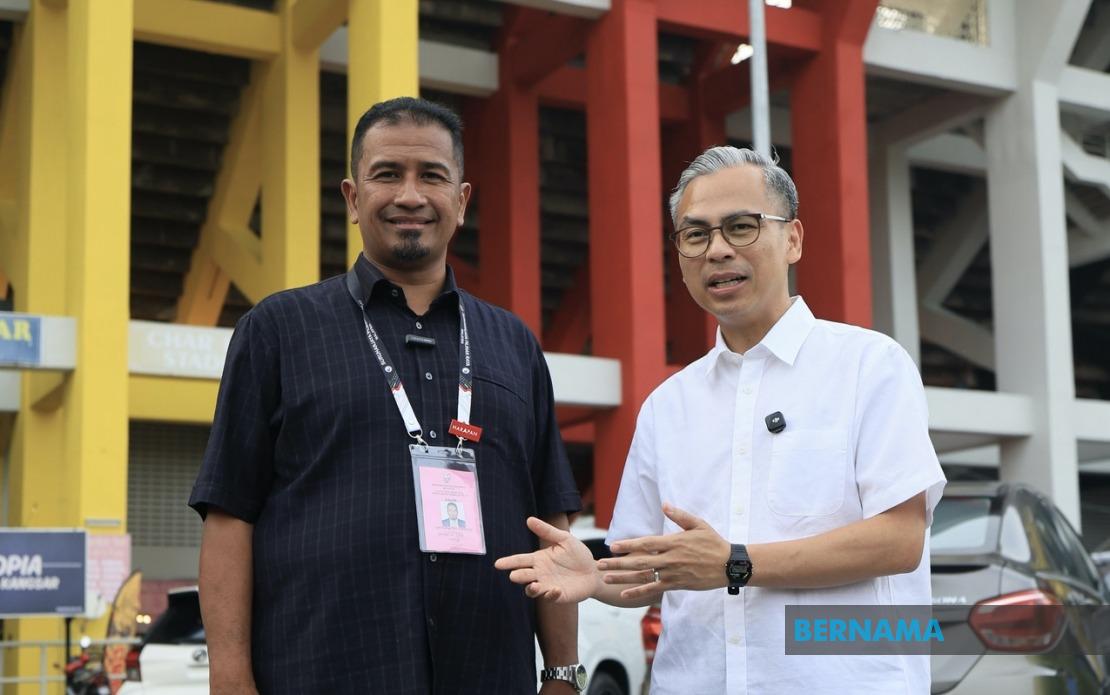
Communications Minister Datuk Seri Fahmi Fadzil has called on all political contenders in the Negeri Sembilan state election to elevate campaign standards by prioritising substantive debate over destructive tactics. His plea comes after Pakatan Harapan candidate Dr Azizul Hakim Mahdi reported that his campaign billboards in the Rantau state constituency had been deliberately damaged. The incident underscores growing concerns about the tone of state-level politics as Malaysia heads into the final stages of what officials expect to be an intensely competitive race.
The damaged billboards represent more than mere property vandalism; they reflect a broader pattern of campaign-related disruptions that have emerged across Malaysian electoral contests in recent years. According to Fahmi, multiple social media posts have documented individuals engaged in the defacement, providing evidence that may assist authorities in investigating and prosecuting those responsible. Such acts constitute a criminal offence under Malaysian law, and Fahmi emphasised that these matters must be left to law enforcement agencies to handle with appropriate legal consequences. The incident highlights the distinction between legitimate political competition and actions designed to intimidate or silence opposing candidates.
Fahmi's intervention carries particular weight given his role as Communications Minister and his position within the ruling coalition's leadership hierarchy. By publicly censuring vandalism and calling for restraint, he has positioned the government as custodian of electoral decorum while subtly reminding all parties that campaign conduct will be scrutinised and evaluated. His remarks were delivered in Seremban during a campaign walkabout accompanying Nur Azman Mohamad, the Pakatan Harapan candidate for the Sikamat state seat, signalling that the coalition is taking vandalism allegations seriously and responding through official channels rather than retaliatory measures.
The minister articulated a clear vision for what constitutes appropriate campaign conduct in a mature democracy. Rather than relying on sabotage, intimidation, or personal attacks, Fahmi stressed that political parties should ground their campaigns in substantive policy discussions and factual claims about their respective records and proposals. This appeal resonates with growing segments of Malaysian voters who express fatigue with negative campaigning and increasingly demand that political discourse address concrete issues affecting their daily lives. By framing principled competition as the hallmark of democratic maturity, Fahmi has reframed the narrative away from claims of victimisation toward questions about which party can best demonstrate responsible leadership.
At the same time, Fahmi acknowledged that the Negeri Sembilan contest remains in its early stages, with only the first week completed at the time of his statement. He observed that many participants and observers were still operating at moderate intensity, comparing the campaign to a vehicle in second gear rather than approaching the higher speeds that would characterise the final push toward polling day. This assessment suggests that campaign dynamics will likely intensify considerably over the remaining period, potentially creating additional flashpoints where candidate safety, billboard security, and broader electoral conduct become flashpoint issues.
Prime Minister Datuk Seri Anwar Ibrahim has already begun ramping up his direct involvement in the campaign trail, appearing at multiple locations and signalling that senior government figures will increasingly take to the ground in coming days. Fahmi's comments indicate an expectation that as more prominent leaders enter the fray, the volume and intensity of campaign messaging will escalate accordingly. This trajectory creates both opportunities and risks: increased visibility and engagement from voters, but also heightened potential for confrontational moments and disputes over campaign conduct.
The Negeri Sembilan state election takes place within a specific political context that holds significance beyond the state's borders. As a state where Pakatan Harapan currently holds substantial influence, a strong performance would reinforce the coalition's mandate heading into other electoral contests, while any reversal would signal shifting voter sentiment. For opposition parties, this election represents a critical opportunity to demonstrate growing support in a state where they have faced challenges in recent electoral cycles. The stakes are therefore high, which may explain why campaign conduct has already become contentious and why vandalism incidents have attracted ministerial attention.
The Election Commission has scheduled August 1 as polling day, with early voting set for July 28. This timeline provides roughly a week from Fahmi's statement for campaigns to proceed, and the compressed schedule intensifies pressure on all parties to maximise their messaging and ground organisation. The early voting arrangement, common in Malaysian elections, offers a mechanism for voters with logistical constraints to participate while also potentially reducing the window for last-minute campaign drama immediately before polling day.
Fahmi's invocation of the principle that campaigns should remain grounded in ideas and facts rather than slander reflects broader concerns about the health of political discourse in Malaysia. Numerous international observers and local civil society organisations have highlighted the degree to which Malaysian electoral campaigns sometimes prioritise emotional appeals and personal attacks over policy substance. By explicitly encouraging all parties to adopt higher standards, Fahmi has positioned the government as defender of democratic norms, even as his statement implicitly acknowledges that such standards are not automatic and require deliberate reinforcement from respected political figures.
The incident also illuminates the practical challenges that candidates face in protecting campaign materials and managing the digital dimensions of modern electioneering. As Fahmi noted, social media has become a vehicle for both documenting vandalism and potentially coordinating such activities. This dual role creates opportunities for evidence gathering and accountability, but also means that campaign disputes can rapidly escalate from physical incidents to viral social media narratives that shape public perceptions of parties and candidates far more broadly than the immediate incident would warrant.
Looking forward, the success of Fahmi's appeal for campaign propriety will depend partly on whether incidents of vandalism and sabotage decrease in the coming weeks, and partly on how visible and consistent enforcement of electoral laws appears to voters. If authorities respond swiftly and evenhandedly to violations regardless of political affiliation, public confidence in the electoral process may be strengthened. Conversely, if enforcement appears selective or insufficient, accusations of bias will likely proliferate and further polarise the campaign environment. The minister's emphasis on leaving such matters to authorities thus carries an implicit responsibility for those authorities to deliver visible, credible results.

