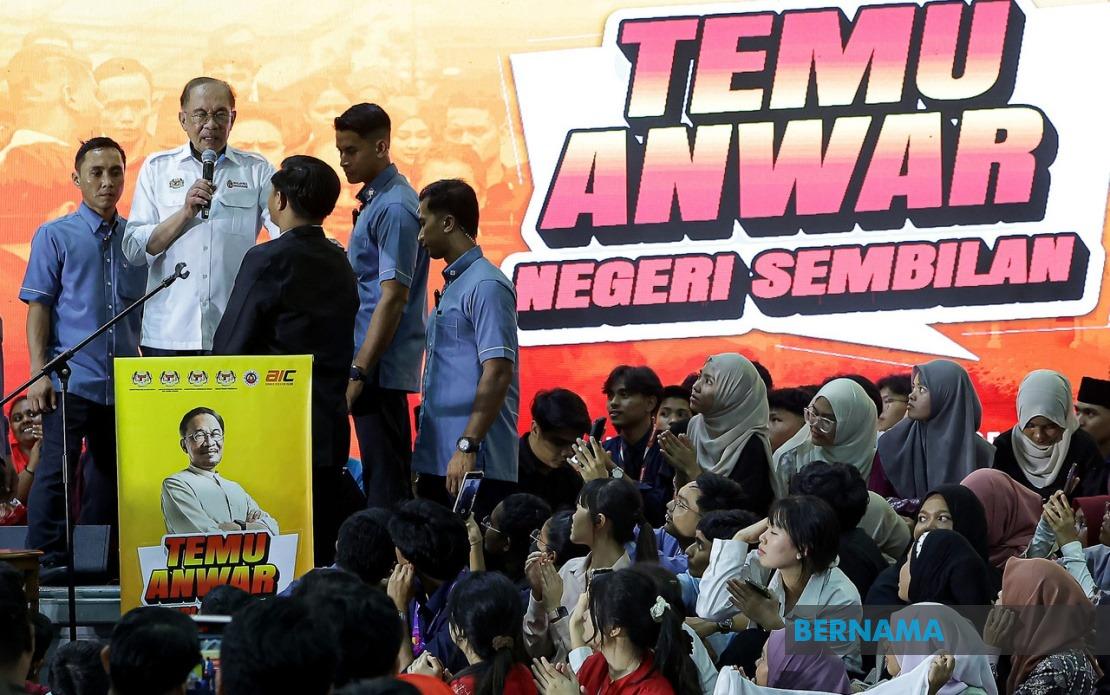
Prime Minister Datuk Seri Anwar Ibrahim has committed to ensuring that the economic windfall from hosting the Formula 1 Bahrain Grand Prix at the Sepang International Circuit this October will flow through to street vendors and small traders across the Sepang area, not merely multinational hospitality operators. Speaking at a youth engagement programme in Seremban, Anwar underscored the MADANI Government's determination to democratise the benefits of staging a world-class motorsport spectacle, positioning the event as an opportunity for grassroots economic participation across Negeri Sembilan and the wider region.
The Prime Minister's emphasis on inclusive wealth distribution marks a deliberate policy stance that reflects contemporary concerns about equitable development in major sporting ventures. Large-scale international events frequently generate concentrated economic gains for established corporations whilst marginalising smaller entrepreneurs, a pattern Anwar explicitly rejected. His statement signals government-level coordination to prevent the standard outcome whereby only luxury hotels, high-end restaurants, and major service providers capture the majority of visitor spending. Instead, the administration aims to channel significant portions of event-related revenue toward the informal economy that characterises much of Malaysia's retail landscape.
Anwar's vision encompasses the hawker ecosystem that traditionally operates in surrounding districts. By deliberately preparing stall operators and petty traders in outer Sepang zones for increased foot traffic and customer demand, the government hopes to create what might be termed distributed economic stimulation. This approach acknowledges that competitive advantage need not be the preserve of established hospitality brands. Rather, strategic planning and advance notice can empower independent vendors to capitalise on the estimated influx of motorsport enthusiasts and their accompanying entourages during the racing weekend.
The accommodation sector has already demonstrated measurable responsiveness to the announcement of the Grand Prix. Hotel bookings in Putrajaya and Kuala Lumpur, cities lying within reasonable driving distance of Sepang, have surged noticeably following confirmation of the event. This uptick validates confidence in the broader tourism and hospitality infrastructure's capacity to absorb incremental demand. The ripple effects extend beyond those two urban centres, creating networking opportunities for service providers across the Klang Valley and southern Selangor to enhance their readiness for visitors seeking dining, shopping, and leisure experiences.
For Malaysia's tourism sector, Formula 1 representation carries symbolic and practical significance. The sport commands a global audience measured in billions across television and digital platforms, positioning Sepang as a temporary focal point of international attention. This visibility enhances Malaysia's brand positioning as a destination capable of managing sophisticated international sporting operations. The country competed against other potential hosts for this specific iteration of the Grand Prix, underlining the prestige and economic stakes attached to the selection. Such events typically generate secondary tourism flows as visitors extend their stays to explore regional attractions beyond the racing circuit itself.
The timing of Anwar's remarks—delivered to Form Six and polytechnic students numbering approximately two thousand—carries pedagogical weight. By framing economic inclusion as a government priority to younger audiences, the administration reinforces messages about shared prosperity and grassroots entrepreneurship. This generation increasingly expects corporate and governmental actors to balance profit maximisation with social responsibility. The Prime Minister's explicit commitment to hawker welfare aligns with evolving expectations among Malaysian youth regarding equitable development outcomes.
Implementing the distributed benefit model requires institutional coordination across multiple agencies. Municipal authorities in Sepang will need to facilitate vendor registration and stall placement. Traffic and security planning must accommodate increased foot traffic in peripheral business zones. Supply chain logistics require advance arrangement to ensure hawkers can source inventory at competitive rates despite anticipated surge demand. The commitment therefore extends beyond rhetorical flourish into practical administrative preparation involving local councils, business associations, and the motorsport organising authority.
The Sepang International Circuit itself has evolved considerably since hosting its first Formula 1 event in 1999. The circuit has matured into a facility capable of absorbing international events whilst simultaneously serving as a catalyst for surrounding economic development. This October's Grand Prix represents an opportunity to consolidate those gains whilst deliberately spreading benefits across social strata. Success in this undertaking could establish a replicable model for how Malaysia structures major sporting events to maximise inclusive economic participation.
Regional context matters significantly to understanding this initiative's implications. Southeast Asian governments increasingly compete for signature sporting events as mechanisms for tourism promotion and infrastructure development. Thailand, Singapore, and Vietnam have explored Formula 1 involvement, making Malaysia's commitment to hosting a Grand Prix valuable from competitive positioning standpoints. However, demonstrable commitment to equitable local participation distinguishes the Malaysian approach from purely extractive event models where external corporations capture disproportionate shares of generated value.
Anwar's statement reflects broader government emphasis on financial inclusion and informal economy strengthening. Earlier policy initiatives have targeted micro-enterprise financing and digital commerce adoption among street vendors. The F1 event presents a concentrated opportunity to apply such frameworks, enabling hawkers to boost cash flows over a compressed timeframe whilst building business resilience through exposure to high-volume customer interactions. These outcomes align with government objectives around reducing income inequality and strengthening small-scale entrepreneurial capacity across urban and periurban areas.
Looking beyond October, the outcomes of this Grand Prix will likely influence how Malaysia structures subsequent international events. Measurable economic benefits to Sepang's hawker community would validate the inclusive approach, potentially becoming embedded in national event hosting policy. Conversely, if benefits concentrate among large operators despite government rhetoric, pressure would mount for revised frameworks. The stakes thus extend beyond a single racing weekend into long-term patterns governing how Malaysia balances attracting world-class events with distributing resulting prosperity across broader population segments.

