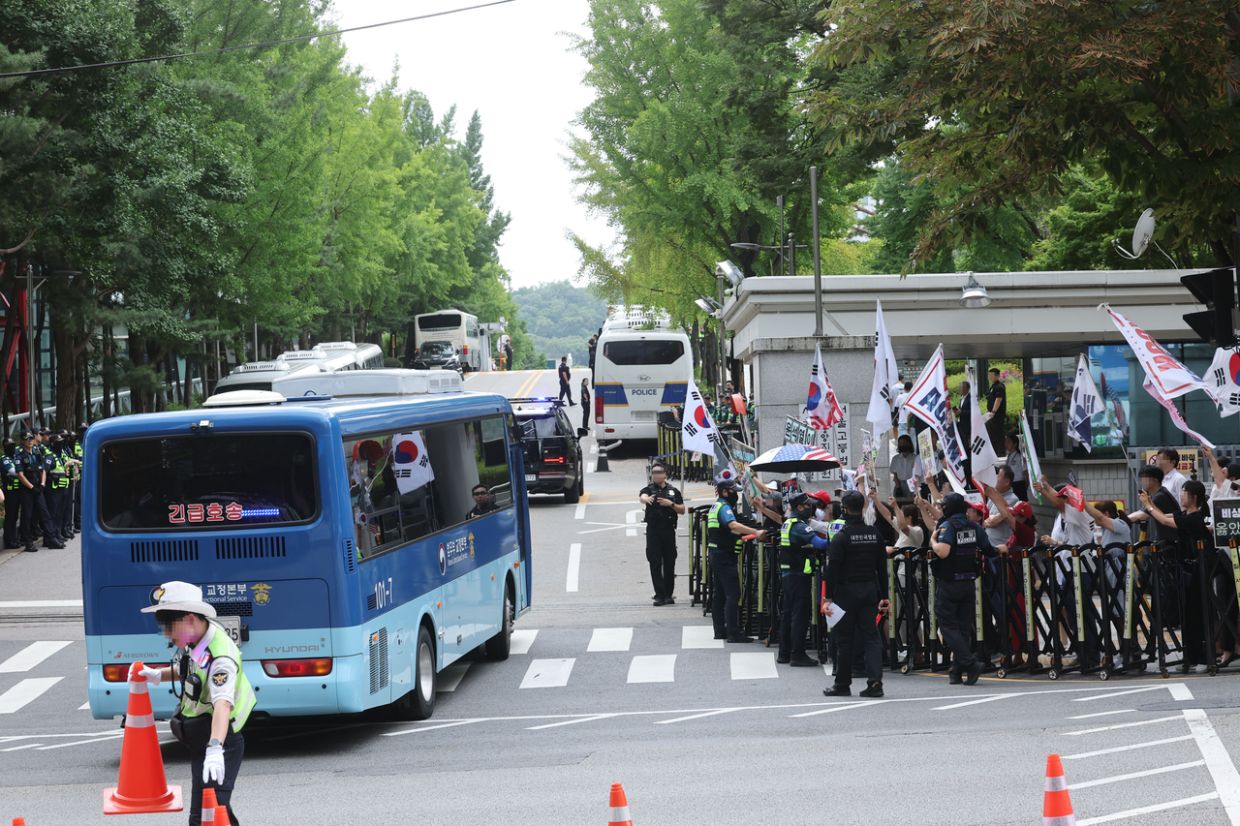
Former President Yoon Suk Yeol received a two-year prison sentence on Monday from the Seoul Central District Court, convicted of breaching the Political Funds Act by accepting unpaid polling services valued at 27.92 million won (approximately $18,600) from political consultant Myung Tae-kyun during his presidential campaign. The ruling represents a pivotal moment in South Korea's political landscape, delivering the first custodial conviction against a former head of state in connection with campaign finance violations.
The court determined that Yoon benefited from 14 separate surveys provided without payment between June 2021 and March 2022, establishing a pattern of illicit campaign support that contravened electoral regulations. While prosecutors had originally alleged a far more extensive arrangement involving 58 surveys worth over 270 million won, the court's more conservative finding still constitutes a serious breach of South Korea's strict campaign finance laws. Presiding Judge Lee Jin-gwan emphasised the fundamental democratic principle at stake, noting that polling data possesses considerable influence over voter behaviour and serves as a cornerstone of electoral integrity.
The judgment reveals a coordinated scheme involving Yoon, his wife former First Lady Kim Keon Hee, and Myung. The court established that Kim authorised Myung to control multiple aspects of the polling operations, including timing, content, methodology, and distribution decisions. Yoon maintained awareness of this arrangement and implicitly approved it, creating what the judge characterised as a successive and silent understanding among the three parties concerning provision of the services. This implicit consent proved critical to the conviction, as it demonstrated a knowing acceptance of illegitimate campaign support.
Beyond the financial irregularities, the ruling identified a quid pro quo element at the heart of the scheme. Yoon allegedly assured Myung that former lawmaker Kim Young-sun would secure the ruling People Power Party's nomination in exchange for the polling assistance. Subsequently, Yoon leveraged his influence through Chang Je-won, then chief of staff to the president-elect, to intervene in the party's nomination procedures on Kim Young-sun's behalf. However, the court noted that establishing this reciprocal arrangement was not legally necessary to prove a Political Funds Act violation, underscoring the statute's comprehensive approach to campaign finance integrity.
The sentencing carries significant implications for South Korean governance and the consequences facing former leaders. Myung, the political consultant who provided the surveys, received an 18-month custodial sentence and was immediately remanded into custody during Monday's hearing. The parallel outcomes for both the official recipient and the service provider signal the court's determination to penalise all participants in campaign finance schemes, not merely those in high office.
Notably, the verdict diverges markedly from simultaneous proceedings involving Kim Keon Hee in relation to the identical polling services. The former First Lady was acquitted at both trial and appellate levels on related Political Funds Act charges, a distinction that puzzled observers and created apparent inconsistencies in the legal reasoning. The lower courts in Kim's case concluded that prosecutors failed to demonstrate she received measurable financial benefit proportionate to the surveys' actual costs, nor could they establish that the polling services constituted payment for the nomination assistance.
Judge Lee acknowledged these divergent outcomes, explaining that although the polling allegations stemmed from the same underlying services, the circumstances differed sufficiently to warrant distinct legal conclusions. This reasoning raised questions about how identical campaign finance conduct could produce opposite verdicts depending on whether the beneficiary was the candidate himself or his spouse. The distinction arguably hinges on the degree of documented control and decision-making authority, with evidence apparently clearer regarding Yoon's personal involvement than Kim's.
The Supreme Court is scheduled to deliver final judgment in Kim's separate case on Thursday, potentially clarifying or further complicating the jurisprudential landscape surrounding the shared polling services. A reversal of her acquittal could either harmonise the legal outcomes or intensify scrutiny of the original trial courts' reasoning. The timing of these rulings places South Korea's judicial system under considerable pressure to demonstrate consistent application of electoral finance principles.
Yoon's conviction arrives amid South Korea's broader political turbulence, including his earlier impeachment and ongoing legal challenges spanning multiple fronts. The case exemplifies the heightened scrutiny facing Korean political figures and the judiciary's willingness to pursue high-profile prosecutions involving campaign irregularities. For Southeast Asian observers, the proceedings illustrate South Korea's institutional mechanisms for holding powerful figures accountable, contrasting with governance challenges in other regional democracies where similar campaign finance violations often proceed without prosecution.
The underlying tension between proving direct quid pro quo arrangements and establishing implicit understandings reflects evolving interpretations of campaign finance law across democracies. South Korea's approach, holding officials liable even absent explicit reciprocal promises, creates a high regulatory bar that extends liability to subtle forms of political influence and indirect benefit-sharing. This expansive interpretation protects electoral integrity but also raises proportionality questions regarding sentencing severity for former heads of state.
The case illuminates how polling data occupies a liminal space in campaign regulation—neither straightforward cash contributions nor purely informational services, yet capable of conferring substantial electoral advantages. The court's recognition of this reality, combined with its willingness to assess financial benefit using market valuation methodologies, establishes precedent for future prosecutions involving in-kind campaign support. The 27.92 million won figure demonstrates judicial capacity to quantify non-monetary contributions, a technique potentially applicable across various forms of campaign assistance.
Yoon's path forward includes anticipated appeals through South Korea's higher courts, potentially extending the legal proceedings for years. The conviction's finality remains uncertain, and comparable cases involving other prominent political figures await resolution. For Malaysian readers monitoring South Korean developments, the Yoon case underscores the importance of robust electoral finance frameworks and independent judiciaries willing to enforce them consistently, regardless of the defendant's former status or political affiliation.

