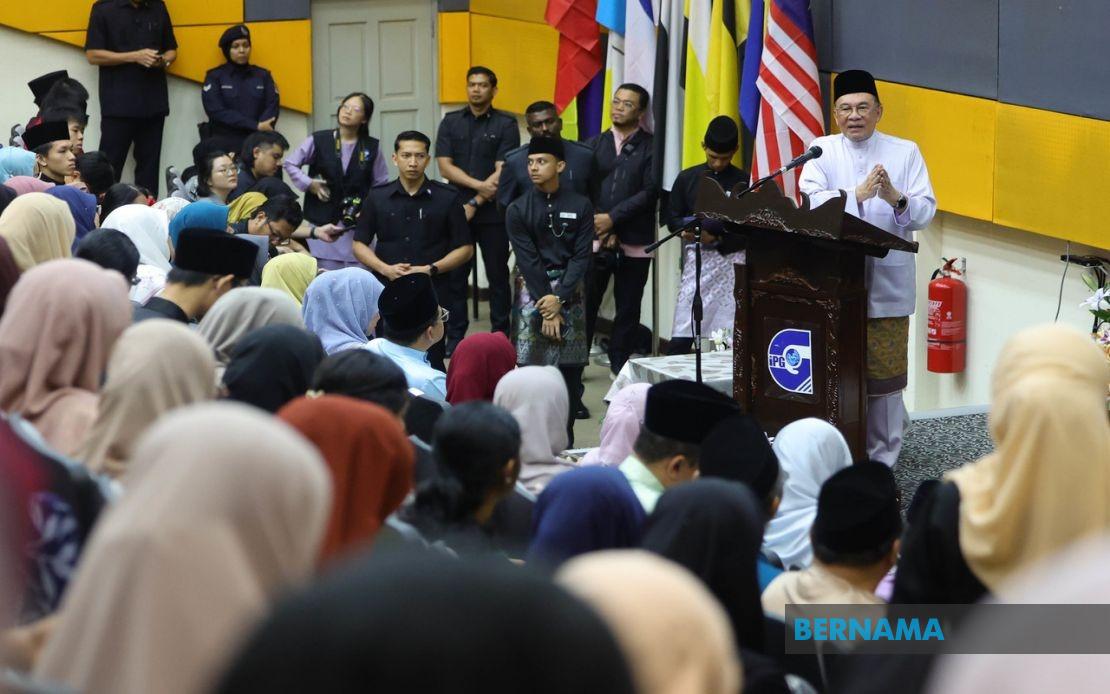
Prime Minister Datuk Seri Anwar Ibrahim has pinpointed cultural resistance and institutional inertia as the fundamental barriers to Malaysia's reform agenda, arguing that the obstacles stem not from technological or skill deficiencies but from vested interests determined to preserve the status quo. Speaking during a youth engagement session at the Technical Education Campus of the Institute of Teacher Education in Bandar Enstek, the Prime Minister underscored how his more than three years steering the government have exposed the reality that systemic change initiatives routinely encounter opposition from those benefiting from existing arrangements.
Anwar's assessment reflects a deepening frustration with the pace of anti-corruption and governance improvements despite the government's stated commitment to these objectives. He characterised the resistance as emanating from members of the elite establishment who have become comfortable defending longstanding practices, even as Malaysia seeks to modernise its administrative machinery. This resistance, he suggested, transcends simple disagreement over policy—it represents a fundamental unwillingness among privileged groups to relinquish advantages gained through opaque systems and institutional vulnerabilities that reward patronage over merit.
The Prime Minister made clear that many citizens and officials experience discomfort when confronted with proposals to overhaul entrenched structures and eliminate corruption normalised over decades. This psychological and institutional resistance, he argued, cannot be resolved through persuasion alone. Rather, meaningful transformation requires sustained political will to proceed despite unpopularity, recognising that those invested in the existing order will mobilise opposition to any initiative threatening their position or accumulated benefits.
Anwar's framing of the challenge carries particular significance for Malaysia's reform trajectory. Rather than attributing reform delays to external factors or resource constraints, he has identified internal resistance as the decisive variable. This diagnosis suggests that technical solutions—new laws, agencies, or procedures—will prove insufficient without confronting the human and institutional factors perpetuating corrupt networks and inefficient governance. The implication is that Malaysia's administrative modernisation depends ultimately on cultural and behavioural shifts among public officials, political elites, and entrenched bureaucratic power centres.
The Prime Minister highlighted a paradox he observes among reform opponents: outwardly cosmopolitan in appearance and lifestyle, yet fundamentally conservative in resisting institutional change. This observation suggests that surface modernisation masks deeper attachment to informal power structures and privileges derived from systemic opacity. Those defending corrupt practices, he implied, do so not through explicit advocacy for corruption but through strategic obstruction, bureaucratic inertia, and selective enforcement that preserves advantageous arrangements while maintaining plausible deniability.
Anwar's comments address a persistent tension in Malaysia's governance reform efforts. Public statements from government and international observers frequently emphasise transparency, accountability, and anti-corruption imperatives. Yet on the ground, implementation languishes when those controlling institutional machinery perceive threats to their authority or financial interests. The Prime Minister's acknowledgment of this gap between reform rhetoric and institutional reality represents an unusually candid assessment of governance challenges facing Southeast Asia's third-largest economy.
The reference to religious, cultural, and civilisational demands for continuous improvement frames reform not merely as technical necessity but as moral obligation. This approach seeks to shift the debate from technocratic efficiency grounds to values-based arguments about Malaysia's rightful place among ethical societies. By invoking transcendent standards, Anwar attempts to position reform resistance as contrary to fundamental principles rather than legitimate policy disagreement, potentially delegitimising opposition within constituencies valuing religious and cultural authenticity.
For Malaysian readers and Southeast Asian observers, Anwar's diagnosis carries implications beyond immediate governance metrics. If systemic resistance to reform stems from entrenched interests rather than capability gaps, then progress requires mechanisms for displacing or constraining those interests. This might involve institutional restructuring, personnel changes, merit-based advancement replacing patronage networks, or constitutional reforms strengthening accountability. Each approach encounters predictable resistance from beneficiaries of existing arrangements.
The Prime Minister's comments also reflect broader challenges confronting anti-corruption initiatives across the region. Indonesia, Thailand, the Philippines, and other Southeast Asian nations have launched similar reform programmes, yet sustainability remains questionable when political coalitions supporting reform weaken or alternate. Anwar's implicit argument—that reform resistance reflects structural incentive problems rather than simple opposition to good governance—suggests that temporary political commitment proves insufficient without institutional redesign making corruption consistently disadvantageous rather than occasionally risky.
Looking forward, the effectiveness of Malaysia's reform agenda may depend less on announcing new initiatives and more on strategies for neutralising institutional resistance. This could include transparency measures exposing obstruction, merit-based advancement removing gatekeepers, or enforcement mechanisms targeting those derailing reform implementation. Anwar's candid acknowledgment of the resistance phenomenon represents a necessary first step toward designing interventions addressing root causes rather than symptoms of Malaysia's governance challenges.

