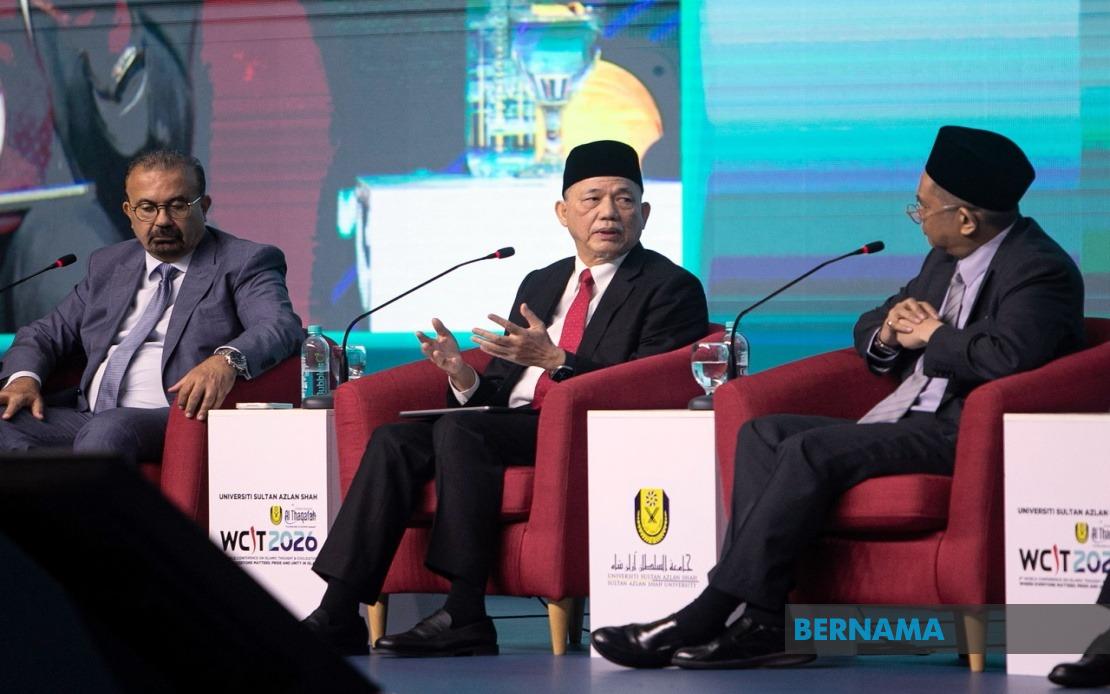
Deputy Prime Minister Datuk Seri Fadillah Yusof has underscored the urgent need to recognise the symbiotic relationship between energy security and maritime safety, arguing that recent international tensions underscore how vulnerabilities in one domain cascade across the other. Speaking as a panellist at the 8th World Conference on Islamic Thought and Civilisation (WCIT) in Ipoh, Fadillah, who also holds the portfolio of Energy Transition and Water Transformation Minister, drew attention to how geopolitical flashpoints thousands of kilometres away now ripple through energy markets, supply chains, and consumer pocketbooks with immediate effect.
The Deputy Prime Minister's remarks come against a backdrop of escalating hostilities between the United States and Iran, a development that has exposed the fragility of interconnected global systems. Fadillah emphasised that the days of treating energy infrastructure and shipping routes as isolated policy concerns are long past. Instead, disruptions originating in one sphere—whether political tensions affecting crude production or military incidents threatening tanker traffic—now invariably generate cascading effects across multiple economic and logistical domains. This recognition reflects a sophisticated understanding of contemporary geopolitical risk and its material consequences for ordinary citizens.
Concrete impacts are already visible across multiple fronts. Recent upheaval in the Strait of Hormuz, through which roughly one-third of global maritime petroleum trade flows, has triggered consequences extending far beyond headline-grabbing political drama. Electricity tariffs face upward pressure as energy costs climb. Fuel supplies become less predictable as refineries adjust procurement strategies in response to shipping uncertainty. International commerce stutters as trading partners grapple with logistical bottlenecks and inventory concerns. Insurance premiums for maritime transit spike sharply, effectively imposing a hidden tax on goods moving through contested waters. The cumulative effect transforms abstract geopolitical risk into concrete price increases at petrol stations and supermarket checkouts.
Malaysia occupies a particularly exposed position within this interconnected ecosystem. The country's prosperity fundamentally depends upon unfettered access to open, predictable, and rules-based international trading systems—a dependency accumulated over more than a century of commerce-driven development. More significantly, Malaysia straddles the Strait of Melaka, one of the world's most critical maritime chokepoints through which approximately one-quarter of global seaborne trade and nearly one-third of liquefied natural gas shipments transit annually. Any disturbance to stability or predictability in these waters reverberates immediately through Malaysian ports, warehouses, and manufacturing facilities.
The strategic implications warrant careful consideration. Unlike many nations that can absorb economic shocks through geographic distance or diversified supply sources, Malaysia's position as both a trading hub and a nation heavily reliant on imports for critical commodities renders it particularly vulnerable to maritime disruptions. Energy security concerns intersect directly with Malaysia's aspirations for industrial growth and economic diversification. Sustained uncertainty or volatility in shipping lanes would inevitably complicate investment decisions, raise production costs for manufacturers, and constrain the competitiveness of Malaysian exports competing in price-sensitive global markets.
Fadillah's articulation of Malaysia's policy response emphasises restraint and diplomatic engagement rather than confrontational posturing. This stance reflects a considered judgment that Malaysia's interests are best served through multilateral dialogue, adherence to established international norms, and advocacy for rules-based dispute resolution. The Deputy Prime Minister's framing positions Malaysia as a stabilising force committed to de-escalation, a posture that carries diplomatic weight and credibility within regional and international forums. By consistently championing dialogue over confrontation, Malaysia seeks to reinforce its image as a trusted, neutral actor invested in global stability.
The broader regional dimension cannot be overlooked. Southeast Asia collectively depends upon maritime passage through waters where tensions simmer. Singapore, Thailand, Vietnam, and Indonesia all maintain substantial stakes in maintaining predictable, safe shipping conditions. Coordinated regional responses to maritime security challenges could amplify Malaysian advocacy and reinforce collective interest in maintaining the status quo. Enhanced cooperation among Southeast Asian nations on maritime surveillance, information-sharing, and diplomatic coordination might prove more effective than unilateral Malaysian efforts.
Energy transition considerations add another layer of complexity to Fadillah's analysis. As Malaysia pursues its commitment to renewable energy expansion and emissions reductions, the country remains dependent upon traditional energy imports to meet near-term demand. This transitional vulnerability means that maritime disruptions affecting conventional energy supplies carry heightened significance during the crucial period when renewables capacity remains under development. Energy security therefore cannot be divorced from climate commitments or long-term development strategy.
The interconnectedness Fadillah identifies extends beyond immediate economic consequences to encompass longer-term strategic implications. Sustained uncertainty regarding energy supplies or shipping safety creates pressure on governments to pursue costly insurance mechanisms, maintain strategic reserves, or develop alternative supply routes. These adaptations impose fiscal burdens that might otherwise support social spending, infrastructure investment, or human capital development. For a middle-income nation like Malaysia, such opportunity costs merit serious policy attention.
Moving forward, Malaysian policymakers must integrate energy security and maritime security planning within unified analytical frameworks rather than treating them as compartmentalised concerns. Intelligence gathering, diplomatic engagement, and strategic communication should reflect this integrated understanding. Regional cooperation mechanisms deserve reinforcement and expansion. Simultaneously, Malaysia should continue advocating within international forums for strengthened mechanisms protecting freedom of navigation, upholding international law governing maritime conduct, and establishing mechanisms for peaceful dispute resolution. These efforts align Malaysia's rhetorical commitments with tangible policy outcomes while advancing the nation's long-term strategic interests.

