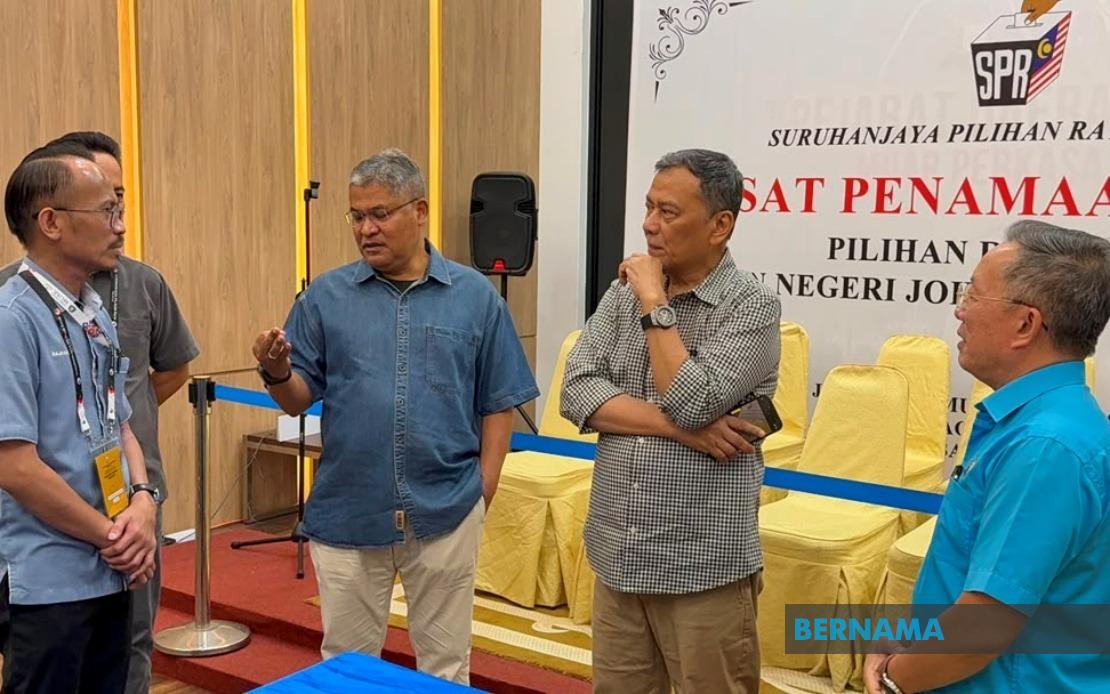
The Election Commission is in final readiness mode as Johor prepares for a crucial day in its political calendar tomorrow, when the nomination process for the state election will formally commence. Across the state, election officials are conducting last-minute checks at the 56 Candidate Nomination Centres that have been established to process submissions from aspiring candidates seeking to contest the 16th Johor state election. These preparations underscore the logistical complexity involved in running state-level elections in Malaysia, particularly in an urbanised state like Johor that spans multiple municipal jurisdictions and diverse communities.
Visits to several nomination centre locations in Johor Bahru revealed that personnel are focused on finalising technical and administrative details rather than undertaking major structural work. The infrastructure at each centre has already been substantially completed, allowing officials to concentrate on systems testing, security protocols, and operational procedures that will govern candidate registration. This staged approach to preparation—with major work completed weeks in advance and final verification occurring just hours before the process begins—reflects the Election Commission's experience managing multiple electoral events across the country.
Nazatul Shima Mohamad, the returning officer responsible for the Perling state constituency nomination centre based at Dewan Jubli Intan Hall, expressed confidence that all preparations have reached completion. She indicated that the physical layout of the premises had been finalised and that a comprehensive simulation exercise involving all participating agencies had been successfully conducted on the day of her statement. This rehearsal approach is standard practice, allowing officials to identify potential bottlenecks, clarify procedures with partner organisations, and build operational confidence before the actual nomination day unfolds.
In her remarks to prospective candidates, the Perling returning officer struck a collaborative tone, emphasising that election staff stood ready to provide guidance and support throughout the nomination submission process. However, she also outlined specific requirements that candidates must fulfil, including arriving at the centres sufficiently early to complete registration, carrying all necessary documentation, and bringing the required deposit money as stipulated under electoral regulations. These practical details, while seemingly routine, are crucial for ensuring that nomination submissions are processed efficiently and that candidates meet all legal requirements for their candidacies to be deemed valid.
At the Kota Iskandar nomination centre, located at the main hall of Iskandar Puteri City Council in Medini, returning officer Shahrulizam Abdul Rashid detailed the extensive coordination that has been undertaken with law enforcement agencies. Given that nomination days typically attract substantial gatherings of party supporters eager to demonstrate backing for their candidates, the centre has instituted comprehensive crowd management measures. These include predetermined road closures on routes leading to the nomination centre, a 50-metre exclusion zone restricting supporter access to the immediate vicinity of the venue, provision of designated tent areas outside the main hall, and physical barriers designed to keep supporters of competing parties spatially separated.
This layered security and management approach reflects lessons learned from previous electoral contests in Malaysia, where nomination days have occasionally witnessed tensions between opposing party supporters. By creating physical separation, controlling access points, and maintaining police presence, election officials aim to preserve the integrity of the nomination process while allowing supporters to participate in the democratic exercise. The emphasis on advance planning demonstrates recognition that electoral events, while primarily administrative in nature, occur within a broader context of political competition that can generate passionate participation from party members and their associates.
Justice and order at the nomination centres depend significantly on the conduct and prudence of supporters themselves. Officials have issued appeals to members of the public who intend to join their respective party groups, urging them to exercise restraint and avoid provocation of supporters aligned with other parties. This messaging reflects an understanding that while election officials can establish physical infrastructure and security measures, the ultimate success of a peaceful and orderly nomination process depends on the voluntary cooperation and maturity of political actors and their supporters. Such appeals are standard practice across Malaysian elections and represent an ongoing effort to cultivate civic responsibility among participants in the democratic process.
The nomination process itself, scheduled to commence at 9 am and conclude at 10 am tomorrow, will be conducted simultaneously across all 56 nomination centres throughout Johor. This compressed timeframe requires meticulous coordination and well-trained personnel at each centre to process submissions within the designated window. The returning officers at each centre will subsequently make official announcements regarding which candidates have been deemed eligible to proceed to the polling stage, based on their compliance with all nomination requirements and legal provisions governing candidacy.
The Johor state election encompasses a substantial electorate, with the Election Commission registering approximately 2.73 million voters across the state. This figure comprises 2.70 million ordinary voters, approximately 12,000 military personnel and their spouses, and roughly 12,700 police personnel and their spouses. The inclusion of military and police voters reflects Malaysia's inclusive approach to franchise, extending voting rights to these categories while maintaining institutional neutrality in their participation. The sheer size of this electorate underscores why the Election Commission has established multiple nomination centres distributed across Johor's geography, ensuring that candidates can submit their nominations without excessive travel burdens.
The timeline for the Johor state election reflects a carefully orchestrated sequence designed to allow adequate preparation time between successive phases. The state legislature was dissolved on June 1, with nomination day falling on June 27, early voting scheduled for July 7, and general polling day designated for July 11. This four-and-a-half-week period from dissolution to polling day provides candidates and parties with adequate time for campaigning, while allowing the Election Commission sufficient opportunity to complete administrative preparations between each stage. For Southeast Asian and Malaysian political observers, this electoral timetable demonstrates how established democracies manage the practical and constitutional requirements of holding elections at the state level within a federal system.
The readiness being reported across Johor's nomination centres carries implications beyond the immediate state election. As one of Malaysia's most developed and politically significant states, Johor's electoral process serves as a barometer for the health of Malaysia's democratic institutions. Smooth execution of nomination procedures, effective crowd management, and orderly candidate submission processes all contribute to public confidence in electoral institutions. Moreover, the Johor election itself may signal broader political trends across Malaysia, as voters in a state that has historically been governed by the Barisan Nasional coalition assess their political preferences and priorities in the contemporary context.
Looking ahead, the Election Commission's preparation activities represent the culmination of months of planning and coordination involving multiple government agencies, from local authorities to police forces to municipal councils. The staff at each nomination centre will play a frontline role in translating these preparations into operational reality, processing candidate submissions, verifying documentation, and managing the flow of nominees and supporters throughout the morning. Their professionalism and efficiency during the nomination process will substantially influence the overall success of the election, setting the tone for the campaign period that follows and ultimately contributing to whether voters view the electoral exercise as fair, transparent, and well-administered.

