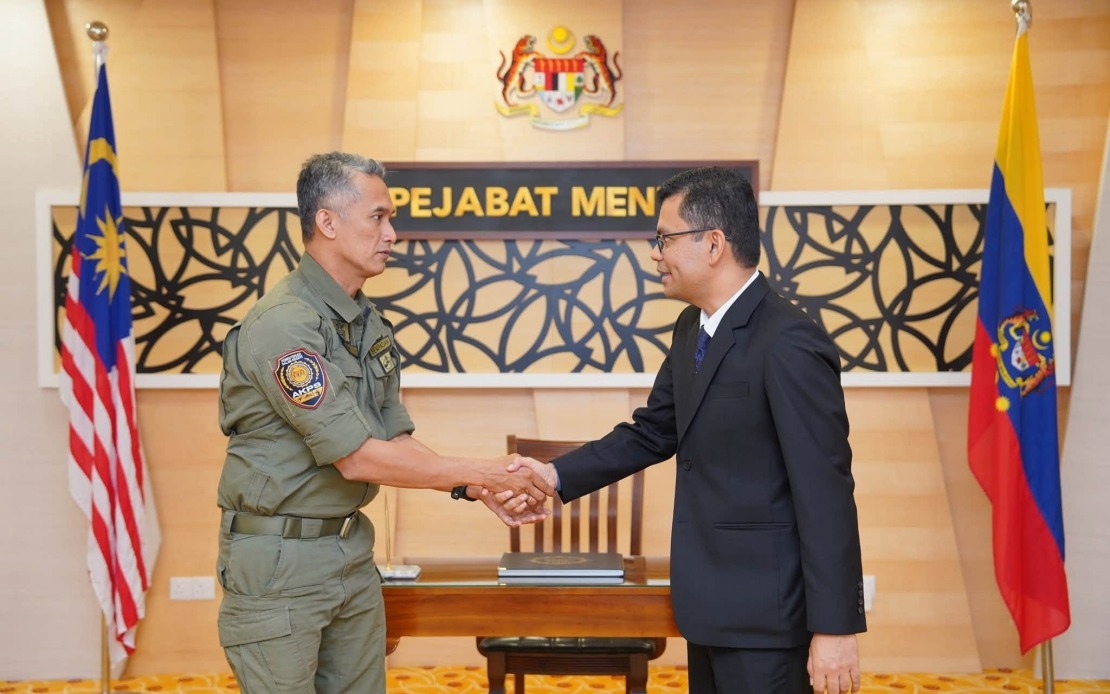
The Economy Ministry and Malaysia's fledgling Border Control and Protection Agency (AKPS) have begun mapping out the budgetary requirements needed to upgrade the country's border management infrastructure and control systems, according to discussions held in Putrajaya this week. The talks between Economy Minister Akmal Nasrullah Mohd Nasir and AKPS director-general Datuk Seri Mohd Shuhaily Mohd Zain underscore the government's commitment to modernising an institutional framework that has long been fragmented across multiple agencies with overlapping mandates.
The timing of these discussions is significant given that AKPS only commenced full operations on January 1, 2025, marking a watershed moment in Malaysia's approach to border governance. The agency represents a structural consolidation of control functions previously scattered among six separate government bodies, including the Immigration Department, Royal Malaysian Customs, the Malaysian Quarantine and Inspection Services Department, and several other enforcement agencies. This integration alone presents substantial logistical and technological challenges that require coordinated planning and investment.
The Economy Ministry's framing of border strengthening as an economic imperative rather than merely a security matter reveals how contemporary governments conceptualise border control. Modernised borders are increasingly viewed as critical infrastructure for trade facilitation and economic competitiveness. The ministry's statement acknowledged that enhanced AKPS capabilities would directly support smoother commercial movement, reduce bottlenecks at entry points, and ultimately contribute to more resilient economic growth. For Malaysian exporters and importers accustomed to congestion at ports and land crossings, this signals a recognition that inefficient borders act as a hidden tax on commerce.
The infrastructure modernisation agenda discussed encompasses several interconnected pillars. Development of strategic assets refers to the physical expansion and upgrade of border facilities themselves—checkpoints, scanning facilities, and processing infrastructure that has in many cases become outdated relative to trade volumes. Equally important are the technological systems being prioritised, which AKPS leadership has indicated will centre on integrated biometric identification, automated cargo inspection, and real-time data platforms powered by artificial intelligence. Such systems promise to dramatically accelerate processing times while simultaneously enhancing security by flagging anomalies that human inspectors might miss.
The adoption of smart border technology represents a particular departure from Malaysia's historical approach. Integrated biometric systems would enable officers to cross-reference travellers and cargo movements across multiple databases instantaneously, reducing the manual verification that currently consumes considerable time. Automated cargo scanning powered by AI can identify prohibited or contraband items without requiring physical inspection of every shipment. Real-time data integration means that information flows seamlessly between the six former agencies now operating under the AKPS umbrella, eliminating the intelligence silos that previously existed when Immigration, Customs, and quarantine operated independently.
This technological transition also carries implications for Malaysia's standing within regional trade networks. Southeast Asian trade increasingly depends on rapid, predictable border crossing times. Countries that successfully implement smart border systems gain competitive advantages in attracting logistics hubs, warehousing facilities, and transhipment operations. Singapore's highly automated port and Customs systems, for instance, have been instrumental in maintaining its position as a regional trading hub. Malaysia's investment in AKPS modernisation can be read as an effort to recapture some of this competitive ground, particularly given the country's strategic position on major shipping routes.
The human resource dimension underscores that technological solutions alone cannot succeed without institutional change. AKPS leadership has explicitly prioritised enhancing human resource capacity, which translates to recruiting, training, and retaining officers capable of operating sophisticated border systems. The transition from six separate agency cultures to a unified organisational identity requires substantial change management. Officers previously trained in specific disciplines—immigration, customs, quarantine—must now understand the broader border ecosystem and be capable of working across previous institutional boundaries. This represents a significant human capital investment distinct from hardware or software expenditures.
Operational efficiency gains depend on resolving the inherent friction between six distinct regulatory regimes now operating under one institutional roof. Immigration officers focus on travel document verification and entry eligibility; Customs officers on duty collection and trade compliance; quarantine inspectors on food safety and agricultural protocols; wildlife enforcement on illegal species trafficking. While all serve border control, their specific objectives sometimes pull in different directions. A streamlined AKPS requires clear protocols for how these competing priorities are reconciled, how decision-making authority is distributed, and how performance is measured across these diverse functions.
For Malaysian businesses engaged in cross-border trade, the implications are substantial. The cost of moving goods across borders—measured not just in tariffs but in time, uncertainty, and procedural complexity—influences competitiveness. Firms manufacturing in Malaysia for export to Thailand or Singapore, or importing components from Vietnam, are directly affected by border efficiency. Reduced clearance times translate into lower working capital requirements, faster inventory turnover, and improved ability to respond to market demand. For the logistics sector, which has become increasingly important to Malaysia's economy, border modernisation directly affects service quality and pricing.
The discussions between the Economy Ministry and AKPS also signal that border management is now firmly positioned as an economic policy tool rather than a mere administrative or security function. This represents a maturation in how Malaysia conceptualises its borders—not as obstacles to be minimised but as critical infrastructure requiring strategic investment. The integration of AKPS functions and the planned technological upgrades constitute one of the more significant institutional reforms undertaken in recent years, with potential ripple effects across Malaysia's trade-dependent economy.
Looking forward, the success of AKPS will depend on whether the promised funding materialises and whether the agency can genuinely integrate six disparate institutional cultures within a reasonable timeframe. The Economy Ministry's engagement suggests that financial resources may be forthcoming, but budget availability is only the first hurdle. Implementation challenges—ranging from technology deployment to staff retraining to inter-agency coordination—will ultimately determine whether AKPS lives up to the promise of modernised border management that both the ministry and the agency are currently articulating.

