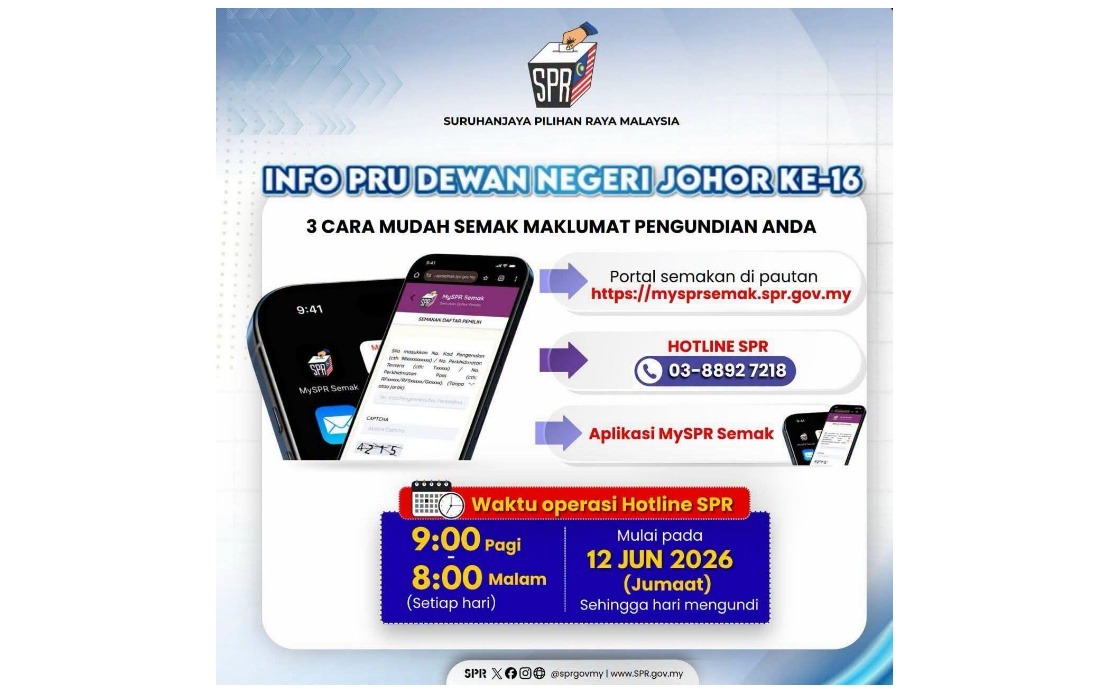
Malaysia's Election Commission has issued a timely reminder to the 2.7 million registered voters in Johor to verify their assigned polling locations and voting streams before the state election takes place on Saturday, July 11. The advisory comes as the country prepares for a significant electoral exercise that will determine representation in 56 state assembly constituencies, highlighting the importance of administrative preparation in large-scale democratic processes.
Voters seeking confirmation of their polling details have been directed to utilise two convenient digital channels: the MySPR Semak online portal or the dedicated MySPR Semak mobile application. This move reflects Malaysia's gradual digitalisation of electoral administration, allowing voters to access critical information independently without needing to visit physical locations or contact authorities. The platform's accessibility through both web and mobile interfaces underscores the Election Commission's recognition that citizens engage with government services through varied technological means.
The timing of this advisory is strategically important in the electoral calendar. With polling day just days away, voters still checking their assigned venues would have sufficient time to make logistical arrangements, particularly those who may need to travel within or across districts. This advance notice proves especially valuable for workers who might need to plan time off, parents requiring childcare arrangements, or elderly voters who may need transportation assistance to reach their polling centres.
Early voting has already demonstrated substantial participation levels across security personnel. A total of 19,471 military and police officers, including their spouses and members of the General Operations Force, exercised their voting rights on the preceding Tuesday. This early turnout segment—comprising 7,960 military-affiliated voters and 11,511 police personnel—illustrates both the organisational capacity of the Election Commission and the commitment of public sector employees to participate in democratic processes, even while on duty schedules that might otherwise prevent attendance on polling day.
The 16th Johor state election has attracted considerable political attention, with 172 candidates fielded across the 56 contested seats. The field includes established political coalitions and newer entrants. Pakatan Harapan and Barisan Nasional have each nominated 56 candidates to contest all available seats, representing the traditional two-bloc competition that has characterised Malaysian state politics. However, the race has become significantly more complex with Perikatan Nasional's 33 candidates, Parti Bersama Malaysia's 15 candidates, and MUDA's four nominees. Additionally, smaller movements including the Parti Orang Asli Malaysia and Parti Sosialis Malaysia have entered candidates, alongside six independent contenders.
This expanded candidate field reflects broader shifts in Malaysia's political landscape, where the traditional two-coalition contest has fragmented into a more heterogeneous competitive environment. Voters navigating this more complex ballot will benefit from clear information about polling procedures and locations. The presence of indigenous-focused representation through ASLI candidates and socialist alternatives through PSM demonstrates that electoral competition in Johor extends beyond mainstream coalitions to encompass ideological and community-based alternatives.
For Johor specifically, this state election carries implications extending beyond local governance into national political dynamics. As the country's southern economic engine and a crucial state in Malaysian federalism, electoral outcomes in Johor have historically influenced broader coalition mathematics at the national level. Voter preparation therefore contributes not merely to local representation but potentially to recalibrations of power across Malaysian politics.
The Election Commission's emphasis on individual voter responsibility—encouraging people to proactively check their details rather than waiting passively for information—represents a modernisation of democratic participation norms. By positioning voters as active participants in preparing for elections, the commission reinforces civic engagement beyond the act of voting itself. This approach acknowledges that electoral integrity and participation require coordination between authorities and citizens well before polling day arrives.
For Malaysian voters unfamiliar with their assigned polling centre location or unsure of their voting stream designation, the MySPR Semak platform offers straightforward resolution. Such systems prove particularly valuable in urban areas where rapid population movement may leave voters uncertain about their registered locations, or in constituencies where boundary changes have occurred since previous electoral cycles. The call to verify details can prevent day-of confusion and ensure smoother election administration.
As Johor prepares to exercise its democratic franchise, this administrative groundwork represents the essential infrastructure supporting meaningful electoral participation. The Election Commission's appeal to fulfil voting responsibility aligns with practical guidance that removes barriers to participation. With 2.7 million eligible voters poised to determine the composition of Johor's state assembly, ensuring that each voter can locate their polling centre without confusion or delay contributes significantly to the legitimacy and efficiency of the entire electoral process.

