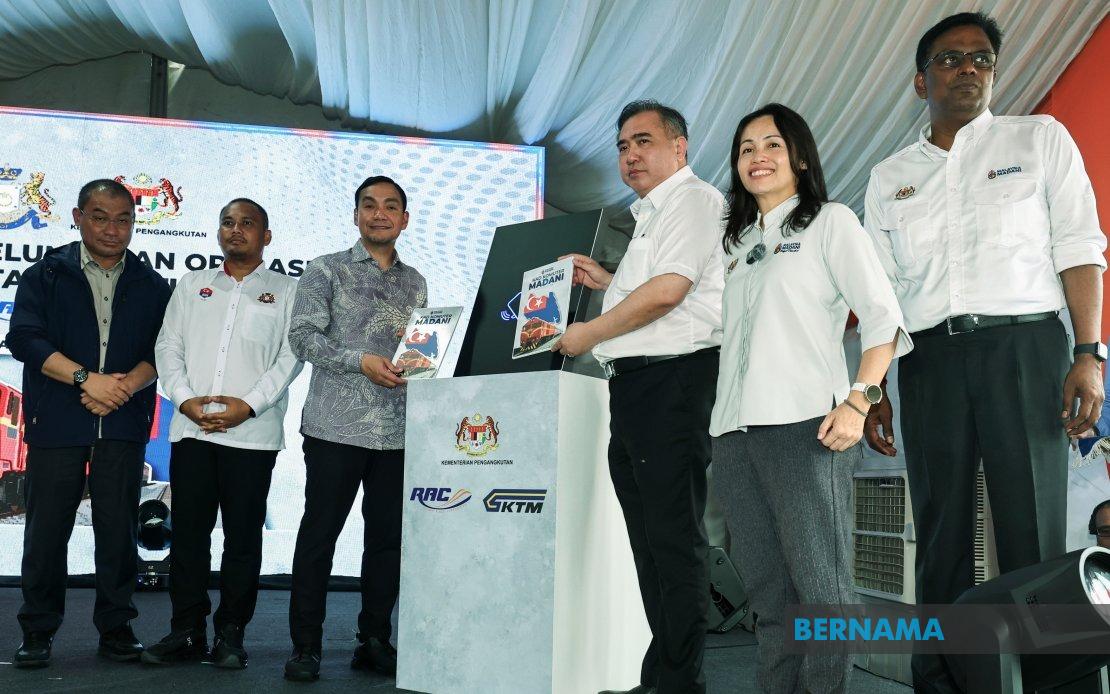
Johor Menteri Besar Datuk Seri Onn Hafiz Ghazi has underscored the critical importance of the Elevated Autonomous Rapid Transit (E-ART) project in safeguarding Johor Bahru from a traffic crisis once the Johor Bahru-Singapore Rapid Transit System (RTS) Link commences operations in 2025. Speaking at the launch of the Southern Shuttle train service at KTM Kulai Station, Onn Hafiz characterised E-ART as an essential long-term mobility infrastructure that must accompany the major cross-border transit facility to prevent gridlock from overwhelming the state capital.
The E-ART initiative represents more than an incremental transport improvement—it forms a cornerstone of Johor Bahru's capacity to absorb the surge in passenger volumes that the RTS Link will inevitably generate. When the railway connection opens, officials anticipate a substantial influx of commuters crossing the Johor Strait, fundamentally altering traffic patterns throughout the city. Without complementary infrastructure to redistribute these passenger flows away from roads, the existing network faces an acute bottleneck that could undermine the RTS Link's own effectiveness and negate its economic benefits.
Onn Hafiz acknowledged that interim measures currently underway provide temporary relief but fall short of addressing the structural challenge ahead. The state government is expanding Park & Ride facilities and deploying smart traffic management systems at JB Sentral to manage congestion in the near term. These initiatives, though necessary, amount to holding actions rather than permanent solutions. They buy time during the implementation window before the RTS Link commences and while E-ART remains under development, but they cannot substitute for a dedicated rapid transit network designed to carry high volumes of passengers across the city.
The scale of Johor Bahru's population underscores the urgency of the situation. With approximately 1.8 million residents, the state capital rivals Penang in demographic size, yet its public transport infrastructure has not evolved proportionally to accommodate such a large urban population. This mismatch between city size and transit capacity creates structural vulnerability, particularly as international movement through Johor Bahru intensifies. The RTS Link will catalyse demand for mobility within the city itself, as commuters arriving by rail will need rapid, efficient connections to their destinations across Johor Bahru.
Johor Bahru's role as Malaysia's primary international gateway amplifies the transport challenge. The city functions as the main portal for cross-border movement with Singapore, channelling both passenger and commercial traffic. This status brings economic opportunity but also imposes extraordinary strain on mobility infrastructure. An inefficient transport system delays goods movement, discourages commuters, and undermines the competitive advantage that Johor Bahru derives from its geographic position. The E-ART project must be understood within this broader context of regional economic integration and the city's responsibilities as a transnational hub.
Onn Hafiz's remarks reflect a strategic recognition that isolated infrastructure projects, no matter how ambitious, achieve limited impact without systemic coordination. The RTS Link alone, without supporting urban transit, cannot realise its full potential and may even exacerbate congestion by depositing passengers into a city with limited options for onward movement. E-ART provides the missing complementary system, enabling the RTS Link to function within a coherent mobility ecosystem rather than as a disconnected facility.
The Transport Minister Anthony Loke and Deputy Communications Minister Teo Nie Ching, who also serves as Kulai Member of Parliament, were present at the launch, signifying federal government engagement with the transport agenda. This ministerial attention suggests awareness at the federal level of the urgency surrounding Johor Bahru's transport crisis. The attendance of key federal officials alongside state leadership indicates potential alignment on the need to prioritise E-ART implementation, though commitment at the political level must translate into funding allocation and project acceleration.
Onn Hafiz framed E-ART as tangible federal intervention, emphasising that its successful delivery would constitute visible evidence of Kuala Lumpur's commitment to Johor's development. This framing carries political significance, as infrastructure investment in major cities influences public perception of government effectiveness. A well-executed E-ART project would demonstrate federal capacity to deliver on developmental promises, particularly in a state with complex federal-state relationships and high expectations for infrastructure quality.
The timeline presents both opportunity and constraint. The RTS Link is scheduled to open in 2025, providing approximately a 12-month window within which E-ART must demonstrate substantial progress. Delays in E-ART implementation would create a critical period where the RTS Link operates without adequate supporting transit infrastructure, potentially causing congestion that persists for years while E-ART construction proceeds. Conversely, accelerated E-ART development could enable a coordinated launch of both systems, maximising passenger convenience and system efficiency from the outset.