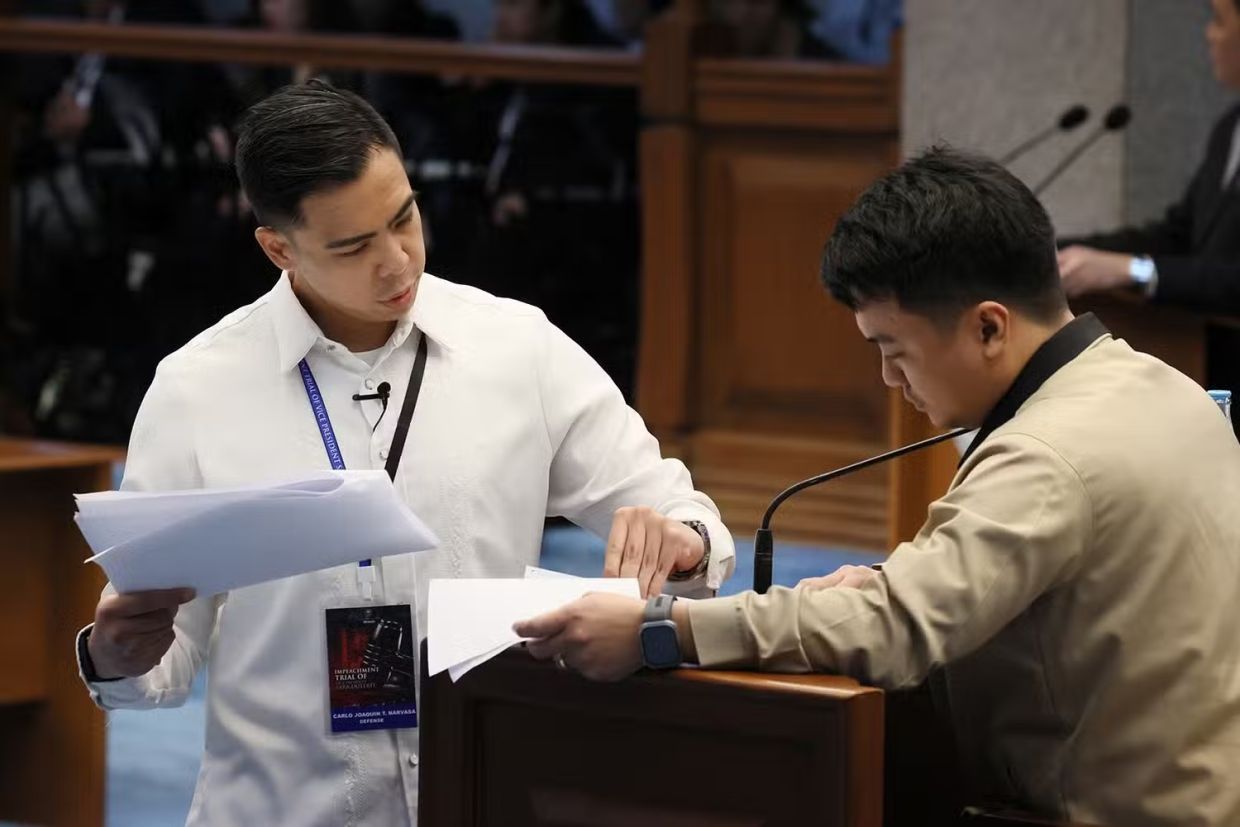
The impeachment trial of Philippine Vice President Sara Duterte advanced into its third day of hearings before the Senate impeachment court on Wednesday, with her legal team mounting a frontal challenge to the constitutional basis of the charges against her. Defence counsel argued that statements she made during an online press briefing on November 23, 2024, directed at President Ferdinand Marcos, First Lady Liza Araneta-Marcos, and former House Speaker Martin Romualdez, do not qualify as "other high crimes" under Article XI, Section 2 of the 1987 Constitution—the specific clause cited in the impeachment complaint as justification for her removal from office.
The prosecution's primary witness on the stand was National Bureau of Investigation senior agent John Mark Calilung, whose examination by defence lawyers Mark Vinluan and Carlo Narvasa revealed significant evidentiary gaps in the government's case. Rather than engage directly with accusations of wrongdoing, the defence strategy focused on dismantling the investigative foundation underlying the charges, questioning how thoroughly the NBI had pursued leads and whether proper procedures had been followed. The approach reflected a two-pronged defence: first, that the statements themselves did not constitute evidence of contracting an assassin, and second, that even if they had, such remarks would fall outside the constitutional definition of impeachable conduct.
Vinluan's core argument centred on the distinction between the Vice President acting in her official capacity versus her personal capacity as a private citizen responding to what the defence characterized as genuine threats to her family's safety. He contended that Duterte had been subjected to "unauthorised intelligence and surveillance operations by government agents" that exposed her household to security vulnerabilities, thereby justifying her unconventional public statements as a defensive measure rather than evidence of criminal intent. The defence presented video evidence from the November 23 briefing showing scenes of Duterte's chief of staff Zuleika Lopez in distress over her planned transfer to a correctional facility, framing the Vice President's subsequent remarks as contextual responses to perceived governmental persecution rather than premeditated threats.
Narvasa methodically challenged the investigative procedures employed by the NBI, highlighting that the bureau had conducted its inquiry "motu proprio"—of its own motion—without formal complaints filed by any of the three individuals allegedly threatened. Calilung acknowledged under cross-examination that he possessed no personal knowledge of whether Marcos, Araneta-Marcos, or Romualdez had submitted criminal complaints, nor had any of them appeared before the NBI to provide sworn statements. This procedural irregularity took on heightened significance given that the revised NBI affidavit dated February 10, 2025, contained no statements from the purported victims or the journalists present at the press briefing where the remarks were made.
The defence's questioning also exposed a fundamental evidentiary problem: the absence of any documentation showing Duterte had actually engaged someone to carry out violence. Vinluan repeatedly pressed the point that the prosecution had failed to present credible evidence of an assassination contract, noting that the prosecution itself had conceded during earlier questioning by Senator Risa Hontiveros that the video recordings did not "100 per cent" establish that Duterte had hired an assassin. Under this interpretation, the entire impeachment case rested on inferential reasoning and circumstantial context rather than direct proof of criminal behaviour.
The constitutional question at the heart of the proceedings proved equally contentious. The defence argued that even if Duterte's statements were deemed threatening, they would not satisfy the constitutional threshold for impeachment, which explicitly restricts removable offences to culpable violation of the Constitution, treason, bribery, graft and corruption, betrayal of public trust, and "other high crimes." By this reading, mere verbal threats—however inappropriate—would not qualify unless they could be tied to concrete criminal conduct such as conspiracy to commit murder. The prosecution's burden, the defence maintained, required demonstrating not just inflammatory language but an actual overt act in furtherance of an unlawful scheme.
Narvasa introduced what he termed a pattern of "systematic oppression" directed at Duterte and her associates by the House of Representatives, with particular emphasis on Representative Joel Chua, who now serves as one of the House prosecutors. The cited in contempt of Lopez and the broader investigative actions against Duterte's office created, in the defence's view, a backdrop of institutional harassment that contextualised her public statements. When Senator Hontiveros posed a question suggesting this logic might justify any grave threats made under circumstances of oppression, Narvasa clarified that the defence was not claiming threats could be categorically excused but rather that the circumstances must inform how the statements are legally characterised and whether they meet impeachable standards.
The impeachment court's presiding officer, Senator Francis Escudero, intervened at several points to constrain the scope of questioning, noting that the discussion had begun circling back to the central legal issue—whether Duterte's conduct constituted impeachable offences—which properly belonged to closing arguments rather than witness examination. Escudero's intervention reflected ongoing tension over the breadth of inquiry appropriate in impeachment proceedings. Senator Hontiveros countered that previous impeachment trials in the Philippines had permitted wider-ranging questioning by senator-judges, suggesting that procedural precedent supported more expansive examination of the legal boundaries of impeachability.
The defence's approach also targeted what it characterised as misinterpretation of Duterte's language. Vinluan argued that the term "assassin" had been supplied by external parties and media commentators who took her remarks out of context, rather than being explicitly stated by Duterte herself. This interpretive positioning sought to reframe the entire controversy as stemming from third-party embellishment and headline-driven distortion rather than clear, unambiguous statements of intent. By this logic, attributing to Duterte a plan to hire someone to commit murder represented a step beyond what her actual words supported.
Calilung's testimony also revealed practical limitations in the NBI's investigative methodology. He conceded that the agency had compiled its findings largely through internal interviews with investigators rather than gathering direct statements from victims or witnesses present at the November 23 briefing. The reliance on an affidavit attesting to the minutes of investigators' interviews, supplemented by Department of Justice certification of the preliminary investigation's sufficiency, fell short of the comprehensive evidentiary foundation typically expected in criminal proceedings. The absence of formal complainant-driven investigation appeared to concern even some prosecution-minded questions from the bench.
For Malaysian and Southeast Asian observers, the Duterte impeachment proceedings underscore the precarious position of vice presidents in presidential systems and the ease with which political conflicts can escalate into constitutional crises. The case demonstrates how allegations of threatening language can rapidly metastasize into formal removal proceedings, yet simultaneously reveals the significant evidentiary challenges prosecutors face in converting rhetorical excess into convictable or impeachable criminal conduct. The defence's strategy—questioning both the constitutional relevance of the charges and the adequacy of the investigation—mirrors legal tactics deployed in high-stakes political trials across the region.
The proceedings also illuminated ongoing disagreements about impeachment procedure itself, particularly regarding the scope permissible for senator-judges' questioning and the standards governing how political conduct should be translated into constitutional violation. These methodological disputes carry implications extending beyond Duterte's fate, potentially shaping how future impeachment trials proceed in the Philippines and signalling to other democracies in the region how questions of executive accountability intersect with procedural protections and evidentiary sufficiency. The trial's trajectory will likely turn on whether the Senate ultimately accepts the defence's distinction between objectionable rhetoric and constitutionally impeachable conduct.

