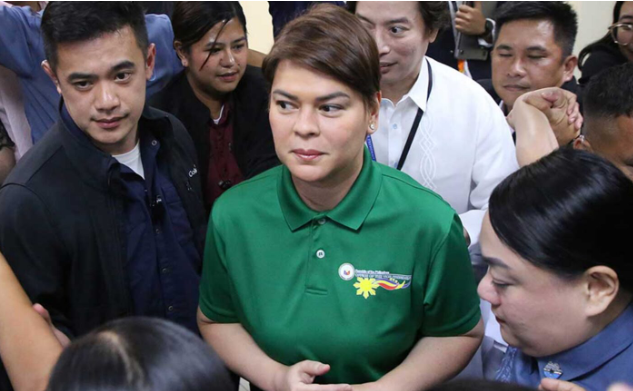
Vice President Sara Duterte doubled down on her defence on Tuesday as the impeachment trial examining the alleged assassination plot reached a critical juncture, with her legal team highlighting what they characterise as significant evidentiary gaps and procedural inconsistencies. Speaking ahead of proceedings on July 14, Duterte asserted that the complaint filed against her lacks the factual foundation required for such a serious charge, describing the case instead as a compilation of manufactured allegations designed to undermine her credibility. Her statement arrived as the trial began examining Article IV of the impeachment charges, the specific article addressing the kill plot that the vice president herself initially disclosed months earlier.
The defence team seized on testimony from NBI-Bangsamero Autonomous Region in Muslim Mindanao (BARMM) Regional Director Jeremy Lotoc during cross-examination by Duterte's lawyer Mark Vinluan, identifying what they argued were material inconsistencies in the dates recorded on affidavits and the corresponding docket numbers maintained in National Bureau of Investigation files. These discrepancies, the defence contended, expose fundamental problems with how the prosecution's case has been constructed and documented. Rather than establishing a coherent narrative supported by contemporaneous records, the defence suggested the prosecution's evidence reveals the kind of administrative sloppiness and potential manipulation that should concern jurors evaluating whether charges meet the threshold for removing a sitting vice president from office.
Duterte's public statement took on a more philosophical tone in challenging the entire framework of the case against her. She argued that repeatedly asserting threats without demonstrable evidence, inventing perpetrators lacking any independent corroboration, and manufacturing supporting documentation does not transform speculative narrative into verifiable fact—a pointed critique of what she frames as the prosecution's methodology. The vice president emphasised that such tactics, beyond failing to prove her culpability, carry broader institutional consequences by corroding public confidence in the justice system and consuming government resources that might otherwise address matters of genuine public concern. Her language suggested frustration with what she perceives as a politically motivated proceeding built on foundations of supposition rather than rigorous investigation.
The underlying procedural reality supporting Duterte's critique is stark. The House prosecution panel has presented only two witnesses thus far and has consumed merely a fraction of the eleven days allocated to them for examining Article IV, meaning substantial testimony remains ahead. The prosecution's languorous pace through available testimony time frames raises tactical questions about either the strength of their case or their strategy for stretching proceedings. The entire impeachment trial is projected to extend across ninety-two days, a timeline that would carry the proceedings into early 2027 if adhered to, placing the resolution of the charges well beyond the remainder of the current congressional session and potentially into the next administration's opening months.
Notably, Duterte has not attended the trial in person, opting instead to monitor proceedings and respond through written statements issued by her communications team. This absence could be interpreted in multiple ways—either as a calculated strategy to avoid providing ammunition for prosecution arguments or as a demonstration of her confidence in her legal team's ability to dismantle the case through cross-examination and procedural challenges. The psychological and optics dimensions of her absence merit consideration within the Filipino political context, where physical presence at such high-stakes proceedings carries symbolic weight.
The invocation of rule of law principles in Duterte's statement represents a rhetorical escalation beyond simple denial. By positioning her defence within a framework emphasizing the primacy of facts over speculation and the dangers of institutional corruption through manufactured evidence, she attempts to shift the trial's underlying debate from whether she committed specific acts to whether the prosecution has met the constitutional burden required to remove a vice president. This constitutive challenge strikes at the legitimacy not merely of the charges but of the entire proceeding itself, should the public come to accept her characterization of the evidence as substantively hollow.
The assassination plot itself originated as a revelation by Duterte weeks before the impeachment process commenced, when she disclosed publicly that she had instructed police officials to kill President Marcos, First Lady Liza Marcos, and former Speaker Martin Romualdez should anything happen to her. The extraordinary nature of this disclosure—made without apparent constraint or equivocation—created the factual matrix from which the impeachment complaint emerged. That the person now defending against charges arising from this plot has characterized the investigation into its legitimacy as fundamentally compromised by lack of evidence presents a paradox that lies at the emotional centre of the trial's political narrative.
For Malaysian observers of Philippine politics, the impeachment proceedings offer instructive parallels regarding institutional stress within democratic systems when political opposition crystallizes into constitutional processes. The Malaysian experience with investigative commissions and parliamentary procedures demonstrates how procedural rigour becomes essential when fundamental political relationships face rupture. The Duterte case illustrates how evidentiary standards and administrative consistency shape not merely individual cases but public perception of institutional integrity—a lesson equally relevant to Southeast Asian democracies where institutional legitimacy remains contested.
The timeline projection to early 2027 carries political ramifications extending beyond the immediate trial verdict. Congressional attention consumed by impeachment proceedings necessarily detracts from legislative agenda-setting, budgetary deliberations, and other governance functions. The extended duration likewise allows public attention to dissipate, potentially eroding the political momentum that initiated the impeachment process. Duterte's suggestion that the case rests on fabrication rather than fact, if accepted by sufficient portions of the Philippine public, could gradually shift the trial from a mechanism for accountability into an exemplar of institutional dysfunction—a transformation potentially more damaging to the prosecution's broader political objectives than acquittal alone would represent.
As the Senate impeachment court prepares to receive additional testimony and contemplate the evidence presented thus far, the foundational question regarding evidentiary sufficiency will likely dominate the institutional and political analysis surrounding the proceedings. Whether the inconsistencies identified by the defence team represent material defects or merely administrative oversights will shape how observers assess whether the prosecution has constructed a credible case or merely a narrative assertion lacking the documentary and testimonial weight that grave constitutional charges demand.

