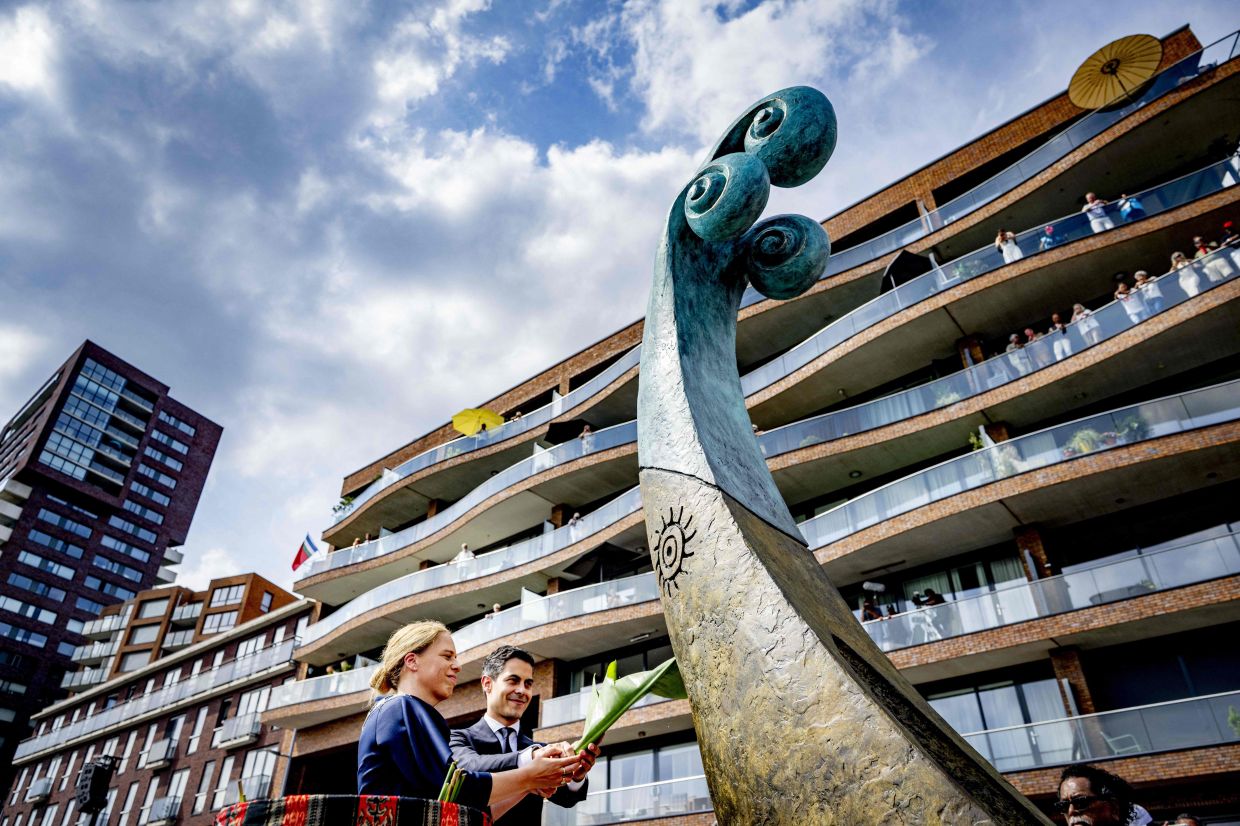
Dutch Prime Minister Rob Jetten delivered a formal state apology on Sunday to members of the Moluccan community in Rotterdam, acknowledging the Netherlands' systematic mistreatment of these people from Indonesia's eastern spice islands over more than seven decades. The ceremony, marking a significant moment in Dutch-Indonesian relations, included the unveiling of the Ulu Kora monument at Lloydkade, the very Rotterdam dock where the first ships carrying Moluccans arrived in the post-war period. Jetten's words, delivered to hundreds of community members many carrying photographs of deceased relatives, represented the Dutch government's formal recognition of what it termed a chapter of profound injustice.
The historical roots of this tragedy trace back to the final years of Dutch colonial rule in the East Indies. As Indonesia fought for independence following World War II, approximately 12,500 Moluccans who had served in the Dutch colonial military faced a precarious situation. These soldiers and their families, hailing from the remote spice islands of eastern Indonesia where Dutch influence had been particularly entrenched, became caught between competing loyalties and political realities. When Indonesia achieved independence in 1949 through negotiated settlement, these Moluccans suddenly found themselves in an impossible position—loyal to the Dutch crown but now citizens of a newly sovereign Indonesia where such allegiances carried mortal danger.
The Dutch government's initial response appeared humanitarian. Rather than abandon these vulnerable people to potential retribution in their homeland, the Netherlands arranged what was presented as a temporary relocation. Around 12,500 Moluccans, including soldiers and their families, were transported to the Dutch port in a state-organised transfer programme. The arrangement was explicitly temporary—a bridge measure intended only until conditions in Indonesia stabilised and they could safely return home. This represented a crucial element of the wider decolonisation negotiations between the Dutch and Indonesian governments at the time. The promise of repatriation was never mere rhetoric but rather a formal commitment underpinning the entire arrangement.
Yet what was promised never materialised. Instead of brief temporary shelter, the Moluccans found themselves trapped in an indefinite limbo that would stretch across generations. The Dutch government simply abandoned its repatriation obligations, leaving thousands in limbo. Upon arrival, discharged Moluccan soldiers were immediately separated from the Dutch military structure, their service credentials rendered meaningless. Many were housed in former concentration camps that the Nazis had used to imprison Jews during World War II's occupation of the Netherlands—a particularly traumatic choice of accommodation for people already traumatised by displacement and uncertainty.
The living conditions imposed on the Moluccan population reflected institutional neglect rather than temporary difficulty. Housing arrangements were grossly inadequate, with overcrowding and poor sanitation becoming endemic features of their existence. The Dutch made little genuine effort to facilitate employment opportunities or meaningful integration into broader society. Instead of investing in education, job training, or language instruction that might have eased their transition, the Moluccans were largely confined to separate communities. Their status remained ambiguous—no longer soldiers, not yet civilians, unable to return home, and unwelcome in mainstream Dutch society. This systematic marginalisation created a population of traumatised people suspended between worlds, mourning a homeland they could not reach and strangers in an adopted country that did not want them.
The psychological and social consequences of this betrayal reverberated across generations. First-generation Moluccans never abandoned hope of returning, clutching memories and photographs of home while enduring years of abandonment. Their children, the second generation born in the Netherlands or arriving as infants, inherited their parents' longing alongside a growing awareness of Dutch culpability. This toxic combination produced the violent incidents that erupted during the 1970s as young Moluccans, feeling profoundly betrayed by the Dutch state, took dramatic actions to express their rage and draw attention to their community's plight. These incidents, though widely condemned, reflected the depth of desperation and disillusionment that decades of neglect had created.
Prime Minister Jetten's formal apology, delivered Sunday, acknowledged the multidimensional nature of this injustice. He specifically apologised for inadequate reception and housing, for the systematic invisibility imposed on the community, for the unfulfilled longing to return home, and for the grief and psychological damage inflicted on countless families. His words represented not merely personal regret but a governmental acknowledgement of institutional responsibility. Yet Jetten himself recognised the limitations of his apology, stating clearly that words alone cannot undo historical damage or repair the lives disrupted by decades of broken promises. The monument unveiling served as a physical marker of recognition, transforming a forgotten chapter of Dutch history into something that could no longer be ignored or minimised.
For Malaysia and broader Southeast Asia, this formal apology carries important implications regarding historical accountability and decolonisation's unfinished business. The Moluccan case illustrates how the formal transfer of sovereignty in 1949 did not automatically resolve the human complications of colonial rule. Many former colonies throughout Southeast Asia contain similar populations displaced by war, migration, or political upheaval—communities whose histories remain contested or forgotten. The Dutch government's decision to formally acknowledge its obligations and apologise for breaking them establishes a precedent for how wealthy former colonial powers might address their historical debts. In Malaysia's own context, where communities remain divided by competing historical narratives regarding the colonial period and independence, the Moluccan example demonstrates both the long-term costs of ignoring injustice and the potential value of genuine official recognition.
The Moluccan story also reflects broader patterns within Southeast Asian decolonisation where promises made during independence negotiations were subsequently abandoned or forgotten. The interim period between formal colonial rule ending and new nation-states consolidating power created vulnerable populations caught between old and new systems. For contemporary Malaysian observers, understanding the Moluccan experience provides context for similar historical grievances that persist across the region—minority communities who feel abandoned by governments, whose contributions to nation-building are forgotten, and whose suffering remains unacknowledged by official histories. Jetten's apology, while decades late and inadequate to repair all damage, at least demonstrates that such recognition is possible and perhaps necessary for genuine reconciliation.
The ceremony in Rotterdam on Sunday thus represents more than a bilateral moment between the Netherlands and Indonesia. It represents an acknowledgement that the colonial era and its immediate aftermath created obligations that do not expire with the granting of formal independence. The Moloccans' seventy-year wait for justice illustrates how decolonisation remains an ongoing process rather than a discrete historical event. For Southeast Asia, where similar histories of displacement, broken promises, and marginalised communities remain largely unresolved, the Dutch government's formal apology suggests that accountability for historical injustice remains both possible and important—though only after considerable delay and continued suffering by those affected.

