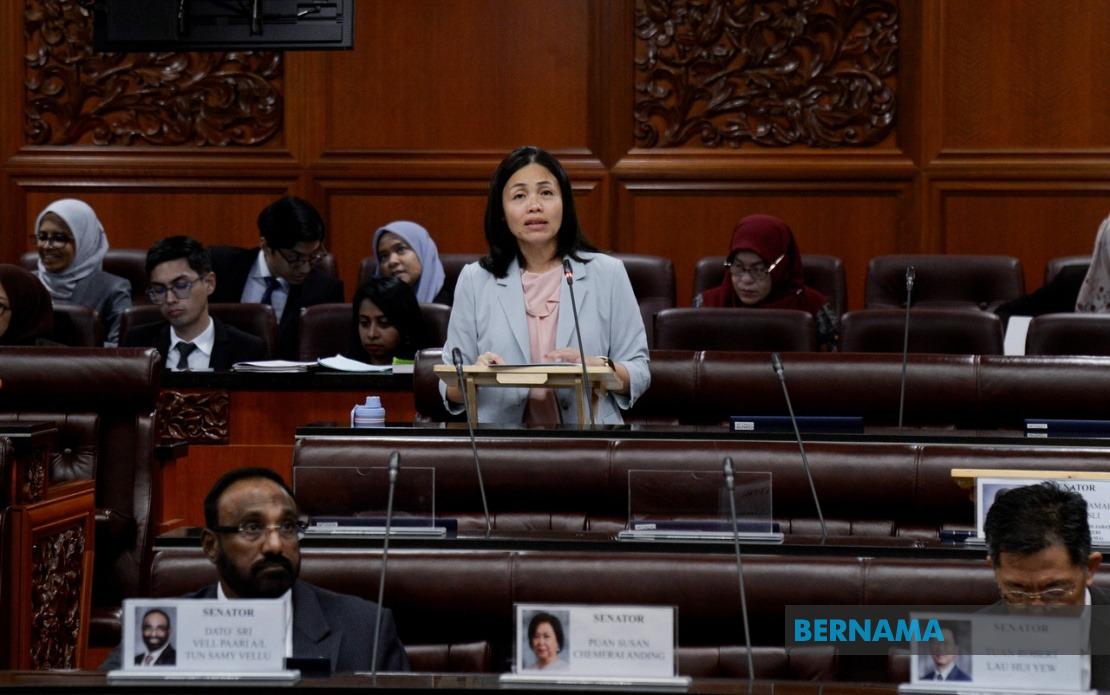
Malaysia's Dewan Negara gave final parliamentary approval to the Communications and Multimedia Commission (Amendment) Bill 2026 on August 3, marking a significant step toward restructuring how the country's digital and communications sectors are governed. The legislation secured passage through a majority vote following substantive debate among 11 Senators, setting the stage for Malaysia to navigate increasingly complex challenges in the digital sphere.
The amendment package addresses a critical gap in Malaysia's regulatory framework: the need to insulate the communications regulator from political interference while equipping it with sharper enforcement tools. Deputy Minister of Communications Teo Nie Ching highlighted during the closing session that one of the Bill's core provisions explicitly bars politicians from serving as chairman of the MCMC. This restriction—which prevents members of Parliament and state assemblymen from holding the top position—signals a deliberate effort to depoliticise the commission and ensure appointments reflect merit and expertise rather than factional considerations. The minister emphasised that limiting ministerial discretion in selecting the chairman serves to guarantee the appointee's genuine professional credentials.
The enforcement track record presented during debate underscores why such governance reforms have become urgent. Between 2022 and July 31 of this year, the MCMC oversaw the removal of nearly 290,000 pieces of online gambling content from digital platforms, with the rate of takedowns accelerating sharply year on year. The data reveals only two instances of content removal in 2022, scaling to 18,814 by 2023, before jumping dramatically to 189,484 in 2024 and 289,486 in 2025. In the first seven months of 2026 alone, the commission had already catalysed the removal of 222,257 gambling-related items. These figures suggest that either the digital proliferation of illegal gambling operations has spiralled or—more likely—that enforcement agencies have grown considerably more effective at identifying and acting on such content.
Parallel to content removal efforts, the MCMC has worked with service providers and enforcement agencies to block access to gambling websites entirely. Since 2022, the combined operations have resulted in the closure of access to 6,982 gambling domains. However, Senator observations during debate noted that this technical blocking capacity must be understood within a broader institutional context: the Royal Malaysia Police maintains primary investigative and enforcement jurisdiction over gambling activities themselves, while the MCMC functions as a technical enabler, providing digital forensic analysis and access restrictions upon official request.
Senator Datuk Abdul Halim Suleiman framed the amendment within a larger strategic perspective, characterising communications and multimedia infrastructure no longer as merely an economic sector but as critical national infrastructure akin to electricity or water supply. This conceptual shift carries profound implications for how Malaysia approaches cybersecurity, digital resilience, and the protection of digital assets against foreign interference and domestic threats. If communications infrastructure is indeed strategic—a position increasingly accepted across Southeast Asia—then the regulator overseeing it must operate with both sufficient power and sufficient insulation from short-term political pressures that might compromise its long-term mission.
Senator Muhammad Hasbie Muda pressed for a deeper examination of merit-based appointment processes, cautioning that legislative reform alone cannot guarantee effective governance. His intervention highlighted a common implementation challenge across Asia: that laws granting agencies broader powers can become counterproductive if those agencies lack the technical capacity, financial resources, or organisational culture to wield them transparently and accountably. True reform, he argued, requires not merely expanding MCMC's functions and authority but ensuring each power is deployed with institutional rigour, public transparency, and clear mechanisms for holding the regulator itself answerable to the public interest.
The Bill itself comprises 17 substantive clauses, with several targeted amendments to Section 16 of Act 589, the foundational legislation establishing the MCMC. These amendments clarify and expand the commission's mandate to develop and regulate digital infrastructure standards and platform governance protocols. This language is significant: it grants the MCMC explicit responsibility for shaping the technical and operational standards that digital platforms must meet, moving the regulator from a reactive enforcement body toward a more proactive architect of Malaysia's digital ecosystem.
The legislative journey reflects considered deliberation. The Dewan Rakyat passed the Bill on July 15, and the upper house's approval on August 3 followed focused debate that examined governance, enforcement capacity, and institutional independence. The timing is noteworthy given Malaysia's regional context. Across Southeast Asia, communications regulators face mounting pressure from illegal online gambling operations, cybercriminal networks, and foreign actors seeking to exploit digital vulnerabilities. The amendment reflects a recognition that Malaysia's regulatory framework had developed asymmetrically—strong enough to demand actions from platforms and service providers, but potentially vulnerable to political capture at its apex.
The explicit prohibition on political figures serving as MCMC chairman must be read against the backdrop of governance debates occurring throughout the region. Several Southeast Asian nations have grappled with questions about whether regulatory bodies can maintain genuine independence while operating within parliamentary systems where Ministers formally appoint leaders. Malaysia's solution—categorical exclusion of elected officials—represents a firmer boundary than some comparable jurisdictions have adopted, potentially setting a regional precedent for how communications regulators can be insulated from electoral cycles.
Looking forward, the amendment's real-world effectiveness will depend on implementation. The MCMC will inherit expanded authority over digital platform standards precisely when such standards are becoming increasingly contested globally. Questions about content moderation, data privacy, artificial intelligence governance, and platform accountability will test whether the commission can exercise its powers with the professionalism and transparency that Senator Muda advocated. Malaysia's move toward a depoliticised regulator with explicit infrastructure responsibilities positions the country to engage more confidently in regional and international discussions about digital governance.
For Malaysian technology companies, telecommunications firms, and platform operators, the amendment signals that regulatory expectations will intensify. The MCMC's clearer mandate to develop and enforce digital infrastructure standards means that voluntary compliance frameworks may increasingly be replaced by prescriptive technical requirements. This shift creates both compliance costs and potential competitive advantages for firms capable of integrating those requirements efficiently. The amendment also sends a subtle message about Malaysia's approach to digital sovereignty: the nation intends to maintain significant regulatory control over the communications sector rather than ceding that control to market forces or international platforms.
The passage of this Bill reflects Malaysia's assessment that its digital economy has matured beyond the point where minimal regulation suffices, and that strategic sectors require institutional safeguards against both external threats and internal political interference. Whether the MCMC will fully live up to the independence and capacity that this amendment envisions remains an open question—but the legislative foundation has been deliberately reinforced.

