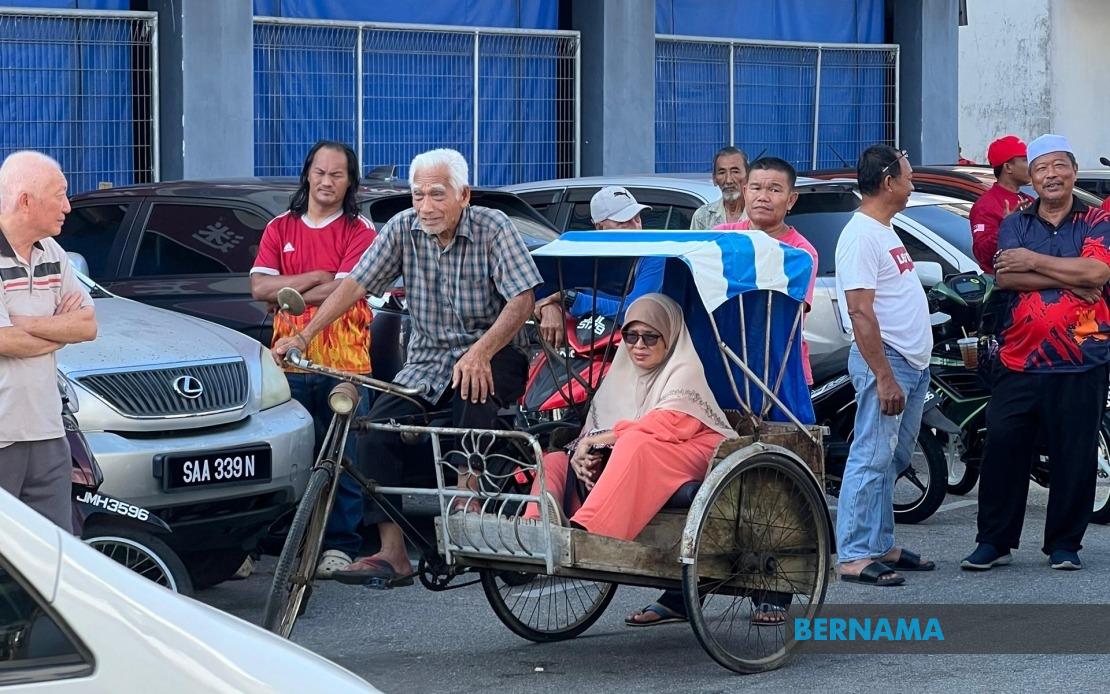
In a touching display of devotion that underscores the personal connections many Malaysians maintain with their political leaders, an 86-year-old man from Batu Pahat took to his trishaw to escort his wife nearly a kilometre through sweltering weather so she could catch sight of Prime Minister Datuk Seri Anwar Ibrahim up close. Abdul Razak Pelangga and his wife Jamilah Samsudin made the modest journey from their home in Kampung Parit Bugis to Kedai Kopi Hailam Sri Medan, where Anwar had scheduled a breakfast stop as part of his campaign engagements ahead of the Johor state election.
Abdul Razak, who serves as an imam at Masjid Raudhatul Jannah Parit Bugis, explained that his decision to deploy the trishaw rather than motorised transport was rooted in practical considerations. The absence of readily available parking spaces near the coffee shop made the three-wheeled vehicle a sensible choice, he reasoned, even though alternative modes of transport were technically available to him. His willingness to exert physical effort in the oppressive midday heat reflects both his commitment to accommodating his wife's wishes and a certain pragmatism about navigating the logistics of public appearances in a busy commercial area.
The couple's eagerness to witness the Prime Minister stems from a decades-old memory etched in Abdul Razak's mind. Many years before Anwar ascended to the nation's highest office, he visited the mosque to lead congregational prayers. That encounter left a lasting impression on Abdul Razak, who fondly recalls the friendly manner in which the then-opposition figure greeted him after the service. He had shared this treasured anecdote with his wife multiple times over the intervening years, transforming it into a cherished part of their shared narrative. When word reached him that Anwar would be stopping in Senggarang, the opportunity to bring Jamilah into that story in a tangible way seemed too significant to pass up.
The couple's experience at the coffee shop underscores the challenges that accompany any high-profile public appearance. Although thick crowds prevented Abdul Razak and Jamilah from achieving face-to-face contact with the Prime Minister, they succeeded in their primary objective: witnessing him in person rather than through the mediated lens of television. For two individuals who had hitherto only watched Anwar's political activities through broadcast media, this physical proximity—even amid a throng of onlookers—represented a meaningful milestone.
Anwar's visit to Batu Pahat formed part of a broader engagement strategy titled the PMX Meet-and-Greet Programme, specifically targeting the Senggarang state constituency. The breakfast event stretched to approximately fifty minutes, during which the Prime Minister mingled extensively with local residents and constituents. The timing and location of such visits reflect the intensive ground-level campaigning that characterises Malaysian electoral contests, where direct interaction between leaders and voters carries considerable political and symbolic weight.
Datuk Fahmi Fadzil, who holds the dual role of Pakatan Harapan Communications Director and Communications Minister, was also present during the engagement. His attendance underscores the importance accorded to the event within the coalition's campaign apparatus, signalling that the breakfast stop represented more than a routine public relations exercise but rather a coordinated effort to maintain visible momentum in the state.
Beyond the immediate spectacle of the trishaw journey, Abdul Razak's narrative reveals deeper currents within Malaysian political culture. His repeated emphasis on fulfilling his civic duty—particularly his intention to vote on July 11, which coincides with his 87th birthday—demonstrates how electoral participation remains woven into the fabric of personal identity and family obligation among older voters. The alignment of his birthday with polling day strikes him as fortuitous, investing the act of voting with additional personal significance and emotional resonance.
The 16th Johor state election represents a consequential political moment, with early voting scheduled for July 7 and main polling day set for July 11. Abdul Razak's determination to exercise his franchise on his birthday speaks to the emotional investment many Malaysians, particularly those from older generations, maintain toward democratic processes. Having participated in multiple elections throughout his life, he views this particular exercise as qualitatively different, endowed with special meaning by the confluence of personal and political timelines.
The story of Abdul Razak and Jamilah's trishaw expedition also illuminates the enduring symbolic importance of informal modes of transport within Malaysian society. The trishaw, often associated with heritage tourism and nostalgic reminiscence, served here as a practical tool for civic participation. Rather than consigning it to the realm of quaint historical relic, Abdul Razak's use of his trishaw as a vehicle for political engagement demonstrates how traditional transport methods continue to facilitate real participation in contemporary democratic life.
Moreover, the incident reflects the softer dimensions of political engagement that exist alongside more formal campaign machinery. While major political parties deploy sophisticated communication strategies and resources, moments like Abdul Razak's journey carry their own potency. The image of an octogenarian pedalling through the heat to bring his wife into proximity with a national leader encapsulates values—persistence, dedication, family affection, civic consciousness—that resonate across demographic and educational boundaries within Malaysian society.
As the Johor state election campaign intensifies, stories such as this one provide snapshots of how ordinary citizens experience and interpret the political process. For Abdul Razak and Jamilah, the exercise transcended abstract notions of partisan politics; it became a personal quest rooted in years of accumulated memory, family aspiration, and an understanding of voting as an obligation intertwined with individual identity. Their trishaw ride through Batu Pahat's streets stands as a modest yet eloquent testament to the ways in which political life intersects with the intimate geography of personal experience.

