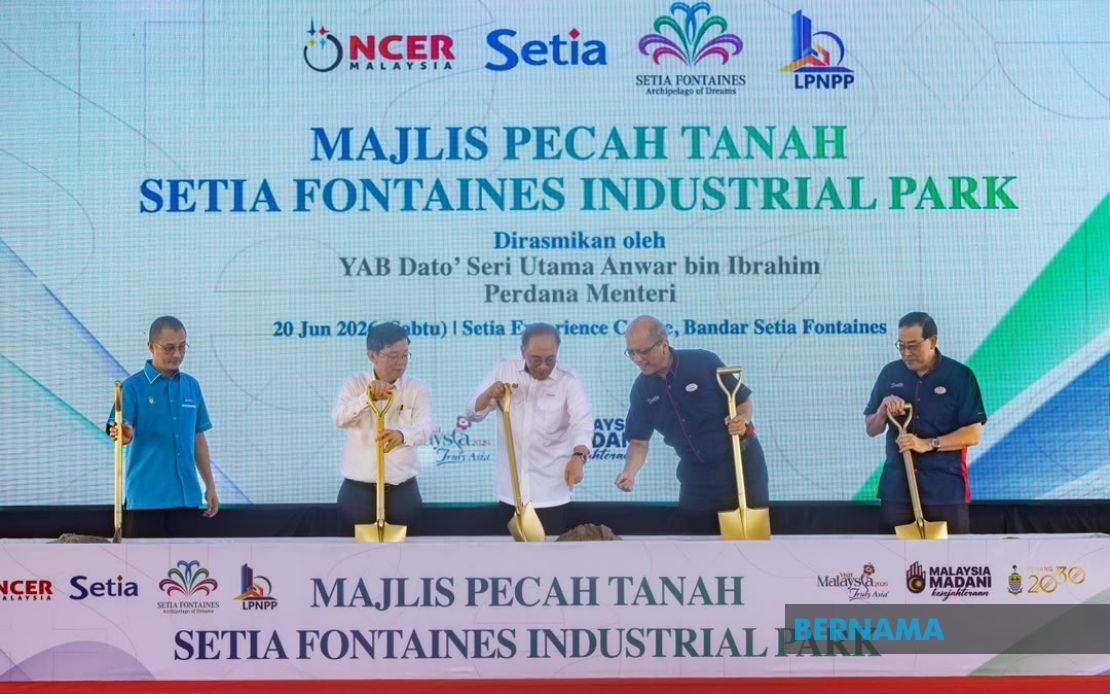
Prime Minister Datuk Seri Anwar Ibrahim has delivered a forceful message on inclusive economic development, insisting that government-linked entities and private corporations must deliberately design projects to benefit middle- and lower-income communities rather than concentrate wealth among elites. Speaking at the groundbreaking ceremony for the Setia Fontaines Industrial Park in Bandar Setia Fontaines, Kepala Batas, Anwar framed equitable opportunity as essential to social cohesion as Malaysia accelerates its growth trajectory across multiple sectors and regions.
The Prime Minister's remarks signal mounting concern within government circles that rapid expansion and rising investment flows risk entrenching economic disparities if benefit-sharing mechanisms are not systematically embedded in major projects from inception. Rather than viewing inclusive growth as a peripheral social consideration, Anwar positioned it as a core strategic imperative that directly impacts national stability and the legitimacy of development programmes. His statement reflects a deliberate policy pivot toward ensuring that prosperity reaches beyond traditional beneficiary networks and corporate insiders.
Anwar outlined his expectations for major institutional investors, specifically naming Khazanah Nasional Berhad, Permodalan Nasional Berhad (PNB), and the Employees Provident Fund (EPF) as entities whose project approvals must incorporate provisions for lower-income participation. He warned that without such deliberate inclusion, Malaysia would witness a compounding wealth divide that simultaneously constrains opportunities for disadvantaged communities. This language suggests the government is preparing to implement or strengthen conditions attached to development approvals, potentially through formal policy amendments or administrative guidance to these agencies.
The Prime Minister reframed how Malaysia should evaluate economic success, moving away from reliance on aggregate investment figures and headline growth statistics toward measurable improvements in living standards across income segments. This distinction carries significant implications for how government agencies track and report development outcomes, implying that future assessments of project viability may increasingly incorporate inclusive prosperity metrics alongside traditional financial returns. For investors and corporations, this signals a shift in regulatory expectations and reputational risk calculations.
The Setia Fontaines Industrial Park itself serves as a case study in regional equity concerns. Located in Seberang Perai, the park is positioned to accelerate economic activity on the mainland side of Penang State, where development has historically lagged behind George Town and the island's established commercial zones. Anwar explicitly framed the project as part of efforts to ensure that Seberang Perai's growth trajectory aligns with the momentum on the island and in southern Penang, suggesting that geographical imbalance within states remains a policy priority for his administration.
The industrial park development is expected to generate employment aligned with Malaysia's strategic pivot toward high-value manufacturing and advanced technology sectors, moving beyond the lower-margin back-end assembly operations that have historically dominated certain regions. This repositioning presents both opportunity and risk for local workers, as employers will demand skills that current labour forces may lack. Anwar acknowledged this skills gap as a potential constraint on job creation, framing it not as an insurmountable obstacle but as a coordination challenge between multiple institutional stakeholders.
Anwar emphasised that collaboration among private industry, technical and vocational training providers, and higher education institutions must intensify to ensure the workforce possesses capabilities aligned with emerging sectoral needs. He specifically highlighted Universiti Sains Malaysia as a potential partner in this ecosystem, though his comments suggest the government intends to broaden such partnerships across multiple academic institutions. This approach reflects recognition that market forces alone will not automatically produce workforce readiness, necessitating deliberate public-private coordination around skills development.
The Prime Minister stressed that rapidly evolving technology creates a moving target for training programmes, with significant sectoral shifts occurring within one to two years. This observation carries sobering implications for conventional vocational and educational planning cycles, which typically operate on longer timescales. Anwar's comments suggest the government may need to fundamentally restructure how training systems update curricula and deliver instruction, potentially incorporating more dynamic, employer-led components that allow faster adaptation to technological change.
Anwar's inclusive growth framework intersects with Malaysia's broader challenge of maintaining political stability amid rising middle-class expectations and persistent inequality. By explicitly tying development project approvals to inclusive opportunity creation, his administration is attempting to redirect economic gains toward constituencies that might otherwise feel excluded from prosperity, thereby reducing political alienation among lower-income voters. This framing also reflects lessons drawn from social tensions in other Southeast Asian economies where rapid but unequally distributed growth has fuelled political polarisation.
For Malaysia's corporate sector and institutional investors, Anwar's statements effectively constitute informal policy guidance that project approvals will increasingly depend on demonstrable inclusive design features. Companies and funds accustomed to maximising shareholder returns without explicit community benefit provisions may face heightened scrutiny and political pressure. The government appears to be signalling that future investments will be evaluated not solely on financial metrics but on their contribution to reducing wealth concentration, though the precise mechanisms for enforcing such expectations remain somewhat ambiguous at this stage.

