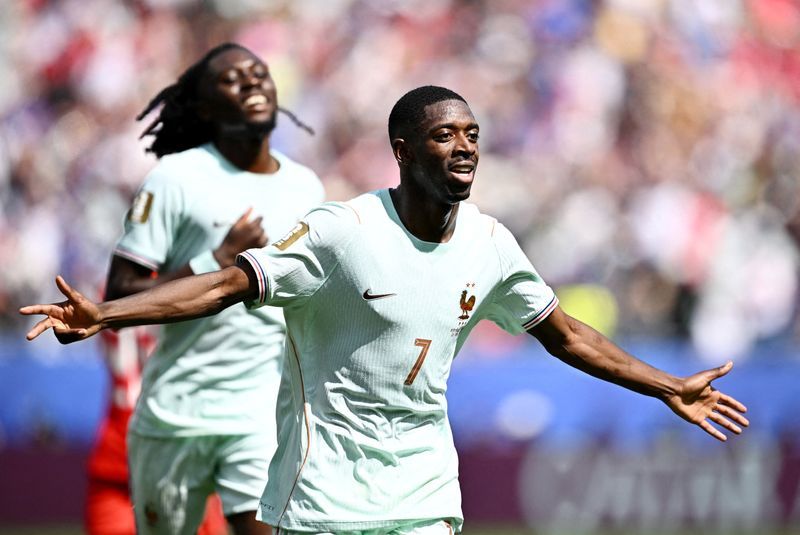
Ousmane Dembele's explosive first-half display has sent France through to the World Cup knockout stages with maximum momentum, the PSG winger striking a remarkable hat-trick to dismantle a drastically weakened Norway side 4-1 in Foxborough, Massachusetts. The clinical performance underlined why Didier Deschamps' team remains among the tournament's elite, despite the French coach's absence in attendance due to a family bereavement.
Dembele's three-goal barrage, accomplished in a bewildering 25-minute spell, marked only the third instance of a French player achieving a World Cup hat-trick. The feat places him alongside legendary striker Just Fontaine and current superstar Kylian Mbappé in that exclusive club, though his performance proves the supporting cast remains capable of delivering moments of genuine brilliance. The timing of his goals—delivered with clinical finishing against a vulnerable backline—signals that France possess multiple avenues for scoring threats as the tournament deepens.
France entered Friday's encounter already assured of passage to the knockout round, as had their Scandinavian opponents, yet the group's top seed carried genuine importance for tournament logistics. The winner's bracket promises a significantly lighter travel burden across the tournament's sprawling North American venues, a considerable advantage when fatigue and recovery become decisive factors in knockout football. By securing first place, France have positioned themselves optimally, likely avoiding the tournament's more daunting early knockout matchups.
Kylian Mbappé's role in orchestrating the attack demonstrated the interplay between France's primary attacking weapons. The Paris Saint-Germain forward, who arrived in the United States as a leading contender for the Golden Boot award, was directly involved in manufacturing opportunities rather than capitalising on them personally. His opening effort, struck within 20 seconds from a narrow angle, rattled the crossbar and set the aggressive tone. More significantly, his creative contributions—including the pass that released Dembele for the opening goal—illustrated how France's attacking philosophy extends beyond individual brilliance to sophisticated combination play.
Norway's capitulation reflected a dramatic team-selection gambit by coach Stale Solbakken, who opted to rest virtually every starting player from the previous Senegal encounter save one. The decision meant talismanic striker Erling Haaland and captain Martin Odegaard remained on the bench, effectively surrendering any pretence of competitive intent. For Norwegian supporters accustomed to seeing their team compete with intensity regardless of circumstances, the wholesale squad rotation represented a jarring departure. Goalkeeper Egil Selvik, thrust into a patched-together defence, faced an impossible task against a France side intent on demonstrating their group credentials.
Dembele's individual brilliance was unmistakable, yet each goal showcased different technical qualities. His first arrived from a glorious Mbappé through-ball, requiring deft footwork to manufacture space and sufficient composure to convert a tight angle. The second, arriving minutes later, again saw him isolate his defender before executing a dipping finish with precision. His hat-trick completion—a curled low drive into the bottom corner—represented the clinical apex of his performance. Collectively, these efforts place him in rarefied historical company; the hat-trick itself ranks as only the second-fastest in World Cup history, behind Austria's Erich Probst, who achieved the feat against Czechoslovakia in 1954 after 24 minutes.
Thelo Aasgaard's mid-sequence goal provided Norway momentary respite, suggesting their defensive vulnerabilities might be exploited. However, France's response was immediate and ruthless, with Dembele restoring authority before the half reached its conclusion. Any Norwegian hopes of a genuine comeback evaporated when Jorgen Strand Larsen's soft penalty kick was superbly saved by Mike Maignan in the second period, effectively concluding any possibility of a dramatic turnaround. The goalkeeper's performance proved crucial; beyond that penalty save, he was called upon to deny Oscar Bobb, maintaining France's defensive integrity despite occasional Scandinavian pressure.
The victory's significance extends beyond mere scoreline and group position. France's emphatic display offered reassurance that their attacking prowess can manifest consistently, not merely in isolated performances. For Malaysian and Southeast Asian observers, the demonstration carries strategic weight—France have unambiguously established themselves among the tournament's most potent forces, combining experienced defensive stability with devastating attacking capabilities. The performance suggests they enter the knockout phase not merely as favourites but as a team capable of delivering dominant victories against quality opposition.
France's positioning atop Group I likely ensures a Round of 16 encounter against Sweden, reflecting the tournament's bracket mathematics. Norway, as runners-up, will face Ivory Coast, a matchup offering genuine intrigue given the unpredictable nature of African football at international tournaments. The contrast in knockout trajectories—one offering a seemingly favourable draw, the other presenting genuine uncertainty—underscores how Solbakken's resting strategy may ultimately influence both nations' tournament outcomes. For France, Dembele's explosive display and their group dominance provide genuine confidence heading into knockout football, where the tournament's intensity dramatically escalates and margins between success and elimination narrow considerably.

