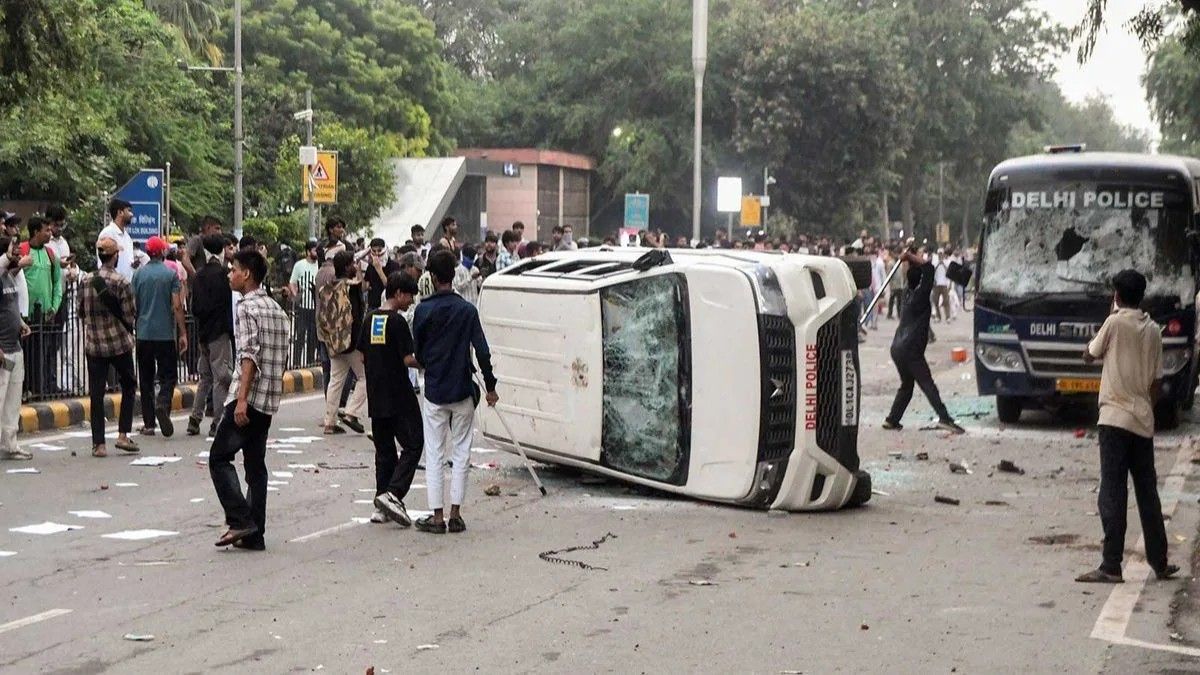
Law enforcement authorities in Delhi have initiated formal investigations into multiple incidents connected to the Cockroach Janta Party's "Sansad Chalo" march towards Parliament, with police registering a total of 10 First Information Reports across several police stations in the New Delhi district. The cases emerge from Monday's demonstration, which escalated into confrontations between protesters and security personnel as demonstrators attempted to reach the legislative chamber to demand the resignation of Union Education Minister Dharmendra Pradhan over alleged examination irregularities.
The distribution of charges reflects the scattered nature of the incidents recorded during the protest. Parliament Street police station has registered four cases, while Connaught Place police station has filed three. Individual cases have been lodged at Mandir Marg, Barakhamba Road, and Kartavya Path police stations. Each FIR addresses distinct allegations spanning from alleged assaults on law enforcement personnel to unauthorised activities during the parliamentary session. The specificity of the charge distribution suggests authorities are pursuing multiple lines of investigation rather than consolidating the incidents into broader conspiracy charges, a strategy that may complicate prosecution but allows for targeted investigation of individual incidents.
Among the more serious allegations is a case concerning a suspected life-threatening attack on a Rapid Action Force personnel during the Monday demonstration. Additionally, police have filed a separate case related to the alleged unauthorised operation of a drone within New Delhi district boundaries during parliamentary proceedings, indicating security forces viewed certain protest tactics as potential threats to institutional safety. The charges invoked across these cases include provisions of the Bharatiya Nyaya Sanhita, India's newly implemented criminal code, alongside the Arms Act and the Prevention of Damage to Public Property Act, demonstrating the range of alleged violations authorities contend occurred during the march.
Police characterisations of Monday's events portray a demonstration marked by escalating hostility despite official warnings. According to Delhi Police statements, protesters exhibited "unruly, aggressive and violent behaviour" throughout the event, despite repeated cautions and standing prohibitory orders restricting public assembly in the area. Law enforcement has released video footage purporting to show stone-pelting incidents in the Connaught Place vicinity, evidence that officials claim substantiates claims of organised violence rather than spontaneous confrontation.
The investigation's scope extends beyond the immediate incidents of Monday. Delhi Police are currently analysing more than 250 videos to identify individuals involved in violent acts and to determine whether the disturbances followed a predetermined strategy rather than representing reactive crowd behaviour. This extensive video analysis represents a substantial investigative commitment and signals that authorities view the protest violence as potentially orchestrated rather than incidental to an otherwise peaceful demonstration.
Parallel to the investigation, controversy has erupted over the characterisation of subsequent events. On Tuesday, fresh claims circulated across social media platforms alleging that additional stone-pelting and police action had occurred at Jantar Mantar, where protesters maintained a continuous sit-in following Monday's clashes. Delhi Police's Deputy Commissioner for New Delhi publicly disputed these claims, describing videos circulating online as "false and misleading" and asserting that no new violent incidents occurred on Tuesday. This denial represents an attempt to control the narrative regarding protest dynamics and police response proportionality, though the emergence of such claims itself indicates ongoing tensions at the protest site.
The protest itself has remained active despite official efforts to disperse it. Security personnel removed protest tents and the demonstration stage on Monday evening, yet protesters returned to Jantar Mantar on Tuesday to maintain their sit-in. Sustained police and Rapid Action Force deployments have continued at the venue, establishing a tense standoff between demonstrators and authorities. This persistence reflects the CJP's commitment to their central demand and the broader frustrations driving participation in the march.
CJP spokesperson Ashutosh Ranka has declared the agitation will persist until the party's core demand—Dharmendra Pradhan's resignation—is met. Beyond this central objective, protest representatives have raised allegations concerning treatment of demonstrators during Monday's confrontations. Ranka claims that numerous protesters, including students and volunteers, sustained injuries during police action, and has specifically highlighted that women participants, including Geetanjali J. Angmo, the spouse of environmental activist Sonam Wangchuk, allegedly faced mistreatment during the clashes. These allegations, if substantiated, would raise questions about police crowd management tactics and adherence to protocols governing use of force against civilian demonstrators.
The unfolding situation reflects broader tensions in Indian political activism, where demonstrations against government policies increasingly encounter robust security responses. The CJP's focus on examination irregularities as grounds for demanding a minister's resignation taps into widespread public concern regarding educational equity and institutional integrity—issues that resonate across India's competitive examination culture. The party's mobilisation of student protesters around these themes suggests calculated efforts to broaden appeal beyond hardcore political supporters to encompass constituencies with direct educational stakes.
For observers beyond India's borders, including Malaysian analysts tracking South Asian political trends, the protest dynamics illustrate the persistent challenges democracies face in balancing public assembly rights against security maintenance. The scale of police response—ten formal cases, hundreds of video analyses, sustained force deployments—against what appears to be a student-focused protest raises questions about proportionality and whether security establishments view contentious political mobilisation as inherently threatening rather than as legitimate democratic expression requiring managed engagement.
The investigation's continuation will likely produce clearer evidence regarding the precise sequence of escalation on Monday and the attribution of responsibility for violent acts. However, the current stalemate—with protesters maintaining their sit-in, police asserting no fresh violence despite social media claims, and formal cases proceeding through the criminal justice system—suggests resolution remains distant absent either successful negotiation or exhaustion of protest participants' capacity to sustain their mobilisation.

