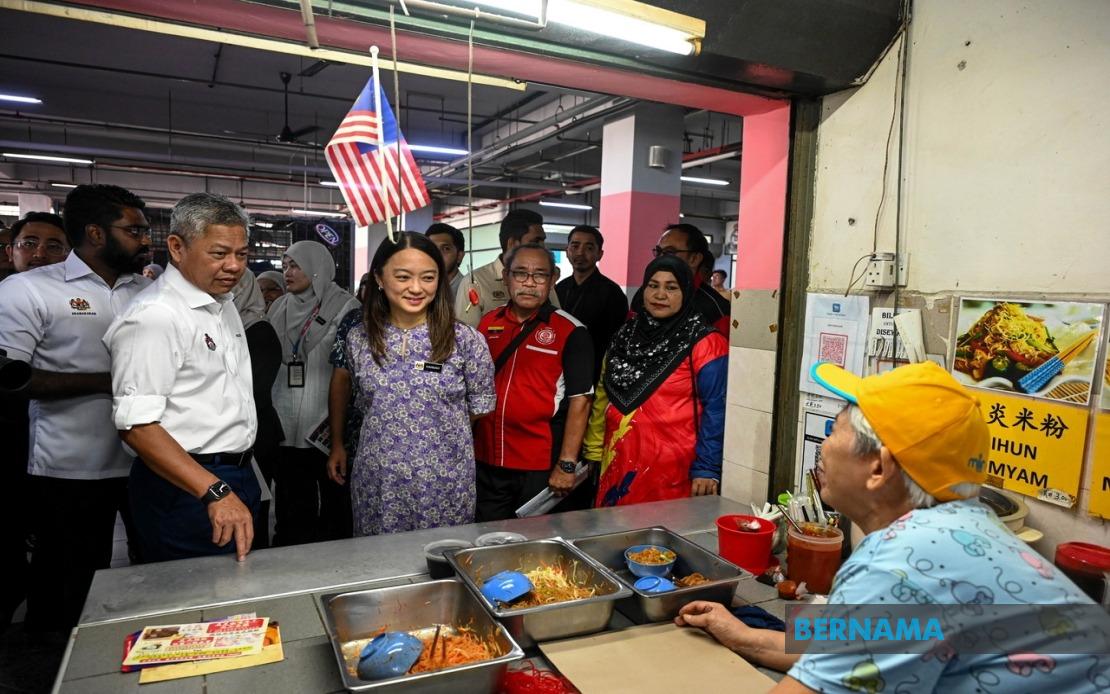
Kuala Lumpur City Hall (DBKL) has committed RM200 million towards a comprehensive transformation of hawker trading environments across the capital, with the ambitious Lestari Niaga @ Kuala Lumpur 2026 initiative set to reshape the city's informal food and retail landscape. The programme encompasses 287 distinct hawker sites dispersed throughout Kuala Lumpur, directly impacting the livelihoods of more than 11,000 small-scale traders and vendors who form the backbone of the city's grassroots economy. Minister in the Prime Minister's Department (Federal Territories) Hannah Yeoh described the initiative as a critical intervention designed to create safer, better-organised, and more economically viable operating conditions for these marginalised business operators.
The scale of this undertaking reflects official recognition that hawker communities require systematic support and infrastructure investment rather than ad hoc enforcement or relocation measures. By simultaneously addressing multiple sites throughout 2026, DBKL aims to demonstrate a coordinated approach to urban informal economy management—a challenge that has long vexed Southeast Asian city authorities balancing livelihood protection against modernisation pressures. The financial commitment signals genuine intent to upgrade rather than merely displace, though implementation success will depend heavily on execution quality and stakeholder coordination.
Hannah Yeoh emphasised that DBKL's methodology prioritises inclusive stakeholder consultation, incorporating perspectives from residents demanding improved traffic flow, traders seeking operational stability, and building tenants requiring orderly commercial environments. This multifaceted balancing act acknowledges the fundamental tension within urban planning: street-level commerce generates vitality and employment but can conflict with municipal order and resident amenities. Rather than imposing top-down solutions, DBKL claims to be calibrating relocation and upgrading decisions through dialogue, though the statement raises questions about how genuinely these competing interests influence final decisions or whether trader voices ultimately carry proportional weight.
The UTC Sentul hawker upgrade project serves as the flagship demonstration of this approach. Launched on June 15, the RM1.6 million initiative will replace traditional wooden stalls with 20 modern modular kiosks featuring improved sanitation, electrical infrastructure, and weatherproofing—scheduled for completion within three months. This relatively compressed timeline reflects confidence in the modular construction methodology, though it also compresses the adjustment period for affected traders. More significantly, DBKL has introduced direct monthly financial assistance of RM1,500 for the 20 active traders operating during the reconstruction phase, a first-time measure designed to ease income disruption.
Kuala Lumpur Mayor Datuk Seri Fadlun Mak Ujud justified this direct subsidy approach by arguing it surpasses temporary trading site alternatives, which typically incur high operational costs and suffer from poor customer accessibility—ultimately depressing trader revenues more severely than the construction period itself. This reasoning reflects evolving sophistication in supporting informal economy workers; simply relocating them to less visible areas often destroys business viability rather than preserving livelihoods. The RM1,500 monthly assistance represents meaningful income replacement, though whether it fully compensates for lost sales during modernisation remains an empirical question traders could answer.
The programme's immediate rollout extends beyond UTC Sentul, with similar simultaneous projects backed by the same special incentive mechanism expanding to Jalan Dato Senu, Pudu Ulu, and Bandar Tun Razak. This multi-location approach demonstrates DBKL's commitment to preventing the staggered, delayed implementation that has plagued previous hawker upgrading initiatives. Coordinating concurrent construction across multiple sites requires substantial logistical capacity, but it also minimises the cumulative disruption of sequential upgrades stretching across years.
The initiative encompasses three distinct trader categories reflecting DBKL's governance structure: approximately 4,000 street hawkers operating informally, roughly 5,000 traders working under mayor-designated assets with some formal recognition, and around 1,000 individuals in the reapplication category—likely those seeking to formalise or regularise their trading status. This segmentation acknowledges that hawker communities are heterogeneous, with varying levels of official recognition and operational circumstances. Initial implementation will focus on 224 of the total 287 locations, suggesting a phased approach that allows learning from early projects before scaling across all remaining sites.
For Malaysian readers and Southeast Asian observers, this programme carries several implications. First, it demonstrates growing municipal willingness to view informal traders not as enforcement problems but as legitimate economic actors deserving investment and support. Second, the scale of financial commitment—RM200 million across a single city—reflects the substantial economic and social significance of hawker communities, particularly for lower-income populations dependent on affordable street food and informal retail. Third, the explicit consultation mechanisms signal that top-down urban development approaches increasingly face pressure from community stakeholder participation, whether genuinely consequential or performative.
The success of Lestari Niaga @ Kuala Lumpur 2026 will ultimately depend on three critical factors: whether modernised facilities genuinely improve trader profitability rather than merely changing the aesthetic of poverty; whether the special financial assistance adequately sustains traders through construction periods without creating dependency; and whether DBKL maintains consistent commitment across all 287 sites despite inevitable budget pressures and political transitions. If executed effectively, the programme could establish a replicable model for other Malaysian municipalities and regional cities grappling with similar informal economy challenges.
However, hawker communities remain vulnerable to shifting municipal priorities and political changes. The five-year timeline through 2026 spans multiple electoral cycles, meaning implementation faces risks from administrative disruption. Additionally, while modern infrastructure creates opportunities for improved trading conditions, it often brings accompanying rent increases and stricter regulatory compliance—potentially pricing out the poorest vendors the programme ostensibly aims to help. DBKL's willingness to address this through direct financial support, as demonstrated at UTC Sentul, suggests awareness of these risks, but sustained commitment across 11,000 traders over several years will test institutional resolve.

