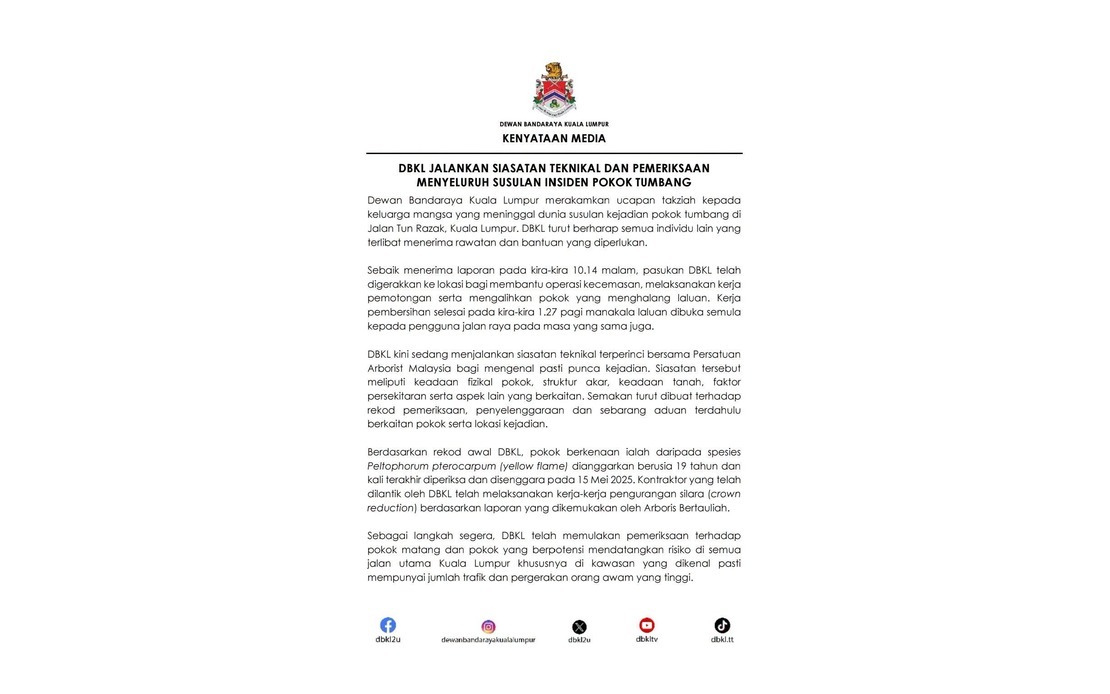
A fatal tree collapse on Jalan Tun Razak has triggered an urgent safety review by Kuala Lumpur City Hall, which is partnering with the Malaysian Society of Arborist to uncover what caused the incident. The investigation represents a significant escalation in how the city authority approaches tree management in high-density urban areas, and comes as municipal authorities worldwide grapple with ageing vegetation in built environments.
The technical examination will assess multiple dimensions of the fallen tree's condition, including its physical integrity, the structure of its root system, and the soil conditions at the site. Environmental factors will also feature prominently in the analysis, alongside a full historical review of previous inspections, maintenance records, and any complaints logged about the tree or its surrounding area. This multi-layered approach reflects growing recognition that tree failures are rarely attributable to a single cause, but rather stem from the interplay of structural degradation, environmental stress, and maintenance gaps.
DBKL's response mobilised swiftly, with an emergency team reaching the scene moments after the 10.14 pm report and working through the night to remove debris and reopen the thoroughfare by 1.27 am. The authority has extended its sympathies to the victim's family and pledged full cooperation with police and other relevant agencies as the investigation proceeds. This rapid deployment underscores the operational capacity of the city's emergency response infrastructure, though it has also prompted questions about whether preventive measures were adequate prior to the incident.
Records indicate the fallen tree was a Peltophorum pterocarpum, commonly known as the Yellow Flame species, and stood at an estimated age of 19 years. Its most recent inspection and maintenance work had taken place on May 15, when the appointed contractor performed crown reduction works following recommendations from a certified arborist. The relatively recent maintenance history raises questions about what changed in the intervening weeks, or whether the initial assessment missed warning signs that would only become apparent through more intensive examination.
The incident has catalysed a broader preventive push across Kuala Lumpur's road network. DBKL has commenced emergency inspections of mature trees and those flagged as carrying elevated risk along all major thoroughfares in the city, with particular focus on routes with high volumes of traffic and pedestrian movement. This citywide screening effort acknowledges that isolated technical failures elsewhere could pose similar dangers, and reflects a precautionary principle increasingly adopted by urban administrators managing ageing green infrastructure.
The inspection programme targets key arterial routes including Jalan Ampang, Jalan Sultan Ismail, Jalan Raja Laut, Jalan Datuk Keramat, and sections of Jalan Tun Razak itself. Eight teams, comprising five professional arborists alongside support staff, have been mobilised to complete the surveys within a ten-week timeframe. This represents a substantial allocation of municipal resources and indicates the seriousness with which city leadership is treating the matter, particularly given Kuala Lumpur's status as a major metropolitan hub where public safety concerns carry heightened political sensitivity.
Looking beyond the immediate response, DBKL is developing medium-term technological solutions to enhance tree monitoring. The authority is awaiting certification from SIRIM, Malaysia's standards and industrial research institute, to deploy four hundred advanced tree sensors across the city in phased installations at identified high-risk locations. These sensors represent a frontier in urban arboriculture, capable of furnishing real-time data on tree condition and generating early warnings when fluctuations in stability occur.
The sensor technology will track soil conditions, moisture saturation levels, structural movement, and the cumulative effects of severe weather events such as heavy rainfall and flood conditions. For a tropical city like Kuala Lumpur, where monsoon seasons bring intense precipitation and humidity levels fluctuate dramatically, such environmental monitoring capabilities address critical variables in tree health. The initial deployment phase will concentrate on four strategic sites: Jalan Bangsar, Dataran Merdeka, Jalan Ampang, and Jalan Raja Chulan, likely chosen for their high pedestrian traffic, commercial importance, or history of environmental challenges.
This incident and the ensuing response strategy illuminate broader challenges facing Southeast Asian cities as urbanisation accelerates and climate variability increases. Many Malaysian municipalities inherited green infrastructure from earlier development phases, and assessing the cumulative deterioration of these assets against competing budget demands remains politically fraught. The technology-forward approach DBKL is adopting through sensor deployment may offer a replicable model for other Malaysian local authorities confronting similar tree management pressures.
The investigation's findings will likely inform future municipal tree policy across Malaysia and neighbouring countries. What began as a tragic accident has catalysed a systems-level review of how cities can better integrate data science and professional arboriculture into urban governance. For residents of Kuala Lumpur, the visible expansion of inspection teams and the planned sensor network deployment signal a commitment to preventing recurrence, though questions remain about whether reactive crisis response adequately addresses the deeper question of how cities should manage ageing vegetation in spaces where human activity is continuous and the consequences of failure are irreversible.

