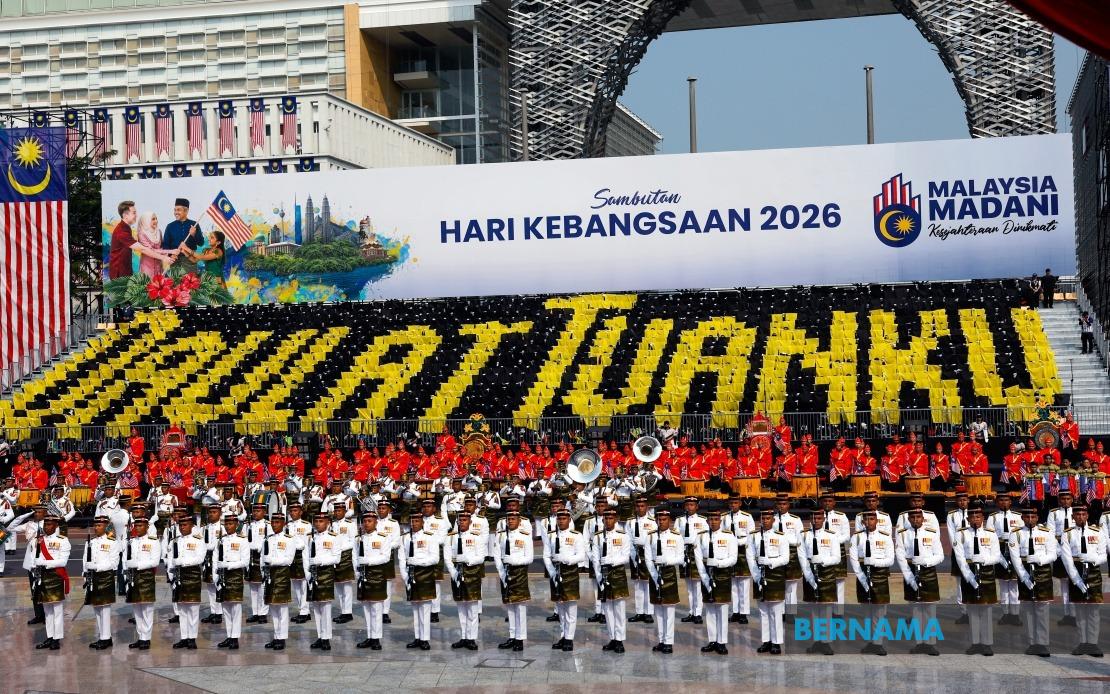
The 69th National Day celebration will unfold at Dataran Putrajaya on August 31, drawing together thousands of participants in a meticulously choreographed display designed to reinforce national pride and showcase Malaysia's diverse strengths. His Majesty Sultan Ibrahim and Her Majesty Raja Zarith Sofiah will be joined by Prime Minister Datuk Seri Anwar Ibrahim and Cabinet members for the event, which commences at 8:00 am under the overarching theme "Malaysia MADANI: Kesejahteraan Dinikmati". The scale of the production reflects the government's ambition to create a spectacle that resonates across generations and communities, combining pageantry with substantive displays of national capability.
The logistical undertaking is considerable, involving 10,819 parade participants distributed across 76 contingents supported by 22 marching bands and 11 float vehicles. The parade will incorporate 328 military and civil assets—comprising land, naval, and air components—along with 112 working animals and 22 electric vehicles. This diversity of elements serves multiple purposes: demonstrating the breadth of Malaysia's institutional capacity, showcasing technological advancement through the inclusion of EVs, and maintaining traditional elements that connect citizens to heritage and continuity. The varied composition of the procession reflects an attempt to construct a narrative of a nation balancing modernity with cultural rootedness.
The opening segment, "Gema Inovasi MADANI", orchestrated by the National Department for Culture and Arts under the Ministry of Tourism, Arts and Culture, will feature 700 kompang frame drums played by performers and 150 additional percussion instruments. This performance serves as the intellectual and emotional anchor of the celebration, fusing traditional Malaysian musical heritage with contemporary artistic direction. The emphasis on percussion instruments representing Malaysia's principal ethnic groups carries symbolic weight—suggesting harmony and shared cultural ownership of national identity—while the fusion of traditional and innovative elements reinforces the Malaysia MADANI philosophy that economic and social advancement need not require abandonment of cultural practices.
The parade structure divides into thematic components covering statehood, well-being, public order, and national security. The statehood section features the Jalur Gemilang contingent alongside officers from the National Resilience Leadership Academy and National Defence University of Malaysia, plus participants from the National Service Training Programme. This deliberately positions the armed forces and youth development institutions as custodians and transmitters of national values. The inclusion of Glasgow 2026 Commonwealth Games medalists within the well-being component creates a bridge between sporting achievement and national prestige, positioning athletic success as an extension of broader national capability and pride.
The well-being and economy segment brings together a coalition spanning both public and private sectors, including corporations such as Munchy's Malaysia, ZUS Coffee, MR. D.I.Y Group, and Carsome Sdn Bhd. This integration of commercial enterprises into the national day narrative reflects Malaysia's positioning of business as a vehicle for MADANI values rather than a force separate from or opposed to national aspiration. The participation of the Malaysian Security Industry Association, cooperatives, and apparel manufacturers demonstrates an attempt to anchor the celebration in tangible economic activity and employment, grounding abstract notions of shared prosperity in visible commercial entities.
Public order and security agencies—the Civil Defence Force, Road Transport Department, and Malaysian Fire and Rescue Department—parade alongside the Johor Military Force, historically the oldest military unit in Malaysia. This placement underscores the multifaceted nature of security in modern Malaysia, encompassing not merely military deterrence but also civil protection, transportation safety, and emergency response. The presence of the Johor Military Force carries additional resonance given its historical role in defending the Johor Royal Institution, symbolically linking contemporary national security frameworks to Malaysia's constitutional and hereditary structures.
The Visit Malaysia Year 2026-2027 campaign floats will showcase regional tourism assets, biodiversity, traditional dress, and musical instruments from Malaysia's component communities. This forward-looking touristic dimension positions the national day celebration as both reflection and recruitment tool—citizens celebrating national identity while potential international visitors observe Malaysia's attractions. The participation of Malaysia Airlines, AirAsia, Batik Air, and Air Borneo extends this commercial-patriotic nexus into aviation and tourism infrastructure, suggesting that national pride and economic interest are complementary rather than competing imperatives.
Les' Copaque's inclusion of animation characters Upin and Ipin targets younger audiences and families, reflecting contemporary media literacy and the recognition that national celebrations must engage across age cohorts through culturally resonant content. The human graphics performance involving 1,500 students from 36 Selangor schools executing synchronized formations represents a significant mobilization of youth, transforming young Malaysians into active participants in national spectacle rather than passive observers. This participatory element, when combined with the scale and duration of rehearsals required, functions as an informal civic education exercise embedding national consciousness through embodied practice.
The climactic Royal Malaysian Air Force display of fighter jets above Putrajaya's skyline carries multiple communicative dimensions. Domestically, it reasserts the visibility and efficacy of national defence capabilities to citizens. Regionally and internationally, it subtly advertises Malaysia's military sophistication and readiness. The juxtaposition of aerial display with civilian celebration and cultural performance softens militarism within a broader civic context, positioning defence capability as enabling rather than dominating national life. The scheduled 10:00 am conclusion allows for afternoon recovery and dispersal, reflecting crowd management expertise.
Composer and performer Faizal Tahir's commissioned song "Aku Berjanji" (I Promise) provides the affective closing note, with lyrics presumably emphasizing love for country. This musical punctuation translates abstract civic concepts into emotional registers accessible to diverse audiences, functioning as a secular ritual moment within the celebration. The choice of a renowned contemporary artist rather than a purely ceremonial composition suggests an intent to make patriotic expression feel current and authentic rather than archaic or imposed.
Communications Minister Datuk Seri Fahmi Fadzil's recent advisory regarding N95 face masks addresses an immediate environmental challenge—current haze affecting Kuala Lumpur and surrounding areas. The provision of masks to over 10,000 participants demonstrates proactive health management and implicit acknowledgment that celebrating national identity occurs within material constraints and environmental realities. This pragmatism within patriotic celebration reflects Malaysia's contemporary context, where aspirations toward national greatness must accommodate environmental pressures and climate-related challenges.
The Ministry of Home Affairs' traffic advisories signal substantial disruptions to Putrajaya's transport networks, with complete closure of the Core Island area from August 30 at 5:00 am through August 31 at 6:00 pm. Five major bridges—Seri Wawasan, Seri Saujana, Seri Gemilang, Putra, and Seri Ehsan—will be unavailable, requiring commuters to plan alternative routes or utilize public transport. For Malaysian readers and residents of greater Kuala Lumpur, this closure represents both the celebratory ambition of the event and its substantial material costs in terms of circulation and accessibility. The emphasis on public transport use aligns with environmental policy objectives while managing the logistical challenge of accommodating large crowds within Putrajaya's designed but spatially constrained administrative precinct.
The 69th National Day celebration ultimately functions as more than ceremonial observance. It represents a carefully constructed narrative about contemporary Malaysia—one integrating military strength, economic dynamism, cultural heritage, youth engagement, environmental adaptation, and institutional pluralism. The mobilization of 10,819 participants, hundreds of assets, and elaborate artistic direction reflects significant national resources directed toward collective identity affirmation. For Malaysians and regional observers, the event serves as an annual benchmark for gauging how the nation positions itself internationally and how it articulates the relationship between governing institutions, commercial enterprise, cultural expression, and ordinary citizens in the project of national self-representation.

