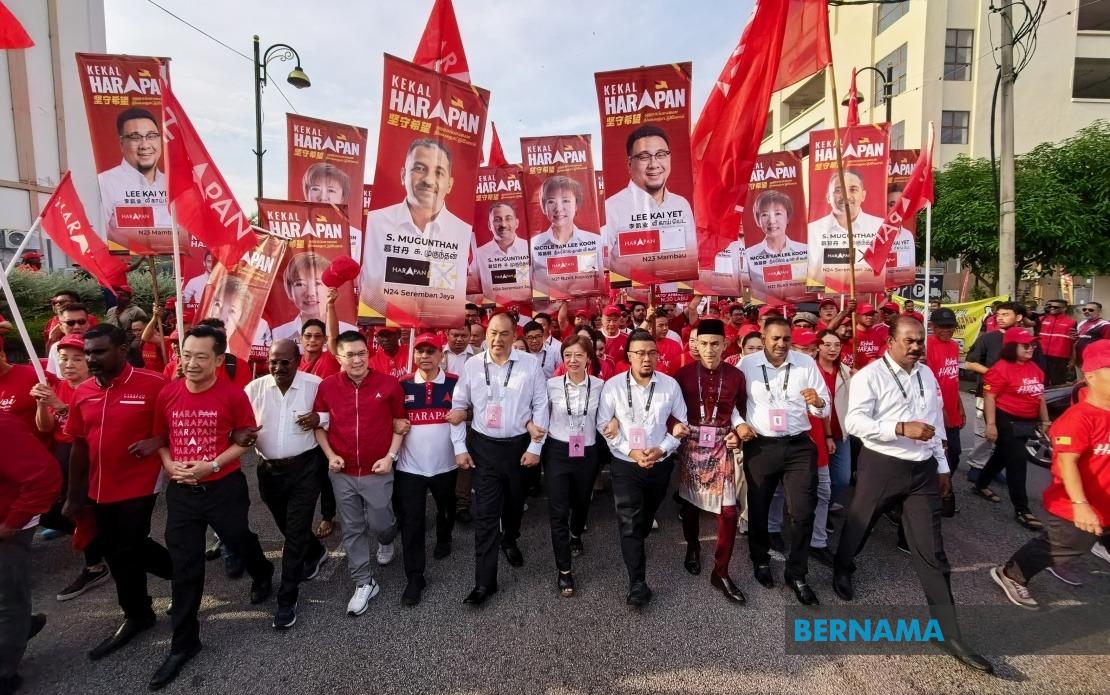
Negeri Sembilan's Rahang constituency will witness a competitive four-cornered battle when the state heads to the polls next month, with Pakatan Harapan's Siaw Meow Keong seeking to retain the seat he has held since 2023. The DAP treasurer, who currently represents the constituency, faces a significantly fragmented field that underscores the fractured opposition landscape in Malaysia's political theatre. Nomination papers were filed on July 18, with the returning officer confirming all four candidates' eligibility to contest.
Siaw's challengers represent a diverse spectrum of Malaysia's political ecosystem. Yap Siok Moy, the Rasah MCA Wanita chief, carries Barisan Nasional's standard in the constituency, representing the traditional coalition that once dominated Negeri Sembilan politics. S. Thinagaran of Parti Sosialis Malaysia brings a left-leaning ideological dimension to the contest, offering voters an alternative socialist perspective on governance and economic policy. Tang Jay San, flying the Bersatu flag, represents Muhyiddin Yassin's faction within the broader Malay-Muslim political space, potentially fragmenting the Bumiputera vote across multiple platforms.
The nomination filing sequence revealed little about momentum, with Thinagaran arriving first at 9.06 am, followed by Tang at 9.10 am, Siaw at 9.12 am, and Yap at 9.13 am. Each candidate's submission of nomination papers signals their commitment to contest despite awareness of the crowded field, suggesting confidence in their respective support bases or party machinery backing. The tight timing of submissions indicates a well-coordinated approach by all camps to complete the procedural requirements.
Rahang's four-cornered contest reflects broader patterns emerging across Negeri Sembilan's 16th state election. The state assembly will feature multiple three-cornered contests, demonstrating that opposition fragmentation extends beyond this single seat. In Bukit Kepayang, DAP's Nicole Tan Lee Koon faces a straightforward two-way battle against Perikatan Nasional's Lee Boon Shian, offering a simpler dynamic for voters in that constituency. Conversely, Labu presents a three-way affair between PH's Datuk Ahmad Faez Abdul Razak, Bersatu's Mohamad Hanifah Abu Baker, and BN's Siti Nur Umaira Hasim.
The Mambau constituency continues the three-cornered trend, with PH's Lee Kai Yet contesting against Bersatu's N. Sarawanan and PN's Eric Michael. This configuration demonstrates how Perikatan Nasional's recent emergence as a significant electoral force has complicated traditional two-coalition dynamics. Seremban Jaya similarly features a three-way contest between PH's S. Mugunthan, BN's Datuk T. R. Thinalan, and Bersatu's R. Mahendran. These multiple configurations create unpredictable electoral scenarios where vote-splitting could determine outcomes more than direct support for any single platform.
For voters in these constituencies, the proliferation of candidates demands careful consideration of policy platforms and candidate credentials rather than reliance on traditional coalition voting patterns. The presence of PSM in Rahang and Bersatu across multiple seats indicates these parties are challenging the hegemony of the three major coalitions—Pakatan Harapan, Barisan Nasional, and Perikatan Nasional. Smaller parties historically struggle to translate significant vote shares into seat gains under Malaysia's first-past-the-post electoral system, yet their candidacies can materially influence outcomes in closely contested constituencies.
Siaw Meow Keong's tenure as Rahang representative since 2023 provides him with incumbency advantage, though his need to defend against three challengers simultaneously presents substantial challenges. As DAP treasurer, he likely benefits from party organizational resources and the broader PH machinery's support infrastructure. However, winning with a split opposition vote base requires either a commanding plurality or strategic consolidation of his support base. The MCA's participation through Yap represents an attempt by BN to recapture ground in what might traditionally be considered an opposition-leaning urban seat.
Negeri Sembilan's political landscape has evolved considerably since the last state election. The rise of Bersatu as a contending force, previously unthinkable in state-level contests, reflects the realignment triggered by Muhyiddin Yassin's departure from Pakatan Harapan and subsequent formation of Perikatan Nasional. For Malaysian observers, the state election serves as a testing ground for how these new coalition dynamics perform in actual electoral contests, particularly regarding whether Bersatu can translate organizational presence into meaningful seat gains or whether traditional patterns reassert themselves.
The electoral commission has scheduled early voting for July 28, providing a condensed timeframe for campaigning. This compressed schedule favors incumbent candidates with established ground networks and media profile—an advantage Siaw possesses as an incumbent DAP figure with party backing. The main polling day is set for August 1, giving candidates approximately two weeks from nomination to conduct their campaigns. In Negeri Sembilan's relatively compact geography, this timeline may suffice for intensive ground operations, though television and social media advertising will likely dominate the campaign narrative.
For the broader Malaysian political context, Negeri Sembilan's results will offer insights into several critical questions. How effectively does DAP retain traditional urban Chinese support, particularly in constituencies like Rahang where it faces a BN-fielded candidate? Can Bersatu establish itself as a viable electoral force at state level, or does it remain a Bumiputera-focused party capable of winning only in specific demographic contexts? Will PSM's presence indicate a growing appetite for alternative political voices beyond the major coalitions, or does it primarily serve as a protest vote mechanism? These outcomes will provide valuable data points as Malaysia approaches the next general election.
The four-cornered contest in Rahang thus transcends a single constituency race. It encapsulates the fragmentation and realignment characterizing contemporary Malaysian politics, where traditional bipolar competition between BN and PH has given way to multipolar competition involving Perikatan Nasional, smaller parties, and the emergence of independent political actors. Siaw Meow Keong's ability to retain his seat under these circumstances will demonstrate whether established opposition parties can maintain their voter bases in an increasingly fractious political environment or whether they face erosion from multiple competing directions.

