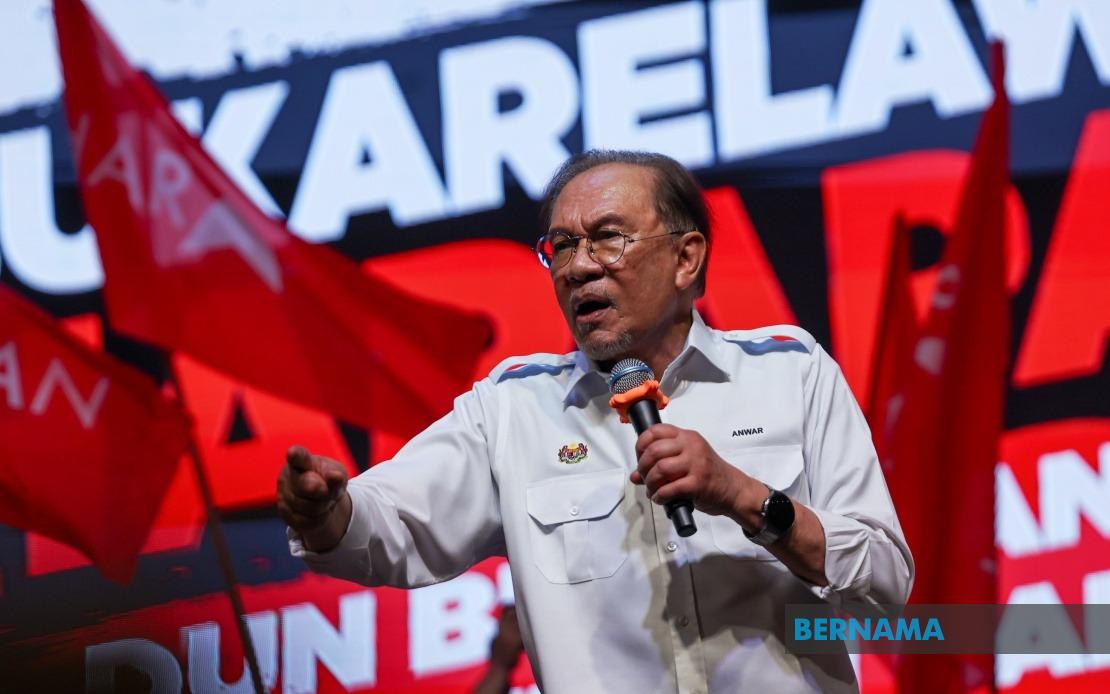
Prime Minister Datuk Seri Anwar Ibrahim moved to counter persistent criticism of the Democratic Action Party (DAP) at a political rally in Muar today, denying suggestions that the party harbours anti-Malay sentiment. Addressing supporters at the Meeting Anwar Programme, Anwar stressed that DAP has consistently respected constitutional provisions protecting Malay and Bumiputera interests, positioning the coalition's governance model as one grounded in fairness rather than communal partisanship.
Anwar cited concrete evidence to support his assertion, noting that DAP raised no objections when the government moved to designate 20.23 hectares of land in Bandar Malaysia as Malay Reserve Land. This willingness to uphold traditional Bumiputera protections stands in sharp contrast to narratives circulated by political opponents, who have sought to portray DAP as an organisation hostile to Malay-Muslim interests. The Prime Minister's comments reflect ongoing tensions within Malaysian politics, where allegations of racial bias remain potent rhetorical weapons despite the country's formal commitment to communal harmony.
Central to Anwar's defence of the Unity Government's approach is his emphasis on inclusive development as a governing principle. He articulated a vision where economic expansion and social programmes benefit all communities proportionately, rejecting what he characterised as the zero-sum framing that pits one group's advancement against another's. This inclusive stance, Anwar argued, should not be mistaken for an abandonment of Bumiputera support mechanisms. Rather, he contended that strengthening provisions for Malays and indigenous communities—including increased allocations to PUNB and targeted entrepreneurship programmes—represents legitimate policy that DAP accepts without reservation.
The Prime Minister's formulation of governance reveals a tension inherent in Malaysian politics: the need to maintain affirmative action frameworks while simultaneously arguing for universal prosperity. Anwar attempted to reconcile this by asserting that fairness to the Malay majority does not require withholding assistance from other communities. He emphasised that poor Chinese and Indian Malaysians require support no less than impoverished Malays, and that comprehensive anti-poverty strategies serve the national interest more effectively than narrowly communal approaches. This argument implicitly challenges the notion that defending Malay-Muslim prerogatives necessitates discriminatory treatment of other groups.
Beyond the specific question of DAP's relationship to Malay rights, Anwar deployed the occasion to articulate a broader vision for resource distribution in Malaysia. He noted that despite robust economic growth, prosperity remains unevenly distributed across society, with wealth concentrating in elite hands rather than trickling down to ordinary citizens. This observation carries particular weight given the country's persistent inequality, which has driven dissatisfaction across multiple communities and contributed to political volatility. Anwar's framing suggests that inclusive development serves not only moral imperatives but also pragmatic governance objectives, stabilising the social contract through shared economic benefit.
The Prime Minister's vision of economic distribution extends beyond poverty alleviation to encompass quality-of-life improvements accessible to broader segments of the population. He articulated aspirations for affordable housing, well-maintained public infrastructure, and elevated educational standards as markers of successful economic management. These priorities align closely with concerns voiced by Malaysian voters across ethnic lines, suggesting that Anwar seeks to build cross-communal political support by addressing material grievances that transcend identity boundaries. The approach implicitly argues that governance focused on service delivery and improved living standards can transcend—though not eliminate—identity-based political divisions.
Anwar's rhetoric on governance carries implicit criticism of political rivals who he suggests exploit divisive narratives for electoral advantage. His assertion that politics constitutes a trust rather than a vehicle for personal enrichment represents a pointed rebuke to perceptions of corruption and self-dealing that have plagued Malaysian politics. By framing political power as inherently tied to public service rather than private gain, Anwar positions the Unity Government's inclusive approach as morally superior to zero-sum communal politics driven by elite opportunism. This moral framing attempts to elevate political competition beyond identity-based mobilisation toward debates over governance quality and equitable resource distribution.
The comments emerge amid the 16th Johor state election campaign, where 172 candidates compete for 56 assembly seats ahead of polling on July 11. The timing of Anwar's intervention reflects the strategic importance of Johor to national coalition stability, particularly given the state's electoral significance and demographic diversity. By defending DAP's communal credentials while reaffirming commitment to Bumiputera protections, Anwar seeks to maintain coalition cohesion and persuade Malay-Muslim voters that the Unity Government can be trusted to protect their interests without abandoning inclusive governance principles.
The Prime Minister's emphasis on equitable distribution reflects broader pressures confronting the Unity Government, which must balance competing constituencies within its ideologically diverse coalition. DAP's urban, multiethnic voter base prioritises secular governance and equal citizenship, while Pakatan Harapan's Malay-Muslim components, particularly Amanah, require reassurance that constitutional provisions benefiting Malays remain inviolate. Anwar's articulation of inclusive development attempts to accommodate both perspectives by arguing that protecting Bumiputera interests and extending assistance across communities represent complementary rather than contradictory objectives.
The persistence of accusations that DAP harbours anti-Malay sentiment, despite evidence suggesting such claims lack substantial foundation, reflects Malaysia's fraught political discourse. Opposition figures and conservative media outlets continue deploying such allegations despite the party's consistent acceptance of constitutional arrangements privileging Bumiputera communities. Anwar's repeated defence of DAP suggests that coalition partners recognise the political damage posed by such narratives, particularly among traditional Malay-Muslim constituencies uncertain about multiethnic governance models. The Prime Minister's intervention indicates that countering these allegations remains a priority even as the government pursues policy implementation.
Looking forward, Anwar's vision of governance hinges upon demonstrating that inclusive development generates tangible improvements in citizens' material conditions. Should economic growth translate into improved public services, expanded housing opportunities, and enhanced educational access across communities, the Prime Minister's argument that communal harmony and inclusive prosperity reinforce one another gains persuasive power. Conversely, if economic expansion continues to benefit elite groups disproportionately while ordinary Malaysians across all communities struggle with cost-of-living pressures, Anwar's inclusive rhetoric risks appearing disconnected from lived experience. The success of the Unity Government's political project depends substantially upon proving that equitable governance produces equitable outcomes.

