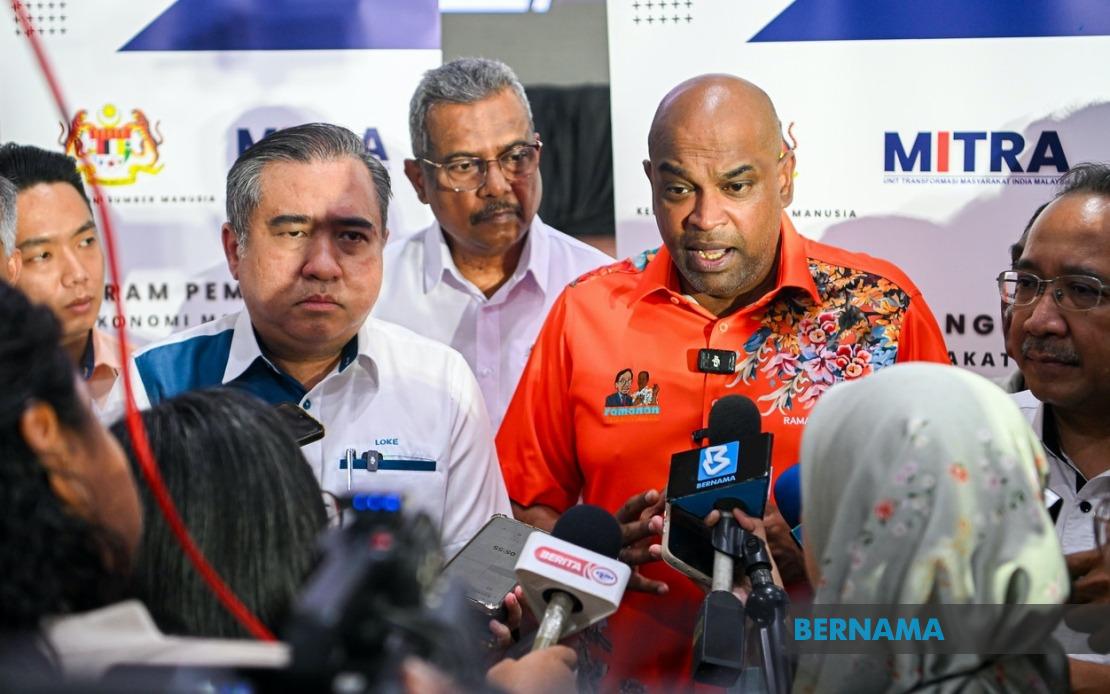
DAP secretary-general Anthony Loke has firmly rejected persistent claims that his party wields excessive control over government decision-making, characterising such accusations as a worn-out political tactic aimed at undermining Pakatan Harapan. Speaking in Seremban on July 7, Loke stressed that both federal and state-level policy formulation follows a consultative process involving all coalition members rather than unilateral directives from any single party.
The Transport Minister elaborated on the inclusive nature of governance under the current administration, explaining that component parties including DAP, UMNO, and PKR each have meaningful opportunities to present their positions before the Prime Minister finalises any major decision. This collaborative framework, according to Loke, ensures that diverse viewpoints within the coalition receive consideration before final determinations are made. He questioned why critics continue to blame DAP specifically, suggesting alternative narratives might reflect deeper political anxieties rather than substantive governance concerns.
Loke emphasised that participating as a coalition member inherently involves advocating for one's party's perspective within cabinet and administrative discussions. He noted that UMNO articulates its interests, PKR advances its priorities, and DAP contributes its policy positions—a normal feature of any multi-party governing arrangement. However, he underscored that ultimate authority rests with Prime Minister Datuk Seri Anwar Ibrahim, who weighs all input before determining the government's official stance. This distinction between providing counsel and wielding decisive power appears central to Loke's rebuttal of the dictatorship narrative.
The same consultative model, Loke indicated, extends to state administration in Negeri Sembilan, where Menteri Besar Datuk Seri Aminuddin Harun similarly solicits collective input from coalition partners before implementing decisions. This parallel structure suggests Pakatan Harapan has attempted to institutionalise coalition governance principles across multiple administrative levels, potentially to demonstrate consistency in its approach to power-sharing arrangements. The emphasis on Aminuddin's leadership role mirrors the national framework, positioning the chief executive as the ultimate decision-maker while preserving partner input.
Addressing a separate but related concern, Loke dismissed claims that Malays face systematic threats under the current administration, particularly in Negeri Sembilan. He highlighted the ongoing appointment of a Malay Menteri Besar as evidence that community representation remains prioritised, contradicting narratives suggesting demographic or cultural marginalisation. This observation carries particular significance in Malaysian politics, where questions about indigenous rights protection and communal representation shape electoral calculations and interethnic relations. Loke's point that such concerns persist despite structural protections suggests certain groups employ existential rhetoric regardless of institutional arrangements.
Loke pointed to substantive policy continuity as additional reassurance, noting that government programmes in Negeri Sembilan have consistently prioritised communal interests since Pakatan Harapan assumed state administration in 2018. By invoking a track record of governance rather than merely defensive rhetoric, Loke attempted to shift the debate from abstract accusations toward demonstrable outcomes. This approach suggests confidence in the administration's performance, though whether voters and opposition constituencies find such evidence persuasive remains an open question in Malaysia's polarised political environment.
The secretary-general's comments reflect broader tensions within Malaysia's coalition politics, where power-sharing arrangements inevitably generate friction regarding individual party influence. DAP, as a predominantly Chinese-led party holding significant parliamentary seats, remains a lightning rod for critics who question whether non-Bumiputera parties exercise disproportionate sway over policies affecting indigenous groups. These concerns transcend mere partisan competition, touching on foundational questions about Malaysia's constitutional bargain and interethnic governance principles established at independence.
Loke's insistence on collective decision-making addresses a legitimate structural question about how multi-party coalitions balance competing interests while maintaining governmental coherence. The Pakatan Harapan arrangement, spanning ideological and demographic diversity from UMNO to PKR to DAP, inherently involves navigating divergent priorities. How effectively this happens determines both government legitimacy and coalition durability. Loke's framing attempts to present these negotiations as orderly and inclusive rather than coercive or dominated by any faction.
The timing of Loke's comments reflects ongoing political competition in which opposition parties and some civil society voices continue questioning whether Pakatan Harapan represents genuine reform or merely an unstable coalition vulnerable to domination by particular members. For Malaysian readers accustomed to stronger executive centralisation under previous governments, the very existence of substantive coalition negotiation might seem unusual. Loke's explanation essentially normalises such processes as standard multi-party governance rather than evidence of dysfunction or hidden influence.
Regionally, Malaysia's coalition model offers lessons and cautionary tales for other democracies managing plurality governance. Successful power-sharing requires transparency about decision-making processes, clear institutional rules, and demonstrated commitment to honoring partner contributions—areas where Loke's public defence of collective governance suggests Pakatan Harapan believes it possesses credibility. However, persistent accusations about DAP influence suggest public persuasion remains incomplete, indicating that rhetorical defence, however eloquent, cannot substitute for sustained institutional performance.
The resilience of claims about DAP dictation, despite Loke's rebuttal, highlights how Malaysian political discourse frequently privileges narrative over institutional analysis. Voters and commentators evaluate coalition governance partly through structural mechanisms and outcomes, but equally through competing political narratives about which groups truly hold power. Loke's response treats this largely as a communication challenge—reframing rather than acknowledging legitimate concerns about representation. Whether this approach suffices for maintaining coalition stability and public confidence remains a critical question for Pakatan Harapan's long-term viability.

