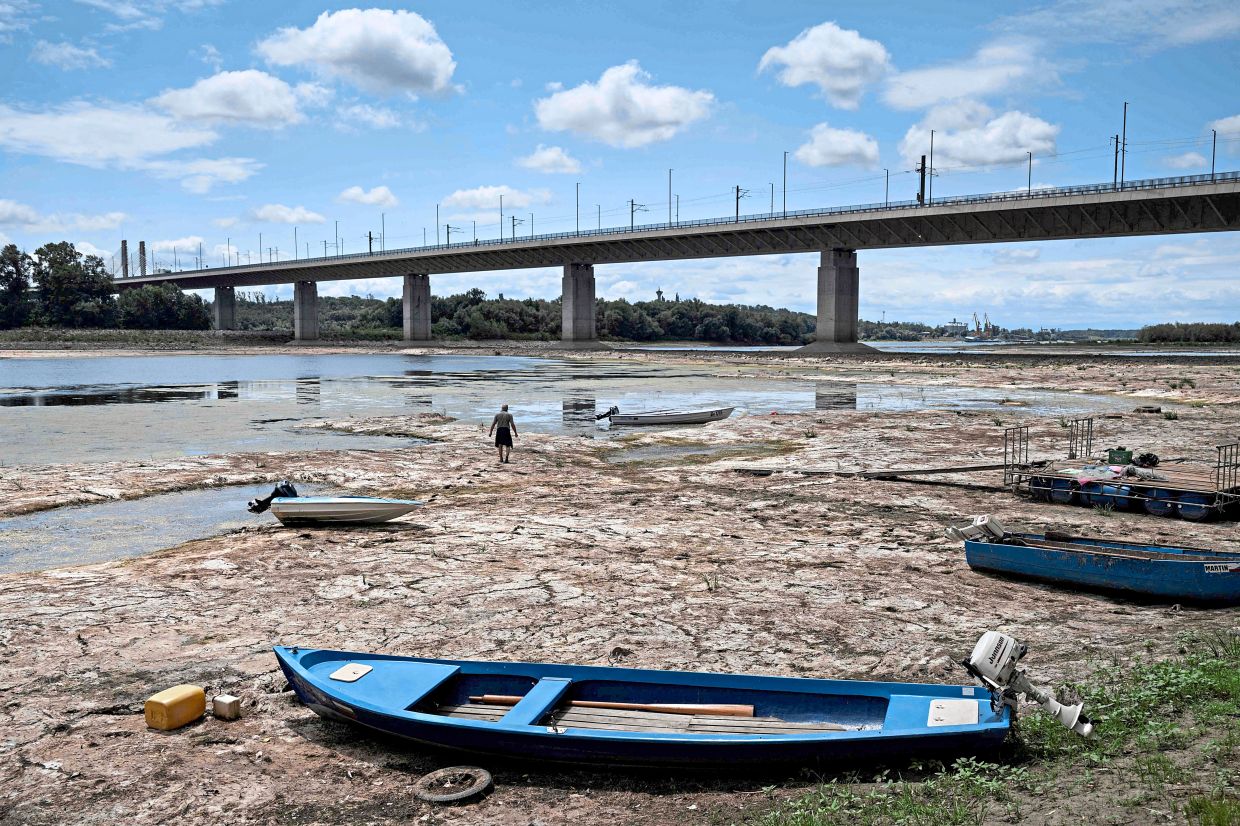
The Danube River, one of Europe's most vital waterways, has receded to historically unprecedented levels as a severe drought grips Central Europe, bringing cascading consequences for tourism, commerce, energy production, and daily life across the region. The crisis, driven by prolonged precipitation deficits and successive heat waves, underscores the mounting climate vulnerabilities facing the continent's critical infrastructure and economies.
Measurements recorded in Budapest on July 29 showed the river at just 23 centimetres, shattering the previous all-time low of 33 centimetres recorded in 2018. This dramatic decline has exposed geological features normally submerged for decades—ancient rocks, sandbars, and the corroded hulks of long-forgotten shipwrecks now visible along stretches of the riverbed. The water level is expected to drop further in coming weeks, with forecasts predicting no significant precipitation and temperatures exceeding 38 degrees Celsius across the region. For photographers like Gabor Kertesz, the transformation has been sobering, revealing the stark contrast between historical water patterns and present conditions whilst raising urgent questions about the trajectory of climate change impacts on Central European water systems.
The underlying cause is a prolonged drought affecting much of Central Europe throughout 2023. According to Hungary's Meteorological Service, 90-day precipitation totals across nearly the entire country have fallen 80 to 130 millimetres below long-term averages. Multiple successive heat waves have accelerated evaporation rates, further straining already depleted water reserves. This combination of reduced rainfall and elevated temperatures has created conditions unseen in living memory, triggering a cascade of economic and operational disruptions across multiple sectors dependent on the Danube's flow.
The shipping industry has been among the hardest hit. Cargo operations have largely ceased, whilst popular cruise lines serving the Budapest tourism market have been forced to reposition vessels far upstream to navigate shallow sections. The Ministry of Transport and Investment has confirmed that the operational constraints now facing both commercial and recreational river traffic represent an acute threat to one of Europe's most important transportation corridors. The economic implications extend beyond immediate shipping disruptions—the Danube supports a substantial tourism ecosystem, particularly in Hungary and Austria, where river cruises represent a significant component of summer visitor activity.
The human toll of these disruptions manifested dramatically on July 28 when Bulgarian police evacuated 186 tourists from the Viking Ullur cruise ship near Vidin after it became stranded on a shallow shoal. The vessel had been unable to reach port to take on supplies, leaving passengers without adequate food and water. The 52 crew members faced an extended confinement onboard pending resolution of the grounding, illustrating the safety hazards created by navigational challenges in exceptionally low-water conditions. In Serbia, the situation has been equally dire, with hundreds of small boats and dozens of cargo ships marooned along the riverbank near Novi Sad. One boat operator, Radovan Segrt, reported that the Danube had withdrawn 15 to 20 metres from its normal shoreline, effectively ending the summer season for river-based tourism and transport services.
Beyond tourism and shipping, the drought has triggered alarming constraints on nuclear energy production across multiple countries. Romania's Cernavoda power plant, which relies on Danube water for reactor cooling, was forced to shut down one reactor unit for safety reasons after water flows declined to approximately 1,630 cubic metres per second—roughly one-third of typical July averages. Additional reactor shutdowns were announced in the immediate term. Hungary's Paks nuclear station, which supplies nearly half the country's electricity generation, began powering down a reactor on July 29 due to insufficient cooling-water supplies. These reductions followed two successive power-output cuts on previous days, signalling the escalating operational stress on the facility. For Hungary and Romania, both heavily dependent on nuclear baseload capacity, the forced reductions represent a significant vulnerability in their energy security posture at a moment when regional electricity demand peaks during summer heat waves.
The receding waters have uncovered additional hazards with historical dimensions. Authorities in Budapest closed the Margaret Bridge after a World War II-era bomb was exposed by the dramatically lowered water levels, requiring emergency assessment and remediation protocols. Beyond official safety concerns, amateur treasure hunters have seized on the opportunity to explore the exposed riverbed. Zsolt Horvath, one such enthusiast, has been systematically removing metal objects using powerful magnets, recovering items ranging from wartime ammunition casings to mid-twentieth-century electronic equipment. Whilst Horvath acknowledges the scientific and historical value of such discoveries, he also recognises the darker reality: the extreme conditions enabling these archaeological finds represent an environmental crisis rather than an opportunity.
The Danube's crisis carries broader implications for Southeast Asia and the wider developing world, where climate vulnerabilities are substantially greater. The river system, spanning ten countries from southwestern Germany to the Black Sea, demonstrates how climate disruptions can rapidly propagate across international boundaries, affecting energy security, transport networks, tourism revenues, and food security simultaneously. For Malaysia and other Southeast Asian nations, the European experience serves as a cautionary model—the region's dependence on monsoon precipitation patterns and river systems for hydroelectric power, irrigation, and transport renders it similarly vulnerable to prolonged drought cycles intensified by warming temperatures. The cascading nature of the Danube crisis—from shipping disruptions triggering nuclear plant shutdowns to safety hazards emerging from environmental exposure—illustrates how interconnected modern infrastructure systems leave little room for climatic margin of error.
The situation remains fluid, with meteorological forecasts offering no relief in the foreseeable term. As temperatures continue rising and rainfall remains absent from the regional weather pattern, further deterioration appears inevitable. Policymakers across Central Europe are confronting uncomfortable truths about the adequacy of existing infrastructure, contingency planning, and climate adaptation strategies. The Danube's historic lows are not merely an inconvenience—they represent a tangible manifestation of climate change reshaping the operational realities of one of the world's most developed and resource-rich regions. The broader message is stark: even wealthy, technologically advanced societies with sophisticated infrastructure cannot remain insulated from climate impacts. For developing nations, the imperative to build climate resilience and diversify resource dependencies becomes increasingly urgent.

