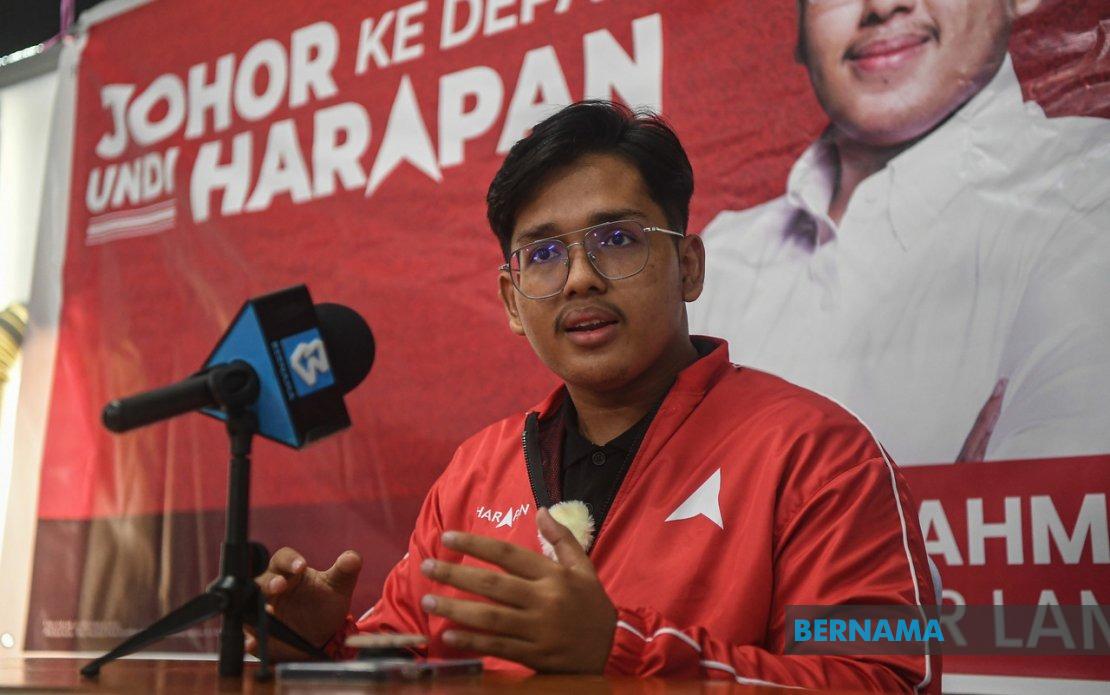
The Johor Lama state seat battle has taken on fresh momentum with Pakatan Harapan fielding Danish Hossman Abd Rahman, whose campaign centres on reversing patterns of rural decline through targeted investment and employment creation. At just 23 years old, Danish represents the youngest voice contesting in the 16th Johor state election, bringing a generational perspective to persistent challenges facing constituent communities beyond the state capital's sphere of influence.
Danish's platform, branded "Wajah Baharu, Johor Lama" (A New Face, Johor Lama), identifies a fundamental imbalance in development distribution across the state. While Johor Bahru, Tebrau and Kulai have enjoyed sustained infrastructure investment and economic activity, surrounding regions including Felda settlements have experienced stagnant opportunities, prompting younger residents to seek employment in metropolitan areas or across the Causeway in Singapore. This migration pattern reflects not merely individual economic choice but systemic underinvestment in peripheral constituencies that contain significant voter populations.
The candidate argues that bridging this gap requires decisive action on two fronts: securing high-impact private investment through improved state-federal coordination, and establishing supportive infrastructure that reduces the burden on ordinary residents. His emphasis on collaboration between Putrajaya and Kota Tinggi acknowledges the reality that state governments operate within federal economic frameworks and require aligned policy implementation to succeed.
A concrete proposal distinguishes Danish's campaign from typical electoral rhetoric. He has identified the absence of an Immigration Department branch office in Kota Tinggi as a tangible pain point affecting residents' daily interactions with government services. Currently, locals requiring passport applications or immigration documentation must travel substantial distances to Johor Bahru, Kulai or Mersing, consuming time and resources. Establishing a branch office would represent accessible governance, directly addressing administrative friction that particularly impacts elderly residents, rural workers and families managing multiple dependants.
This granular approach to governance reflects a pragmatic understanding of voter concerns. Beyond abstract promises of development, voters in rural constituencies often prioritise immediate quality-of-life improvements and reduced administrative friction. The immigration office proposal responds to this reality by identifying a specific service gap and offering a measurable solution that would benefit thousands without requiring massive capital investment.
Danish's campaign methodology combines traditional grassroots engagement with digital outreach, recognising that Johor Lama's 32,000 voters span age groups with varying media consumption patterns. Direct face-to-face interaction remains essential in rural constituencies where personal relationships and community standing influence voting behaviour, yet social media enables rapid message dissemination and provides mechanisms for voters to signal support and share campaign content within their networks. Early indicators suggest this mixed-media approach has generated positive traction among younger voters and digitally engaged constituents.
The three-cornered contest presents a competitive dynamic that may amplify focus on local development priorities. Incumbent Norlizah Noh representing Barisan Nasional and Aisah Esa from Perikatan Nasional bring established political records to the contest, while Danish's status as an insurgent candidate offers voters a choice premised on generational change and fresh perspectives rather than continuity with existing political machinery.
For Malaysian observers tracking rural development dynamics and youth migration patterns, the Johor Lama contest encapsulates broader questions about economic geography within the state. Malaysia's resources have historically concentrated in established urban nodes, while peripheral regions with significant agricultural populations and Felda communities have struggled to retain young talent. If implemented, Danish's proposed investment focus and administrative improvements could model approaches applicable across similar constituencies in Johor and neighbouring states experiencing comparable demographic and economic pressures.
The polling scheduled for July 11, with early voting on July 7, will test whether voters prioritise the incumbent record, the broader coalition affiliation represented by Perikatan Nasional, or Pakatan Harapan's development-focused campaign articulated through its youngest state election candidate. The result will indicate whether rural constituencies increasingly value specific delivery commitments and generational representation over traditional party loyalty, a pattern that could reshape electoral dynamics across Malaysian peninsular states facing similar development inequities.

